Responding to increasing frequencies of Coral Bleaching and loss-by Dr. Ranil Senanayake
The Threat to Corals
Source:Island
Coral reefs comprise some of the most biologically diverse and valuable ecosystems on the planet. Although reefs occupy only 0.2 percent of the ocean’s area worldwide, they are home to one-third of all sea life. and support more species per unit area than any other marine environment, including about 4,000 species of fish, 800 species of hard corals. It is estimated that there are 8 million (8,000,000) undiscovered plants and animals that may live in or near coral reefs. While the optimum temperature for coral growth is around 25 °C , although some species can survive temperatures up to 35 0 C. However once corals are established in a stable environment, a temperature increase of just one degree Celsius for only four weeks can trigger bleaching.
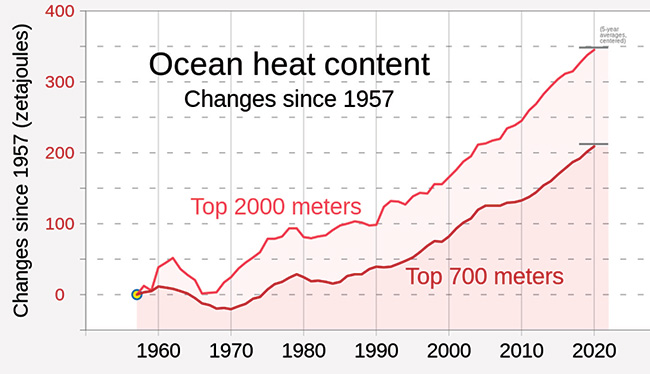
Global warming is considered to be the most severe threat to coral reefs globally. According to NASA Ninety percent of global warming is occurring in the ocean, causing the water’s internal heat to increase since modern recordkeeping began in 1955, They also suggest that the burning of fossil fuels has been the main driver of ocean warming since the 1970s. Based on NASA’s Estimating the Circulation and Climate of the Ocean (ECCO) project, the total heat stored by the oceans (ocean heat content) rose 187 zettajoules from 1992 through 2019. And most corals can’t take the heat, corals are fine-tuned to their environment. Thus, even small changes in temperature can stress a coral out. This can lead to coral bleaching, especially if the rise in temperature is a period of unusually high ocean temperatures and is defined by its duration and intensity.
Bleaching occurs when stressed corals expel their zooxanthellae, revealing their underlying white skeleton. Once a coral is bleached, it becomes more vulnerable to any additional stressors,like algal overgrowth, including those from diseases and storms. Historically, corals take about 20 years or so to recover between stressful events (marine heat waves or cold spells, disease, or storms). However, with climate change, the frequency of events like marine heat waves increase in frequency leaving corals with insufficient time to recover. (Figure 1)
To overcome this ongoing crisis, it has been suggested that cooling the coral environment with an artificial upwelling of cooler deep water to the surface layer might be a useful mitigation tool. In Bermuda a study that investigated the effect of simulated artificial upwelling using water from 50 meters deep at 240C and from 100 meters at 200C on its effect on the symbiont biology of three species of corals. It was clear that the lowering of temperature was effective in the reduction of heat stress, indicated by photosynthetic rate, chlorophyll- a concentration and zooxanthellae density. The reduction of heat stress responses indicates that artificial upwelling could be an effective strategy to mitigate coral bleaching during heat stress events.
Prior work on controlling the thermal regime by the thermal exchange of deep water from the bottom of the ocean with a floating pump device in the middle of the ocean was found to be successful in 2009. In 2011- 2012, the Univ. Hawaii, Hawaiian Institute of Marine Biology (HIMB), Climate Foundation explored how to cool off the reef on a bigger scale with solar arrays, a generator, a marine pump and a thermo-electric cooling system. They demonstrated the reality of using cold water to control the thermal regime effectively in mitigating and controlling coral bleaching. The major problem in all such ventures was the energy cost of operating pumps.
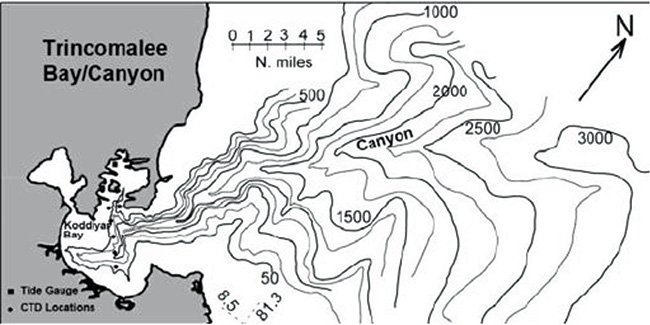
The bay of Trincomalee could provide the answer. The Canyon of Trincomalee makes this bay one of the deepest natural harbours, in the world. The bay, surrounded by the erosion remnants of an ancient rock formation, provides spectacular natural formations both above and under the water; the canyon, carved out by the drainage of the entirety of the upland watersheds, demonstrates the age of the landmass of the island. The landmass known to have been unflooded by marine events for over 20 million years, the canyon is an example of an ancient geological process.
The unique placement of the bay and the delta of the Mahaweli River, has generated a series of wetlands called villus that harbour a large population of elephants, the drainage and transition from fresh to salt is rapid due to the depth of the canyon. The nutrient load provides for the generation of a large volume of planktonic biomass, which in turn has established permanent populations of whales that exist in the area. This is probably the closest point the largest land mammal can get to the largest sea mammal. It possesses a huge representation of biodiversity, with over six distinct marine ecosystems and over three distinct terrestrial ecosystems. The close proximity of the canyon to the shore makes it possible to view and examine the phenomenon of diurnal migration of marine organisms in the most effective and sustainable way. (Figure 2)
The bay of Trincomalee was first identified as a potential site for OTEC power generation by Sir Arthur C Clarke. The Sri Lankan territorial waters average temperature of surface seawater is around 25 0 C. At a depth of around 1000 m, the temperature goes down to about 5 0 C. Therefore a temperature gradient of about 20 0 C is there to be exploited for an OTEC project. Ocean thermal energy conversion (OTEC) uses the difference between cooler deep and warmer shallow or surface ocean waters to run a heat engine and produce useful work, usually in the form of electricity. Sri Lanka is considering OTEC, or ocean thermal energy conversion, in the eastern deep-water harbour of Trincomalee as part of the country’s renewable energy drive. As the movement of cold water in the OTEC system will be done through pipes, controlled delivery of cold water will be a constant byproduct of sustainable energy production (Fig 3).
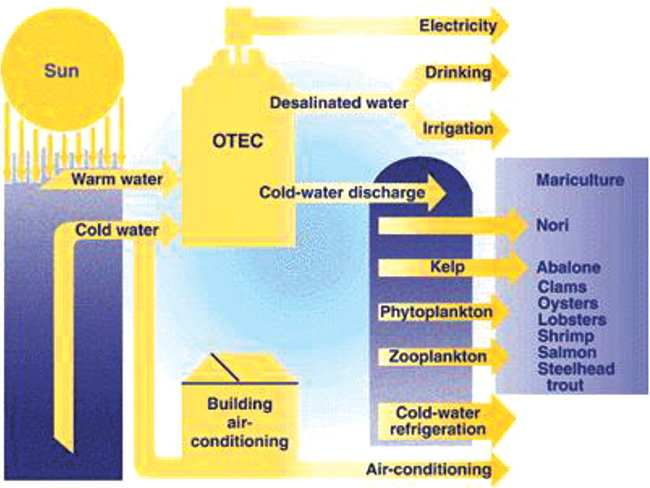
The most commonly used heat cycle for OTEC is the Organic Rankine cycle using a low-pressure turbine. This is a closed cycle operation. In simple terms it operates the same as an ordinary steam turbine found in a coal power plant. Yet as the temperature difference in which this plant operates is very low (around 20 0 C) steam cannot be used as the working fluid in the turbine. Therefore, an organic compound with a low boiling point is used as the working fluid. A basic closed-cycle OTEC plant is shown in the figure 3 (above). Warm seawater passes through an evaporator and vapourises the working fluid, an organic substance such as ammonia, propane, refrigerant gases, etc. This vapour which is at a higher temperature and pressure is fed into the turbine. The vapour expands as it passes through a turbine which turns a generator making electricity. The lower pressure vapor leaves the turbine and condenses in the condenser connected to a flow of cold seawater pumped from the deep ocean bed. The liquid ammonia leaves the condenser and is pumped to the evaporator to repeat the cycle. A political commitment to energy security should make OTEC commercialization economically attractive in tropical island communities such as ours where a high percentage of electricity production is oil based.
As Trincomalee is blessed with a huge array of bays and coves, different conditions for different groups of corals can be maintained by using the cold-water upwelling created by OTEC. The unique geographical conditions make Trincomalee the ideal site for establishing a Global Coral Bank for the Indo Pacific.