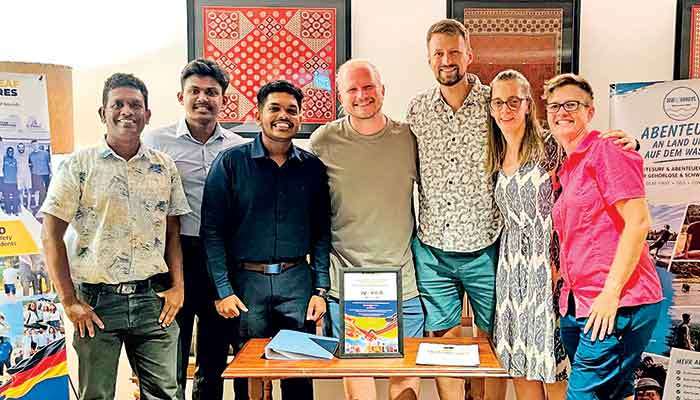
Source image: Daily FT. The individuals shown have not been identified in this article unless verified by the source.
Sri Lanka’s potential as an inclusive tourism destination has received international recognition through the work of Ceylon Deaf Adventures, a Negombo-based travel initiative developed around sign-language communication, Deaf leadership and more accessible hospitality.
The organisation, founded and led by Praveen Waas, has entered into a strategic partnership with Germany-based DeafVentures, creating a new platform for cooperation between Sri Lanka and Europe in the field of Deaf-led and accessible travel. The development was reported by Daily FT on 1 September 2026 and was also announced through the company’s public LinkedIn material.
The partnership represents an important step for Sri Lankan tourism entrepreneurship because it places accessibility, communication and lived experience at the centre of a business model, rather than treating them as supplementary considerations. It also demonstrates how a locally developed initiative can respond to a clear community need while contributing to Sri Lanka’s international profile in a constructive and socially conscious manner.
From a family homestay experience to a tourism initiative
Ceylon Deaf Adventures is understood to have emerged from a family homestay experience in Negombo, a coastal city situated north of Colombo and close to Bandaranaike International Airport. Negombo has long been associated with hospitality, fishing traditions and international visitors, making it a practical setting for an enterprise seeking to develop more welcoming forms of travel.
Within that family environment, the importance of communication and inclusion became increasingly evident. For Deaf travellers, the quality of a tourism experience can depend not only on accommodation or scenery, but also on whether information can be exchanged clearly, respectfully and independently.
Sign language can assist with that process, particularly when it is supported by an understanding of Deaf culture and by staff or hosts who appreciate the practical realities faced by Deaf visitors. Ceylon Deaf Adventures has therefore developed around a model in which accessibility is connected with leadership, trust and direct communication.
This approach is significant because it moves beyond a narrow interpretation of accessibility. A ramp, written notice or visual sign may be useful, but accessible hospitality also depends on the attitudes, skills and confidence of the people providing the service. Deaf-led tourism can help ensure that the experiences being offered are shaped by those who understand these requirements most closely.

An AI-generated illustrative image representing Deaf-led hospitality and sign-language communication; it does not depict the individuals in the Daily FT source image.
A partnership connecting Sri Lanka and Europe
The strategic partnership with DeafVentures in Germany is being presented as a new chapter for Deaf and accessible tourism. According to the Daily FT coverage and the organisations’ public announcements, the agreement establishes a framework for cooperation between Ceylon Deaf Adventures and DeafVentures, with the shared objective of promoting Deaf-friendly travel and accessible experiences between Sri Lanka and Europe.
The Memorandum of Understanding was signed by Praveen Waas on behalf of Ceylon Deaf Adventures and Patrick Bauer on behalf of DeafVentures. The agreement was formalised on 19 August 2026, with a DeafVentures delegation visiting Sri Lanka for the signing and related activities.
The partnership is valuable at several levels. It provides an opportunity for knowledge exchange, strengthens professional connections and gives accessible travel initiatives in Sri Lanka a pathway towards broader international cooperation. It may also help travellers identify services that have been designed with greater awareness of Deaf communication and participation.
No assumptions should be made about the exact tours, visitor numbers, destinations, financial arrangements or certifications associated with the partnership unless those details are formally confirmed by the organisations. The importance of the agreement, however, is already clear: an enterprise that developed from a local homestay experience is now being connected with an international partner whose work is focused on Deaf travel.
That progression illustrates the potential of carefully developed community enterprises. A small initiative can become internationally relevant when its purpose is clear, its leadership is authentic and its services respond to an underserved group.
Deaf leadership as a strength
Deaf leadership is central to the significance of Ceylon Deaf Adventures. Tourism businesses are often designed according to assumptions made by hearing people about what Deaf visitors may require. A Deaf-led model offers a different foundation, as decisions can be informed by personal experience, community knowledge and a practical understanding of communication barriers.
This does not mean that every Deaf traveller has identical preferences. Deaf communities are diverse, and accessibility can involve different languages, communication styles and individual requirements. A responsible tourism provider must therefore remain attentive, flexible and willing to communicate with travellers before and during their visit.
Ceylon Deaf Adventures’ model places that principle within an entrepreneurial framework. It presents inclusion not as an act of charity, but as a professional service standard and a potential area of innovation. When tourism businesses recognise that a significant number of travellers value clear visual communication, respectful service and accessible information, they can develop more effective and sustainable visitor experiences.
The approach also has wider implications for employment and representation. Deaf people are frequently described in relation to the barriers they face, yet Deaf-led enterprises highlight capability, leadership and commercial judgement. They show that accessibility can be advanced by people who are not merely receiving services, but creating organisations, forming partnerships and shaping the future of an industry.

An AI-generated illustrative image symbolising international cooperation in accessible travel; it does not reproduce the source photograph or depict named individuals.
Inclusive hospitality and the wider tourism sector
Sri Lanka’s tourism industry has considerable scope to build stronger accessibility practices across accommodation, transport, attractions, guiding and visitor information. The country’s cultural diversity, coastal settings and varied landscapes provide a strong foundation, but the quality of a destination is also measured by the extent to which different travellers can participate with dignity and confidence.
For Deaf visitors, useful improvements may include advance information in accessible formats, visual explanations, staff awareness, reliable sign-language support where available and clear procedures for emergencies or changes to an itinerary. These measures require planning, training and consistency, rather than isolated gestures.
Ceylon Deaf Adventures offers a practical example of how such thinking can be incorporated into an enterprise from its earliest stage. Its work suggests that the most effective inclusive tourism models may be those developed in close connection with the communities they serve.
The benefits can extend beyond Deaf travellers. Clear visual communication, well-organised information and considerate hospitality can assist older visitors, families, international guests who do not speak the local language and travellers who prefer information to be presented in more than one form.
In this respect, accessible tourism is not a specialised concern separated from mainstream hospitality. It is part of a broader effort to make travel more usable, respectful and welcoming for all.
Sharing Sri Lankan expertise internationally
The partnership with DeafVentures gives Ceylon Deaf Adventures an opportunity to share Sri Lankan experience in an international setting while learning from European practice. Such cooperation can be particularly valuable when it is based on mutual respect rather than a one-way transfer of ideas.
Sri Lanka is often recognised internationally for its natural beauty, cultural heritage and hospitality. The work of Ceylon Deaf Adventures adds another dimension to that reputation: the country can also contribute knowledge and leadership in accessible, community-focused tourism.
The initiative’s progress will be watched with interest by Sri Lankan entrepreneurs, accommodation providers and community organisations seeking to develop socially responsible businesses. It may encourage further investment in accessible communication and create a stronger understanding that inclusion and commercial quality can support one another.
For the global Sri Lankan community, the story is also a reminder that innovation does not always begin in a large corporate office or a major urban development. It can emerge from a family setting, respond to a real human need and grow through determination, collaboration and well-directed enterprise.

An AI-generated illustrative image representing an accessible Sri Lankan visitor environment; it is not a photograph of a specific Ceylon Deaf Adventures location.
A promising new chapter
Ceylon Deaf Adventures’ partnership with DeafVentures marks a promising development in Sri Lanka’s inclusive tourism story. Led by Praveen Waas and grounded in Deaf-friendly communication, the organisation has demonstrated how lived experience can become the foundation for a purposeful tourism enterprise.
The international agreement does not merely connect two organisations. It creates the possibility of shared learning, stronger visibility for Deaf-led travel and more meaningful participation for Deaf visitors travelling between Sri Lanka and Europe.
As the partnership develops, its greatest contribution may be the example it provides: hospitality is strengthened when access is planned from the outset, when leadership reflects the communities being served and when entrepreneurship is directed towards both professional excellence and social inclusion.
Sri Lanka’s tourism future has room for many forms of innovation. Ceylon Deaf Adventures shows that one of the most valuable may be a model in which communication is opened, leadership is shared and every traveller is treated as a full participant in the journey.
Public references:
Ceylon Deaf Adventures: “A New Chapter for Deaf Tourism”
Praveen Waas on LinkedIn
This article was written based on the source https://www.ft.lk/it-telecom-tech/A-Negombo-homestay-s-sign-language-tourism-model-goes-international/50-796642, kindly email us at info@eLanka.com.au if any information needs to be corrected.
(adsbygoogle = window.adsbygoogle || []).push({});
At eLanka, we respect the rights of creators. If we have used an image you own and you’d like it removed, please email us at info@elanka.com.au and we’ll handle it promptly.