Colombo Port under threat with proposed Galathea Bay Transshipment Port-By Arundathie Abeysinghe

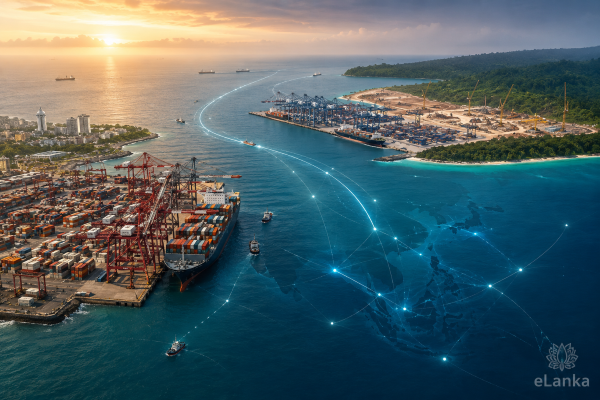
Scholars are of the view that Colombo Port is under threat due to India’s proposed Galathea Bay International Container Transshipment Port on Great Nicobar Island, one of the most strategically significant maritime infrastructure projects emerging in the Indian Ocean. With almost, Sri Lanka’s record-breaking port performance, there is a strategic vulnerability as 45% of Colombo’s transshipment trade is linked to Indian cargo and 50% of Colombo’s transshipment business is linked to India. As India is constructing an alternative transshipment gateway, it is a great disadvantage to Colombo.
In 2025, Colombo Port handled a record 8.29 million Twenty-Foot Equivalent Units (TEUs), its highest-ever annual throughput. Almost 81% of that volume was transshipment which confirms Colombo Port’s position as one of the Indian Ocean’s key container hubs.
Location of Galathea Bay is especially significant as it is situated on Great Nicobar Island, close to the major East–West international shipping route and strategically situated towards the. Malacca Strait, a crucial 900-kilometer (560-mile) shipping lane serving as the major sea route linking the Indian Ocean and the Pacific Ocean.
The 5.2 billion project is advancing through its pre-construction and Public-Private Partnership (PPP) implementation stages and is expected to groundbreaking shortly. The first phase of the project is envisaged at approximately 4 million TEUs, ultimately expanding towards 16 million TEUs.
According to maritime scholars “Colombo’s success in transshipment trade is linked to India’s enormous cargo base being connected to global shipping networks through Colombo. India is currently planning to change that equation. For decades, India has relied heavily on foreign ports to transship cargo, especially, Colombo and Singapore as it lacked a comparable deep-water transshipment facility in a strategically advantageous location. Currently, New Delhi wants to change that. Why should Indian cargo leave India to generate jobs, revenue and maritime business in other countries? Hence, India wants to capture more of that value domestically. Galathea Bay is one of the mechanisms through which it intends to do so.”
“Colombo’s success has been built on its strategic location, deep-water terminals, efficient connectivity and established relationships with global shipping lines, although, majority of the cargo passing through Colombo does not belong to Sri Lanka. Although, Sri Lanka controls the port, it does not control the cargo as cargo owners, shipping lines and logistics companies ultimately decide where the container moves as shipping networks can change.”
Senior academics are of the view that “although, Galathea may not take millions of containers away within a few days, the real possibility is the gradual restructuring of shipping networks. If carriers begin routing more Indian cargo through an Indian transshipment hub, they will develop new feeder networks, sailing schedules, including logistics relationships as well as commercial arrangements around that hub. When those networks become established, reversing the shift becomes significantly more difficult. The danger is therefore not that Colombo suddenly loses its business, instead, Colombo will gradually lose its strategic centrality.’
“Sri Lanka requires a serious, measurable as well as a nationally coordinated Colombo Maritime Competitiveness Strategy 2035, which is not another policy document nor a committee, instead, a measurable 2035 competitiveness strategy targeting faster vessel turnaround, stronger transshipment volumes, competitive pricing, higher container productivity, digital operations and resilient feeder connectivity. It is also necessary to modernize and expand shipping-line services, bunkering, repairs, logistics and maritime technology, while attracting regional logistics investment and securing long-term carrier commitments. With transshipment representing approximately four-fifths of Colombo’s total container throughput, the Indian connection is not a marginal part of the port’s business, instead, it is one of the foundations of Colombo’s position as a regional hub.”