Understanding Hindu Funerals: Traditions, Rituals & the Final Journey – By Vin Govindan | Moksha Funerals – Specialist Hindu Funeral Director
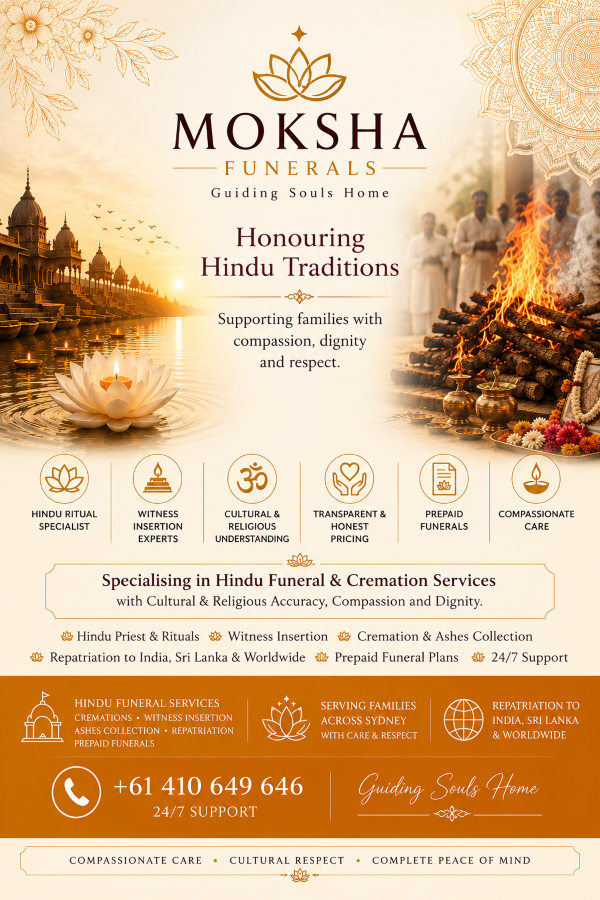
For Hindu families, a funeral is much more than a final goodbye. It is a deeply spiritual occasion, guided by traditions that have been observed for generations and centred on one fundamental belief: while the physical body is temporary, the soul is eternal.
Known as the Atman, the soul is believed to continue beyond physical death, progressing through the cycle of birth, death and rebirth known as Samsara. The ultimate spiritual goal is Moksha — liberation from this cycle. These beliefs influence many of the rituals performed before, during and after a Hindu funeral. (Moksha Funerals)
Antim Sanskar – The Final Rites
The Hindu funeral rites are commonly known as Antim Sanskar, meaning the “final rites” or final sacrament.
Although customs differ between families, regions and Hindu communities, a funeral may include sacred mantras and prayers, floral offerings, circumambulation of the deceased and rituals performed by close family members under the guidance of a Hindu priest. (Moksha Funerals)
Traditionally, the eldest son has played an important role in performing certain final rites. Today, however, traditions are evolving, and daughters and other family members may also take significant roles depending on the wishes and beliefs of the family.
Why Is Cremation Important?
Cremation has profound significance within Hindu tradition. It represents the release of the physical body and its return to the natural elements, while supporting the soul’s onward spiritual journey.
For this reason, Hindu funerals are traditionally conducted relatively quickly following death. In Sydney, families often seek to hold the funeral within 24–48 hours, although timing depends on the necessary documentation, preparation of the deceased, priest and family availability, and crematorium bookings. (Moksha Funerals)
Another particularly meaningful ritual for many Hindu families is witness insertion, where close family members are permitted to witness the coffin entering the cremator. For some families, this represents the true final farewell and an important completion of the cremation rituals. (Moksha Funerals)
The Journey Continues After the Funeral
The funeral itself is not necessarily the end of the rituals.
Following cremation, families collect the ashes and may perform Asthi Visarjan — the ceremonial immersion of the ashes in water. Some families perform this locally, while others return the ashes to India or another spiritually significant location.
Memorial prayers, family gatherings and further religious ceremonies may also take place in the days following death, with practices varying considerably between different Hindu traditions and communities. (Moksha Funerals)
Honouring Tradition in Australia
One of the challenges Hindu families can face in Australia is bringing centuries-old religious traditions together with Australian funeral, legal and crematorium requirements.
This is why cultural understanding is so important when arranging a Hindu funeral. It is not simply a matter of organising a coffin, chapel and cremation. Families may need assistance coordinating a Hindu priest, puja items, cultural dressing of their loved one, religious rituals, witness insertion, cremation, ashes collection and, in some cases, repatriation.
Every Hindu family is different, and traditions can vary according to region, language, community and family practice. A meaningful Hindu funeral therefore begins by listening to the family rather than assuming that every Hindu funeral should be the same. (Moksha Funerals)
Ultimately, these rituals serve a beautiful purpose: to honour the life that has been lived, fulfil the family’s final duties and help guide the soul on its onward journey.
Vin Govindan is the Founder and Funeral Director of Moksha Funerals, specialising in Hindu funeral and cremation services across Sydney.
Moksha Funerals — Guiding Souls Home
24/7 Assistance: 0410 649 646
At eLanka, we respect the rights of creators. If we have used an image you own and you’d like it removed, please email us at info@elanka.com.au and we’ll handle it promptly.
Thanks.
eLanka teamnbsp;