The Story of Lovina Alphonso — A Dalit Heroine of her Time

Sourse:medium
This account is translated from the research and writings of N.Sarawanan, A Sri Lankan Tamil Dalit activist and author of the piece. You can read his original piece here in Namathu Malayagam. This contribution to Dalit History Month would not be possible without his work and his generosity. Translation from Tamil for this piece was done by Saivi, a Tamil Dalit writer, economist and mother. This piece was edited by Maari Z.Maitreyi.
Today in Dalit History, we look at how a Dalit woman, Lovina, negotiated with colonialisms in Sri Lanka and ultimately instituted benefits to her community.
The “Rodi” caste people are the most oppressed in the Sinhala community. Historically, this community was involved in folk religion, magic, mantras, and ritualised caste begging. Rodis were treated as untouchables and violently discriminated.
Rodiya men and women were denied permission to wear any upper-body covering. It was also forbidden for them to cover themselves below the knee. In one era, both men and women were only allowed to cover their genital area and nothing else. Even if they felt ill or cold and clothed themselves to feel warm, and an “upper” caste person caught them in the act, they would have to say, “Please forgive me, Lord, I was feeling too cold!” It was up to the “upper” caste person, then, to decide whether to allow the act of covering or not.
You can find many texts that use derogatory language to describe Rodiyas. In Sinhala, Dalit people are called “Sandalas” in various texts. In the book “The Taprobanian” (1886) by Hugh Nevill, the author calls the area where Rodipeople lived as “the Sandalas ghetto” John Doyle, another colonizer, in the19th century, describes Rodi people as living in a Rodi ghetto where they didn’t have a right to own or build independent homes. According to Doyle, they had to live in makeshift shacks and were not allowed to have windows or doors to their homes. They were not allowed to travel into the main villages or freely interact with people who were not Rodiya.
This was Lovina’s community, and this was her background.
Lovina’s story is known to us because it’s told through the narrative of one Sir Thomas Maitland, a 47-year-old English Governor. When he was posted to Sri Lanka in 1806, he was put up in a typical colonial bungalow. To make him feel “welcome”, occasionally, mestizo dancers come to the mansion. Among them was 16-year-old Lovina Alphonso. Lovina and many other Rodiyas in that area were of mixed heritage often part Portuguese, the previous colonisers of that region.
It’s said that this 47-year-old English colonial felt immediately and deeply “in love” with 16-year-old Lovina. He proposed a relationship to her and Lovina “accepted”. Quickly, he changed Lovina’s name to Lavinia, because he “preferred” that version.
News of this Governor’s love with an untouchable girl quickly spread among the British colonial elite and the message reached as far as King George’s ears. The result was that King George sent him a very stern message that threatened consequences should their relationship continue.
Maitland told Lovina not to come to visit him until he would say it was ok to do so. In the meantime, Maitland began the construction of an underground tunnel that went straight from the bungalow to a well, situated right inside of Lovina’s home in the ghetto.
Within six months, the tunnel was completed and Lovina and Maitland began meeting through this secret passageway. Lovina was taught special calls and sounds to make sure that it was only them using the tunnel, and no one else.
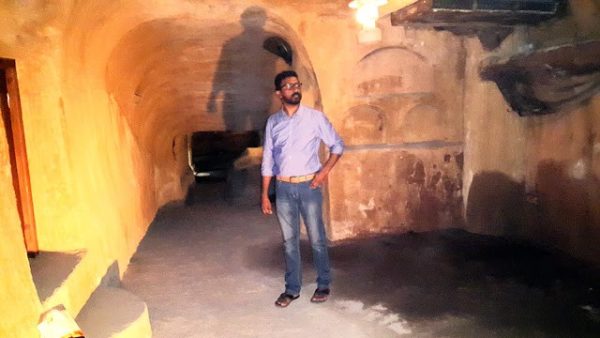
Photo Credit: Author N. Sarawanan visited the tunnel, Namathu Malayagam
However, core to this story, are Lovina’s demands. While she had to be with Maitland, young Lovina made very specific asks. She asked that Maitland oversee several changes to the social conditions her people were living in. She pointed out that things like not being able to cover themselves or not being able to have windows and doors in their homes were deep injustices and absolutely no way to treat human beings. She urged Maitland to use his humanity and his power as the ruler in that area to end these oppressions.
Moved by her thoughts and words, Maitland ordered the immediate freedom of the people from the Rodiya ghetto. He granted written rights for them to cover themselves as they pleased and to build proper homes with windows and doors.
However, in 1811, an urgent letter came to Maitland from King George ordering the immediate removal of Thomas Maitland from the post of Governor. He was given just two weeks to leave Sri Lanka. The British Empire could not stand the thought of a white British man having an illicit relationship with — not just a “native” — but the lowest of the low natives at that. It’is thought that several secret tip-offs came from the bungalow and around town and that those were the reasons for the action against Maitland.
He promised Lovina he would return to her and appeared to have left in deep distress. He is also known to have said — “I do not know whether the next Governor will use this palace as his official residence. But before I leave, I suggest this house be named “Mount Lavinia”. I hope my desire can be fulfilled.”
After this point in time, there are no more references and there is no way for us to know what happened to Lovina.
During the second world war, the bungalow served as a military hospital. Today, “Mount Lavinia” has been converted into an upscale hotel. The tunnel that was closed off after Maitland left is now a tourist attraction in the city of Galkissa.

Photo Credit : N. Sarawanan, Namathu Malayagam
Where the Rodi ghetto one was, there is now a Galkissa Buddhist Girls’ School, and it is not clear how, why or where that community of Rodiyas went.
Many people do not think highly of Lovina. She is judged by various patriarchal yardsticks and has never been known as anything other than a white coloniser’s illegitimate lover. There are works in Sinhala — movies and novels — based on her life but written as cheap erotic fiction.
Despite all this — what is most important to note is that a very young girl, who came from a very oppressed community, managed to negotiate a serious change of conditions for her community.
Considering her young age and the deep power-imbalances between them, we will never know whether Lovina grew into a consentful relationship with Maitland. However, what we do know, is that she could have asked for many things — material, wealth or power — but what she asked for was for her people to be able to cover themselves, for them to have homes they could actually live in and, most of all, for their right to basic human dignity.
In this respect — Lovina was a Dalit heroine of extraordinary courage and integrity. And deserves to be memorialised and remembered as such.
N.Sarawanan, the author of this piece recently released a book about Dalits in Sri Lanka. You can get in touch with them here: nsarawanan@gmail.com