Women in Power-by By Kusum Wijetilleke
Source:Island
The Revolutionary Lives and Careers of Siva, Doreen, Vivi and Sirima
(kusumw@gmail.com) & Rienzie Wijetilleke (rienzietwij@gmail.com)
Women in Sri Lanka make up 52% of the population and 56% of registered voters, but a mere 5% of legislators. The Sri Lankan female voter, whilst having significant strength in numbers, has been unable to translate said the bers should make women’s issues front and centre for politicking but the reality is quite the opposite. The tax rate on sanitary napkin imports was just over 100% in 2018, until a reduction to 52%. There was controversy over the recent halving of maternity leave from 84 days to 42 days for trainee development officers in the public sector. Throughout the country we find reports of domestic abuse being ignored by authorities, of street harassment with the countrywide tradition of ‘cat-calling’ being “accepted” as part of a culture. Our politics indicate a level of flippancy with regards to women’s issues in general, with the Ministry of Women’s Affairs no longer worthy of a place in the Cabinet.
There were eight women elected to parliament at the 2020 General Elections, out of a total of 75 female candidates from the major political parties, making them a distinct minority in Sri Lanka’s 225-seat chamber. Around the world and in Sri Lanka, the debate around female representation in politics has been raging in social sciences for some time, with a variety of explanations proposed. Most pertinent might be the principle of “you cannot be what you cannot see”, asserted by Feminist Author Marie C. Wilson, President of the Ms Foundation for Women, established by Gloria Steinem. Ms Steinem remarked, “We’ll never solve the feminization of power until we solve the masculinity of wealth”. This is especially true for women that long to enter the very expensive business of politics. Another given and accepted reason is that the conservative and traditional family arrangements restrict most women’s career choices.
In Sri Lanka, the argument from traditional family restrictions on career choices certainly rings true, but with a few very notable and accomplished exceptions. In her most famous work; ‘Feminism and Nationalism in the Third World’ (1986), Sri Lanka’s definitive feminist academic and activist Kumari Jayawardena stated the importance of a political account on women’s struggles in the East as necessary for the women of these countries who may be “unaware of the role in liberation struggles of their ancestors and great-grandmothers”. She further discusses the limitations of women achieving liberation through education and entering the workforce, proposing that true liberation is only achieved through political as well as social and economic equality.
A cursory glance at Sri Lanka’s early history as a nation State shows that women did indeed hold some very important keys to power. These women were, as you might expect, from the upper classes and many with substantial financial clout and some did also have the full support of their families in political endeavours while others succeeded in spite of familial and cultural restrictions.
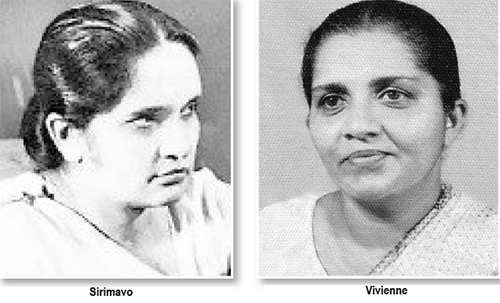
When Sri Lankans envision women in politics, we invariably fall back on the two most recent matriarchs, both from the same aristocratic family. ‘Sirima’ and ‘CBK’ certainly blazed their own trails in the world of politics. Whereas their political dynasty seems to have ended with CBK’s final term, the mixed fortunes of ‘Mrs. B’ and the times during which she ‘ruled’ are nonetheless fascinating. To begin with, Ms. Sirimavo Bandaranaike becoming the world’s first female Prime Minister may no longer be appreciated in the way that it should. When she was elected in 1960, six years ahead of Indira Gandhi, the London Evening News stated “… there will be need for a new word. Presumably, we shall have to call her a states-woman… This is the suffragette’s dream come true.”
If you define democracy as a system where all citizens of the state have an equally weighted right to vote, then Sri Lanka is the oldest democracy in Asia. Class, sex and ethnicity were all used to restrict the vote throughout history. Until 1918 in the UK, only property owning men over the age of 21 were allowed the vote. The 1965 Civil Rights act definitively lifted restrictions on Black Americans voting in many Southern States. Indigenous peoples in Canada achieved the right to vote in 1960 and those in Australia had to wait until 1967. Japanese women achieved suffrage in 1947 and Pakistani women in 1956. Yet Sri Lanka achieved universal suffrage in 1931 which is quite significant considering India only achieved the same parity in 1950. Thus the introduction of Universal Suffrage was by no means a simple evolution.
Sri Lankans will recall “Sirima” and her time in power with a shrug of dissatisfactio n given the failures of her socialist economic policies. Following her husband’s assassination and her elevation as the leader of the SLFP and its candidate for PM, she would often cry during campaign speeches, which earned her a nick name; ‘the weeping widow’. Members of Parliament would speak disparagingly of her efforts to govern with references to the “kitchen cabinet”. Yet due to her strong intellectual and ideological positions, she eventually earned a sort of begrudging respect from the many men in that kitchen cabinet. Her time in power was characterized by food shortages, bread lines and rationing, but Ms. Bandaranaike is also remembered for her ruthless dismantling of the JVP insurrection in the early 70s, leading to a remark by a prominent politician that she was “the only man in her cabinet”.
The 1962 coup d’état attempted by high ranking military and police leaders is less recalled and worth revisiting. The aborted plan to detain Ms. Bandaranaike and her senior officials at the Army Headquarters was the result of a power struggle many decades in the making. Sri Lanka’s pre-independence elites were highly westernized, even Anglophilic, right wing and Christian and many had close ties to the UNP. The sudden and dramatic power shift post-independence, led to a political establishment that was staunchly Sinhala-Buddhist, left wing and ‘rural’, that is to say; non-westernized. Sri Lankans today are acutely aware of past ethnic divisions, but may not fully appreciate the class and religious divisions that were dominant during the colonial era.
The inevitable shift and consequent fissure, betrayed the nation’s ethno-religious divisions. The main protagonists of the attempted coup were all from the upper classes; property owning, well-educated and with right-wing ideologies. The coup was aborted at the last minute after an informant revealed the plans to the PM. All 24 individuals charged with the conspiracy were Christian: 12 Sinhalese, six Tamils and six Burghers. The coup was also an attempt to arrest the country’s economic decline that began with Ms. Bandaranaike’s nationalization of key industries including banking, foreign trade, insurance, transport and petroleum. Her policies further exacerbated the import-export imbalance and the country was $2 billion in debt, but the mantra she repeated defiantly through-out was “produce or perish”.
Whilst the faults of “Sirima” are widely accepted, her foreign policy and internationalism, which in many ways saved the Sri Lankan project, deserves more attention. With only two weeks’ worth of rice in stock, she negotiated an emergency shipment of 40,000 tons from China. These being the beginnings of the cold war, international diplomacy was fraught and required careful navigation, especially for a Socialist Republic having just achieved independence. Sri Lanka grew in stature internationally as a founder nation of the Non-Aligned Movement under the guidance of Ms. Bandaranaike and she made countless overtures for peace between the major Western Powers and the Soviet Union. In 1963, following several state visits to “western” nations, understanding the need to balance both sides, she became the first Sri Lankan Prime Minister to visit the Soviet Union and returned with an agreement for large quantities of discounted petroleum from the Soviets. The nationalization of the oil industry and the resulting distress to British and American corporate interests led to the US cutting aid to Sri Lanka. Egyptian President Abdel Nasser sent oil tankers to Sri Lanka and in 1975 Ms. Bandaranaike negotiated a supply arrangement for 250,000 tons of oil on a deferred payment scheme after direct negotiations with the then Vice President of Iraq, Saddam Hussein.