


Views: 51
The British planted the Seeds of Lanka’s Bankruptcy in 1942-by Michael Roberts
Source:Thuppahis
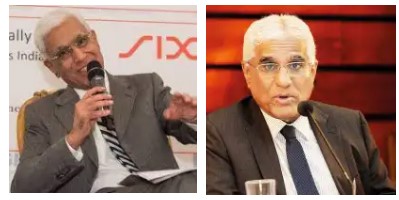
I keep watching Karan Thapar’s interview with Dr. Indrajit Coomaraswamy: viz. https://www.youtube.com/watch?v=hLLMdx74-aw. It’s fascinating. Karan Thapar is a skilled, hard-nosed interviewer and Indrajit Coomaraswamy is a knowledgeable and articulate interviewee. So what you get is two clear thinkers who cut to the nub of the issue. It’s a trenchant analysis of how Sri Lanka got into this hole and how it can get out of it.
That said, I have a quibble with something Dr. Coomaraswamy asserted about Sri Lanka’s budget-busting culture of unaffordable entitlements. He believes that Sri Lankans got habituated to receiving government handouts from the time of Independence in 1948.
He’s wrong about that. The something-for-nothing culture started six years earlier, during the Second World War when the Ceylonese were conditioned to expect entitlements. When I was growing up in the 1950s, I’d hear adults speak fondly of how good their lives had been in Ceylon under British rule during World War II. And the Ceylonese did have it good.
There was a reason for that. It was called the Cocos Island Mutiny. Members of the Ceylon Garrison Artillery (CGA) mutinied against their British officers, with the stated intention of seizing the garrison and surrendering it to the Japanese. I can’t locate my copy of Noel Crusz’s The Cocos Island Mutiny (it’s probably with the rest of my books in a Kern County storage locker that’s costing me two hundred buckaroos a month). So I’ll have to rely on the not-always-reliable Wikipedia for details.
The Cocos (Keeling) Islands are two atolls made up of 27 coral islands in the middle of the Indian Ocean, 1700 miles northwest of Perth, Australia. In 1857 the British annexed the islands and administered them from Ceylon. Fast forward to the night of Friday, May 8, 1942. Thirty out of the 56 members of the CGA stationed on Horsburgh Island turned their guns on their officers and on men of the Ceylon Light Infantry (CLI) stationed nearby. They killed one infantryman, but the CLI fought back and overpowered the mutineers.
The question is, why did this mutiny happen in the first place? The following paragraph is a straight lift from Wikipedia:
The question is, why did this mutiny happen in the first place? The following paragraph is a straight lift from Wikipedia:
“With the Japanese successes, public sentiment on Ceylon increased in favor of the Japanese; encouraged by successful Japanese-trained and -directed rebellions in Indonesia and support for Japanese forces in Thailand, Sinkiang and the Philippines, many Ceylonese hoped that the Japanese would help them gain independence. At this time a young JR Jayawardene, later to be President of Sri Lanka, held discussions with the Japanese with this aim in mind. However, this was immediately stopped by DS Senanayake who collaborated with the Colonial Government, being rewarded with the Premiership, being hand-picked to lead the post-colonial government after 1948.”
The mutineers were shipped back to Colombo and court-martialed, and three of them were hanged at Welikada Prison. The incident sent shockwaves through the British military establishment. The Japanese had captured Singapore, and if the Ceylonese revolted the ass would fall out of the British war effort in Southeast Asia.
One can’t overemphasize Ceylon’s geostrategic importance to the allied war effort: Supreme Allied Commander of SEAC Admiral Louis Mountbatten had his headquarters in Kandy, once the hill capital of Ceylon. (Mountbatten’s irascible deputy, Vinegar Joe Stilwell, detested him. Stilwell’s wartime diary has an entry reading, “Meeting with Mountbatten. Went to the zoo and looked at the monkeys to get in the mood.”)
Also, once Malaya and other rubber-producing countries fell into Japanese hands, Ceylon became the British Empire’s single largest remaining source of natural rubber–a raw material vital to the war effort. The Allies couldn’t risk losing it.
Anyway, in the immediate aftermath of the mutiny, the British decided that they couldn’t trust the Ceylonese to have their backs. The natives were restless, they realized. So they began a pacification program to coddle them. What happened next is summed up in the following understatement (again lifted from Wikipedia):
“Rationing was instituted so that the Ceylonese were comparatively better fed than their Indian neighbors, in order to prevent disaffection among the natives.”
So that’s when it began–all the way back in 1942. And by the war’s end, it was too late to put the toothpaste back in the tube. Successive governments have outdone each other–bankrupting the country in the process–by recklessly adding layer upon layer of subsidies as vote-getting ploys.
It’s the story of how and why Sri Lankans have been on an unsustainable path of artificially low prices for everything from basic food items to electricity, cooking gas and gasoline for the past 80 years. And now, as both Dr. Coomaraswamy and Karan Thapar intimate in this wonderful interview, the jig is up.

Captain John Howard Cassady, USN, greets Admiral Louis Mountbatten, Supreme Allied Commander of the Southeast Asia Command (SEAC), aboard the USS Saratoga, Colombo Harbor, April 30, 1944 (credit: National Naval Aviation Museum). Cassady would go on to command the United States Sixth Fleet.

Captain Michael Maynard Denny, RN, welcomes Louis Mountbatten aboard the aircraft carrier HMS Victorious, Trincomalee Harbor, Ceylon, 1943 (credit: Imperial War Museum). Denny joined the Royal Navy in 1909, aged thirteen. He attended the Royal Naval College, Osborne and the Royal Naval College, Dartmouth, and served in the First World War. Before this meeting with Mountbatten, he’d been chief staff officer for the evacuation of Dunkirk.

Mountbatten’s insubordinate subordinate, General Joseph Warren (Vinegar Joe) Stilwell, at his desk in Kandy, Ceylon, August 1944 (credit: United States Army).
Disclosure: I confess I’m biased in favor of Stilwell. He was a scholarly soldier who learned several languages and whose ideas were often misunderstood. But army chief of staff George Catlett Marshall had faith in Stilwell’s unconventional approach to jungle warfare in the China-Burma-India theatre. Stilwell helped form the deep penetration unit that gained wartime fame as Merrill’s Marauders. Modeled on Orde Wingate’s Chindits, it was the forerunner of the long-range reconnaissance patrols (LRRPs aka lurps) in the Vietnam War.
If you’ve seen the 1979 Steven Spielberg movie 1941, you might recall the scene where Robert Stack (playing Stilwell) sings along as he watches Disney’s animated classic Dumbo. That was based on real events: Stilwell was in Los Angeles in the immediate aftermath of Pearl Harbor, and it’s a matter of record that he watched Dumbo twice in the chaotic month of December 1941.
By the way, quite a few people who were stationed in Ceylon during the Second World War would later become celebrities in their own right. Among them were Lt. Col. John D. MacDonald, who’d go on to become a best-selling novelist (and who has never gotten his due as the man who made Sri Lanka famous as a surfing destination), and Julia Carolyn McWilliams Child, a gawky six-foot-two-inch girl from Pasadena. She was attached to the Office of Strategic Services (OSS), forerunner of the CIA. Julia Child inspired a generation of chefs after bringing French cuisine to the American public with her book, Mastering the Art of French Cooking.