



Anuradhapura Sacred City: Development Must Honour Heritage and Trust-by Harold Gunatillake

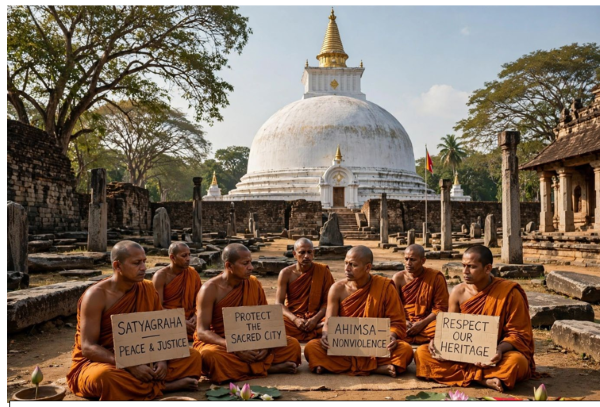
Buddhist monks and laypeople continue a sit-in (Satyagraha) near Ruwanweli Maha Seya in Anuradhapura.
- Leader: Venerable Balangoda Kassapa Thero
- Began: November 7, 2026
- Main demand: Withdraw the gazette notification concerning the proposed
Anuradhapura Sacred City Development Plan.
- Location: The dansal grounds and nearby areas around Ruwanweli Maha Seya and Jaya Sri Maha Bodhi.
- Current status: Protesters are defying an Anuradhapura Magistrate’s Court order to leave the sacred area and remove temporary structures. The Anuradhapura
Divisional Crime Investigation Bureau has recorded statements from participating monks.
What is happening in Anuradhapura, and why are Buddhist monks staging a satyagraha in front of Ruwanweliseya?
Last Friday, 7 November, police removed monks attempting to stage a satyagraha at the Dansal premises near Ruwanweli Maha Seya. Two people were arrested.
The protest opposed the Anuradhapura Sacred Area Development Plan, a sensitive issue for our diaspora community.
Let me outline the plan and explain the objections.
What is the Sacred City Plan?
The plan builds on earlier efforts to protect Anuradhapura, beginning in 1941 and continuing through the 1946 Preservation Ordinance and the 1961 Sacred City project led by the late Walisinghe Harischandra.
The National Physical Planning Department published the latest Gazette on 27 February 2026.
The proposals include expanding the Sacred City from 28 to 38 sq km at a cost of Rs 7.7 billion, with Rs 6.5 billion sought from India following Prime Minister Modi’s offer.
Other proposals would ban diesel vehicles within the Sacred City and introduce electric buses on circular routes, walkways and bicycle lanes. They would also improve waste management, sanitation, roads and pilgrim facilities at Jaya Sri Maha Bodhi and Ruwanweli Seya.
The plan would relocate 331 families from the Inner City to Lolugaswewa, with compensation.
A protective fence extending 500 metres around the stupa would keep animals out.
Buddhasasana Minister Dr Hiniduma Sunil Senevi says the Buddha Sasana Council has approved all development, which is supervised by the Director General of Archaeology.
He describes it as a continuation of earlier work, not a new secular project.
.Why Are Monks Objecting?
The Asgiri Chapter, a leading authority of the Siam Nikaya, has asked the Government to clarify the plan. Last week, its Registrar, Ven Dr Medagama Dhammananda Thero, said there appeared to be a problem, but the proposed work remained unclear.
Other monks and lay groups have raised further concerns.
The Fence and Offerings: Reports suggest a fence will surround Ruwanweli Seya, with new rules for flowers and other offerings. For Theravada Buddhists, offering flowers in their own way is an expression of faith that the Government should not regulate.
Underground Buildings: The Gazette permits “underground buildings”.
Former MP Udaya Gammanpila claims such construction could damage the great stupas’ ancient brick-and-soil foundations.
The Term “Religious Sites”: The Gazette refers to “religious sites” rather than “Buddhist religious sites” or “ancient shrines”.
Some fear this wording could permit kovils, churches or mosques within the Sacred City.
Rumours of an Indian-funded Rama kovil have circulated, but the Department of Archaeology denies approving any kovil.
Commercial Zones: The plan establishes “Public Utility Zones”. Critics fear these could permit hotels, liquor shops, spas and gambling centres, undermining the sacred area’s serenity.
A proposal already allows for hotels and houses within designated zones.
What is Anuradhapura’s hydraulic heritage?
Anuradhapura’s hydraulic heritage is one of the ancient world’s most sophisticated water-management and irrigation systems. From roughly 377 BC to 1017 AD, the Sinhalese kingdom in Sri Lanka’s dry zone developed an environmentally sensitive network of artificial lakes (wewas, or tanks), interconnected canals and
advanced water-purification systems. This network sustained agriculture and a large population through severe droughts.
Overlooking the Hydraulic Heritage:
Heritage experts such as Dr Gamini Wijesuriya warn that the plan sees Anuradhapura as ruins rather than a living landscape linking water systems, spirituality, wewa, dagaba and monasteries.
Misinformation has also fuelled these fears.
Fact Crescendo debunked a fabricated BBC card claiming Prime Minister Harini Amarasuriya had said Anuradhapura belonged not only to Buddhists. The Minister has filed CID complaints over false statements intended to inflame religious tensions.
A Middle Path for the Diaspora
Dear friends abroad, Anuradhapura needs development.
Pilgrims endure intense heat without adequate shade, toilets, water or transport.
This 2,200-year-old living heritage needs scientific preservation. Development must involve the Maha Sangha as partners, not simply beneficiaries.
Anuradhapura is neither Sigiriya nor a tourist park. It is the heart of Theravada Buddhism, preserved by monks and patriots. No plan can succeed without the full trust of the Atamasthanadhipathi and the Asgiri and Malwatte Chapters.
The Government must take three immediate steps:
Publish the full plan in plain Sinhala rather than the Gazette’s legal language.
Publicly revoke or amend any clause permitting non-Buddhist places of worship, liquor businesses or commercial spas within the sacred zone.
Convene a Dharma Sannipatha with the Maha Sangha before
At eLanka, we respect the rights of creators. If we have used an image you own and you’d like it removed, please email us at info@elanka.com.au and we’ll handle it promptly.
Thanks.
eLanka team
eLanka Disclaimer
Content published on eLanka may be created by the eLanka team, submitted by contributors or third parties, reproduced or adapted from other sources with appropriate source acknowledgement, or provided as promotional/advertising material by our clients. While eLanka takes reasonable care in preparing and publishing content, we do not warrant its completeness or accuracy. Views expressed are those of the respective authors or contributors and do not necessarily represent the views of eLanka. Third-party contributors, content providers and advertisers are responsible for the accuracy of material they supply and for ensuring they hold the necessary rights and permissions for its publication. Advertising and promotional content should not be regarded as an endorsement by eLanka of any product, service or claim.