ARTEMIS, Silent Orbit of LAIKA, and Noise of Human ‘Glory’-by K.K.S Perera
Source:Dailymirror

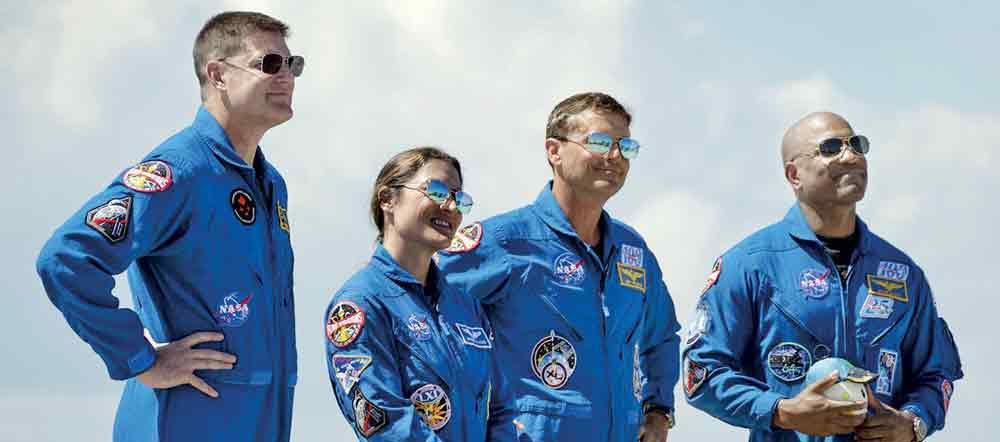
The successful return of Artemis II marks yet another milestone in humanity’s long and ambitious journey into space. The Orion spacecraft, carrying four astronauts, completed its mission with precision, re-entering Earth’s atmosphere at nearly 25,000 miles per hour, enduring temperatures close to 5,000°F, and splashing down safely in the Pacific Ocean after a ten-day voyage around the Moon. From a scientific and engineering standpoint, the mission was an undeniable success.
But beyond the triumph lies a deeper, more troubling question: where, exactly, are we heading?
For all our technological brilliance, humanity today appears no closer to resolving the contradictions that define its existence. We can send astronauts to the Moon and plan missions to Mars, yet we struggle to live in peace on our own planet. Wars rage, economies strain, and political rhetoric grows increasingly hostile. The contrast is stark — astonishing progress in science alongside persistent failure in human conduct.
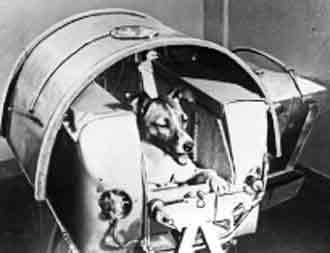
From Laika to Artemis — a challenge to evolve beyond base instincts
From Hunter-Gatherers to Moon Voyagers: Are We Better?
This paradox invites a reflection that may seem uncomfortable: Were early humans, hunter-gatherers who lived in the Middle Paleolithic broadly spanned from 300,000 to 500,000 years ago, happier than we are today? They possessed none of our technological sophistication, yet their lives were not shaped by global competition, the relentless accumulation of wealth, or the anxieties of modern existence. Their world was simpler, governed by immediate needs rather than distant ambitions. While their lives were undoubtedly harsh, they were perhaps freer from the burdens we now consider inevitable.
The roots of this contradiction can be traced back to the very origins of the space age. When Sputnik 1 was launched in October 1957 by the Soviet Union, it became the first man-made object to orbit the Earth, a remarkable scientific achievement. Yet it was also a political statement, signaling the beginning of the Space Race between the then powerful ‘Soviet Empire’ [USSR] and America. Space was not merely a frontier for discovery; it was a stage for rivalry.
That rivalry took a darker turn in the following month with Sputnik 2. On board was Laika, a small stray dog from the streets of Moscow, the first living being to orbit Earth. She proved that a mammal could survive launch and weightlessness, providing vital data for human spaceflight. But she was never meant to return. The spacecraft had no recovery system. From the moment she was sealed inside, her fate was decided.
Alone, trapped, and slowly succumbing to unbearable heat, she endured immense suffering before dying of hyperthermia during the spacecraft’s fourth orbit. Her agony was concealed behind the triumphant language of success; her life reduced to a mere cost of progress.
Four years after the precautionary tests made possible by the data provided by Laika, triumph followed. Yuri Gagarin journeyed into orbit on 12 April 1961. He was celebrated across the world as a hero. Crowds cheered, nations rejoiced, and he later visited Sri Lanka as part of his global tour. Yet even as the applause rang out, another story remained untold. Far above the Earth, the unsung heroine Laika’s lifeless body continued its silent orbit. The glory belonged to others; the sacrifice was hers alone. The nation that sent her into the heavens, the Soviet Union, would itself disintegrate in the 1990s, losing the very power, prestige, and supremacy in the space race it had once sought to project through her journey.
This contrast reveals a deeper truth: human progress is often driven not only by curiosity, but by a relentless hunger for power, recognition, and accumulation, where compassion and justice are too easily set aside.
Today, as humanity embarks on a new era of lunar missions and plans for Mars, resources such as water and ice on the Moon are viewed not just as scientific opportunities, but as assets to be secured. Private corporations play an increasingly central role, transforming space into a domain of economic interest.
Aggressive political rhetoric
Even the political rhetoric reflects this mindset. Donald Trump, shifting effortlessly from geopolitical posturing to cosmic ambition, reportedly declared “Next is Mars” following the success of Artemis II. Just a week earlier, he had warned that Iran would be “wiped out” and added, with the same casual assertiveness, “Next is Cuba.”He also launched a sharp public attack on Pope Leo, dismissing his moral authority and criticising his position in unusually combative terms. Whether directed at nations on Earth, global religious figures, or worlds beyond it, the language carries the same undertone of dominance and confrontation.
In this context, Artemis II appears not as a break from the past, but as its continuation under new conditions. The frontier has changed, but the motivations remain strikingly familiar.
This raises a fundamental question: is progress, in itself, enough? The answer, increasingly, appears to be no. Technological advancement without ethical growth risks amplifying the very problems it seeks to overcome. The ability to travel to the Moon does not guarantee wisdom in how that ability is used. Without a corresponding evolution in values, progress may lead not to liberation, but to new forms of conflict and inequality.
From Sputnik I to Artemis II: Progress or the Persistence of Power?
This perspective finds resonance in the work of Arthur C. Clarke, particularly in 3001: The Final Odyssey. Clarke envisioned a future in which humanity’s survival depends not on its technological prowess alone, but on its moral development. Intelligence, he suggested, is not sufficient; it must be guided by wisdom. Without it, even the most advanced civilisation risks destruction. Clarke’s vision is both inspiring and cautionary. It acknowledges humanity’s potential to transcend its limitations, but it also warns of the consequences of failing to overcome its darker instincts, violence, greed, and the pursuit of power at any cost.
Sacrificed in the name of science
In many ways, the story of Laika embodies this warning. She did not choose her fate. She did not seek glory or recognition. Yet she became a pioneer, her life given in the service of human ambition. Her story forces us to confront an uncomfortable reality: progress often carries a hidden cost, borne by those without a voice. As we celebrate the success of Artemis II and look forward to future missions, it is worth asking whether we have truly learned from the past.
Are we moving toward a future defined by cooperation and shared purpose, or are we simply extending old patterns into new realms?
The answer will shape not only the future of space exploration, but the future of humanity itself. For all our achievements, we remain a species in transition, capable of reaching the stars, yet still bound by the instincts that once governed life on the Savannah.
The challenge before us is not merely to explore the universe, but to evolve beyond those instincts.Until then, the story of space exploration will remain a story of both triumph and contradiction. And as history continues to celebrate its heroes, it would do well to remember a small, silent pioneer who once circled the Earth alone.
Long before humanity claimed the stars, a canine laid down its life, not for necessity, but for a species driven by an unyielding desire for power, prestige, and the endless accumulation of more.
kksperera1@gmail.com