Australia’s Dictation Test and early Arrivals from Ceylon By Earlson Forbes

Migrant and other Arrivals from Ceylon/Sri Lanka to Australia during the second half of the 20th century have been well documented. From the post 2nd World War inflow of genealogy tested Burghers; to the later inflow of professionals; the Family Reunion, refugee and skilled migrant intakes; many of differing status and age have made it across by ocean liner, leaky boat and airplane to Australia. This is not their story.
What is presented here is a glimpse of one aspect of the lives of individuals who came to Australia from Ceylon in the late 19th and early 20th centuries. Many of these Ceylonese arrived before Australia became an Independent Nation.
In 1882, a sizable number of Ceylonese arrived in Queensland, as indentured labour. With the expansion of sugar cane planting in Queensland at that time, there was an ever-present need for labour to work the plantations. In November 1882 nearly 500 Ceylonese arrived by sea in Port Mackay, Queensland. Some 300 disembarked in Mackay and the rest were taken to Bundaberg. The 500 Ceylonese had been brought to Queensland under a private arrangement between business Agents in Ceylon and Queensland plantation owners. No government agencies were involved in this enterprise in either Ceylon or Queensland. The deal included paid passage to Queensland, with the requirement that the worker was contracted to serve for five years. At the end of the five-year contract, the worker was to be repatriated to Ceylon with the return passage paid. Workers were entitled to
rations and an annual wage during the tenure of the contract. Some were even given a plot of land for a home garden. In some instances, the terms of the contract could have been varied to meet circumstances. There are no detailed figures as to how many of these workers returned to Ceylon at the end of their contract and the number that stayed behind. Suffice to say many went back and some stayed on to build a life in Australia, not so much on the plantations but as cooks, waiters, artisans and domestics. [1]
The other significant development which drew individuals from Ceylon across the seas to Australia was the commencement and development of the Pearl Fishing Industry in the Torres Strait Islands and to a lesser extent in North Western Australia, around Broome.
In the 1870ies there was a rush to the Torres Strait Islands where rich Pearl Fishing resources were discovered. Not only were the natural pearls here of great value, but the Torres Strait Island seas had also comparatively large deposits of good quality pearl shells. Pearl Shells were used to make the product, ‘mother of pearl.’ Mother of pearl was sought after for making high quality buttons, buckles, handles for exclusive cutlery and similar high- priced products. In an era where diving gear had not yet begun to be used, experienced workers (both bare skin divers and boatmen) were highly sought after. In Ceylon pearl fishing in the Gulf of Mannar had gone on from time immemorial. It was only logical that the North Queensland Pearl Fishery operators would look to Ceylon to source cheap labour for the growing industry. In the Torres Strait area, Thursday Island became the base from
which the larger and more prominent pearling operations were conducted. As early as 1879, four Ceylonese, (called Cingalese at the time) are recorded being employed as boatmen. In 1882 some 25 Cingalese were recruited to work on Thursday Island. Entry of Ceylonese workers to Thursday Island after 1882, continued on a less formal basis. Although numbers were small, as the population on Thursday Island was comparatively sparse, the additions were significant. Also, there was more occupational variety in the arrivals from Ceylon. In addition to divers and boatmen there came shell cleaners, cooks, domestics and traders. Some of the employment contracts did not stipulate that at the end of the contract, the worker was required to go back to the country from where he had come.
Probably with a view to saving on repatriation costs some contracts were intentionally left open ended. This facilitated the continued stay on Thursday Island of those among the Ceylonese arrivals who wished to stay on. In the years following, right up to the 1940ies, the Ceylonese on Thursday Island left a lasting impression on the Island’s township. At the height of their influence there was a Cingalese quarter, a place for Buddhist worship, and even an area where their preferred groceries were sold. [2] Another account refers to a Ceylonese, who having studied dentistry by correspondence, set himself up as a dental surgeon on Thursday Island. [3]
Arrivals from Ceylon to the other Australian Colonies at this time appear to be much less than to Queensland. In 1851, gold was discovered in Ballarat, Victoria. This event followed by discovery of gold in some of the other colonies led to an influx of a large number of persons from all parts of the world to Australia.
Victorian Government sources, on the subject of immigration history, comment as follows: –
‘Sri Lankans (formerly referred to as Ceylonese) have been settling in Victoria since the 19th century. They were first counted in the 1871 census, when 58 people were recorded’.[4]
Whilst the 19th century saw arrivals from Ceylon to Australia in an irregular form as indentured labour, skilled workers mainly in the pearl fishing industry and the casual entrepreneur, the new century heralded major change.
In 1901 the Australian Crown Colonies of New South Wales, Victoria, Queensland, Tasmania, South Australia and Western Australia came together to form the Independent Nation of The Commonwealth of Australia. One of the earliest acts of the new Nation was to pass legislation [Immigrationn Restriction Act 1901] effectively limiting entry to Australia only to Europeans. Enshrined in this Act was the infamous DICTATION TEST. Section 3 of the 1901 Act read as follows: –
‘The immigration into the Commonwealth of the persons described in any of the following paragraphs of this section (hereinafter called “prohibited immigrants”) is prohibited, namely: –
- any person who when asked to do so by an officer fails to write out at dictation and sign in the presence of the officer a passage of fifty words in length in an European language directed by the officer;’
Post 1901 although there was restriction of entry to Australia, those who were in the country were not deported en masse. A number of persons who had entered Australia from the South Pacific Islands were sent back to their home countries, but others such as Chinese, Japanese, Philippinos and Ceylonese were able to stay on if they wished to do so. However, if a non-citizen left Australia, he/she could be subject to the Dictation Test on return and denied entry if unsuccessful at the test. As this was an onerous requirement (mainly to the many Chinese who had entered Australia before1901) there was a concession offered. Before leaving Australia, residents who were not citizens, could apply for an exemption from the Dictation Test on return to Australia. The exemption applied for a maximum period of 3 years from the date of departure from Australia.
Australian National Archives records indicate that in the first three decades of the 20th century several Ceylonese, especially in the Northern States of Australia, applied for and received Certificates of Exemption from the Dictation Test prior to travel to Ceylon. Such travel at the time would have been costly and those who availed themselves of the Exemption Concession were very likely in well paid employment, profitable business, or were supported by generous and influential sponsors.
Four cases of Dictation Test Exemption are examined below.
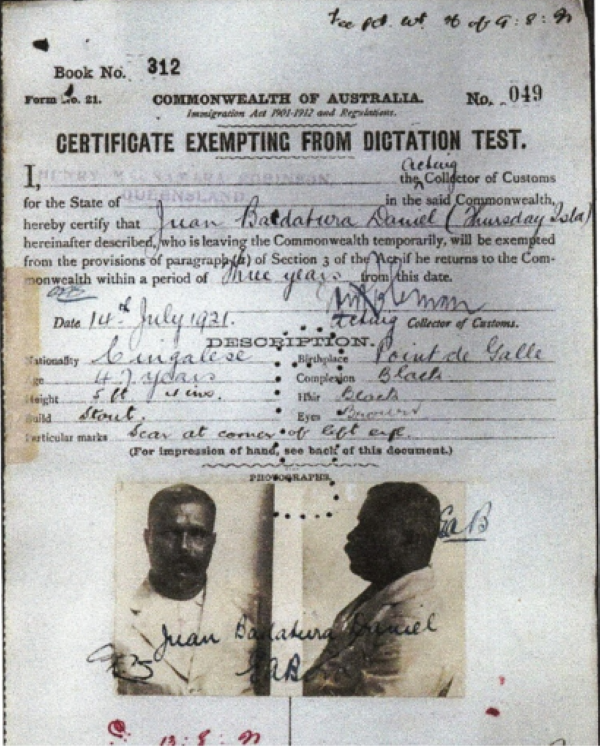
The first is that of Mr Juan Badatura Daniel. [Figure 1]. Next to the applicants name the words Thursday Island are written within brackets. One can logically assume that Mr. Daniel was one of the many Ceylonese engaged in the Pearl Fishery and jewellery trade. A brief description of the applicant is also given. Nationality-Cingalese; complexion-black; eyes-brown; hair-
black; height -5 feet 4 inches; and build stout. He is noted as being 47 years of age. Mr. Daniel has rather proudly described his birthplace as ‘Point de Galle’! His visit to Galle was comparatively short. Mr Daniel left for Ceylon on the good ship Victoria on 13 August 1921 and returned to Thursday Island on 10th December the same year.
Figure1
The next record is that of Mr. H. L. Punchi Singho and his Dictation Test Exemption Certificate (figure2). Mr Punchi Singho is noted as being 55 years old and of Cingalese Nationality. His birthplace is ‘Galle Ceylon’. At this time as Ceylon was still a British Crown Colony the question of nationality was probably a difficult
question to readily answer accurately. His complexation is quaintly described as ‘chocolate’, with black hair and brown eyes’. He embarked at the port of Townsville on the vessel Montoro, on 7th August 1921. His return to Sydney on 17th April 1922 is noted on the bottom part of the Exemption Certificate. Mr Punchi Singho left Townsville for Singapore. At this time there was a strong relationship between Singapore and Colombo in the jewellery trade. [Figure 2].
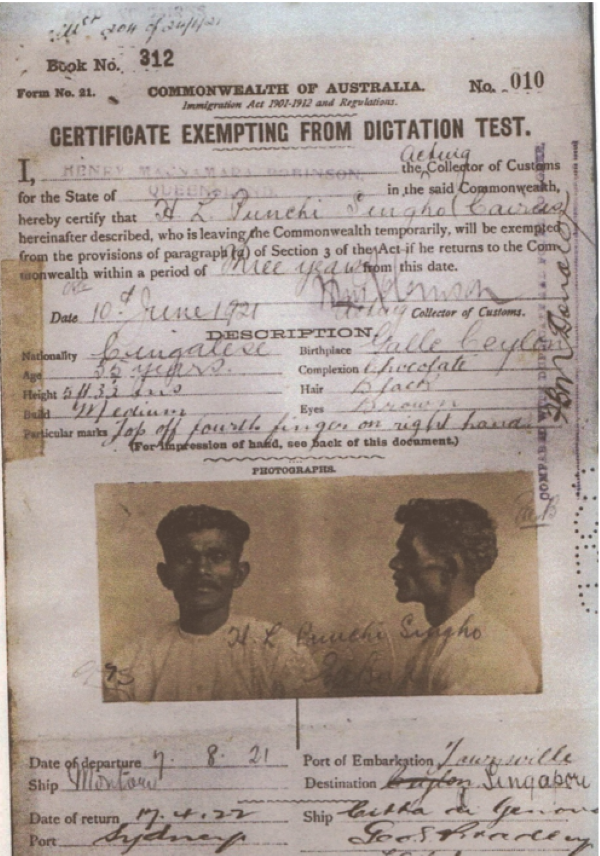
Whether Mr. Punchi Singho was involved in the jewellery business in Queensland, specifically the pearl trade, or he was a descendant of the Ceylonese group that arrived in North Queensland in 1882, has not been determined.
Case 3 is of a Ceylonese who left Australia in 1914 and returned only in 1922. Mr. M. G. Girigoris of North Queensland had overstayed the three year time period usually given in a Dictation Test Exemption Certificate and returned nearly 8 years after departure. [Figure 3]
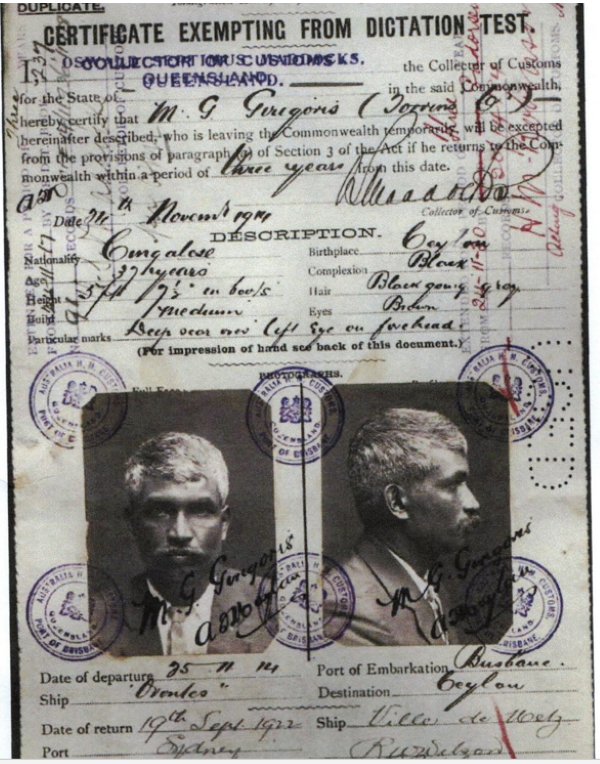
Probably Mr. M. G. Grigoris would have been an influential person as extensions to Exemption Certificates were not normally given. For his birthplace Mr. Girigoris nominates ‘Ceylon’ and not a specific location or town such as ‘Point de Galle’ or ‘Galle’. His port of embarkation was Brisbane and destination Ceylon. At the time of departure his age is noted as being 37 years, but the colour of his hair is noted as, ‘black going grey’.
The fourth and final Exemption Certificate looked at is that issued to William Perera. [Figure 4].
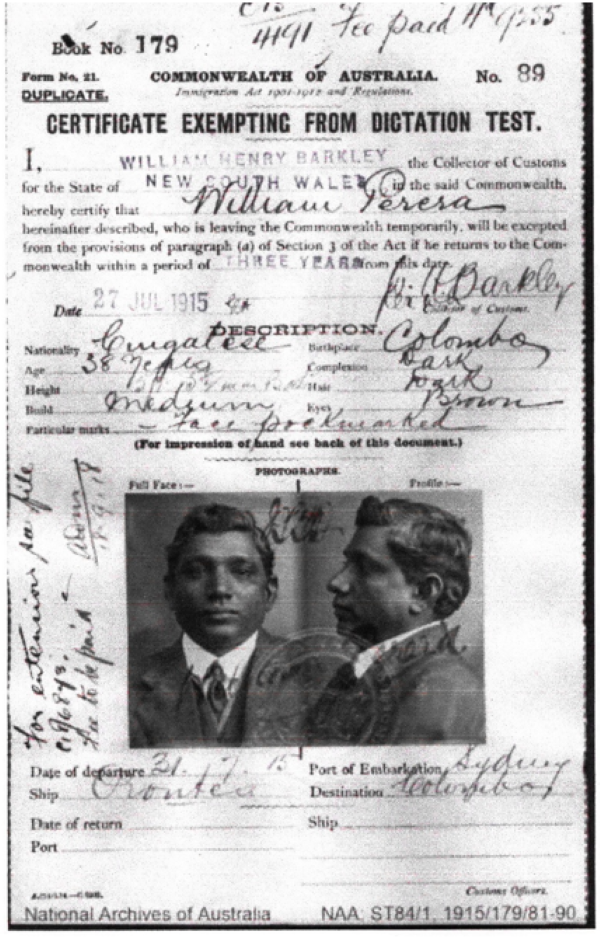
William Perera is a well-dressed relatively young man 38 years old, with dark complexion, black hair and brown eyes. His place of birth is stated as ‘Colombo’. William Perera left Sydney on 31st July 1915 on the Orantes. William returned to Australia in September 1918, a few weeks outside of the 3 year limit. William Perera seems to have been reprimanded and fined for the few weeks late return. On his Exemption Certificate it is noted that a fine was imposed and that he has paid the fine.
This is a glimpse of some of the very early Ceylonese pioneers who arrived in Australia with a determination to advance their employment or promote their business. These pioneers operated in a newly independent Australia, which had as its population policy a strong European only bias (White Australia Policy). Around this time a Hon. Member of the Australian Parliament (Mr Bruce Smith) stated that:
’he had no desire to see low class Indians, Chinamen, or Japanese…. swarming into this country’
In the face of this unwelcome and hostile atmosphere the workers and businessmen from Ceylon were able to do their jobs and ply their trades successfully. Such was their success that they were able to afford a trip back to the homeland and return to Australia to resume their profitable occupations or trades.
[1] [W S Weerasooria. Links between Sri Lanka and Australia.
[2] Stanley Sparkes and Anna Shnukal. The Sri Lankan Settlers of Thursday Island.
[3] W S Weerasooria. Links between Sri Lanka and Australia.
[4] Museums Victoria. ’Immigration Policy’.
[5] Photos and documents. National Archives Australia.