First Energy Wins Two National Awards for Sri Lanka’s First Building-Integrated Solar Roof at People’s Bank Head Office
First Energy’s building-integrated solar installation at the People’s Bank head office in Colombo. Image credit: Colombo Gazette.
Sri Lankan engineering innovation has received national recognition after First Energy SL (Pvt) Ltd won two awards for an advanced building-integrated solar installation at the new People’s Bank head office in Colombo.
The company received Project of the Year: Building-Integrated Solar (BIPV) and Technology Innovation of the Year: Building-Integrated Solar (BIPV) at the Sri Lanka Clean Energy Week Leadership Awards 2026. Both awards were presented for the same project, reflecting the architectural and technical significance of the installation.
The awards were presented on 21 August 2026 at Hotel Marino, Colombo, during Sri Lanka Clean Energy Week, an industry event organised by SolarQuarter. Reports published by Colombo Gazette and LankaTalks described the project as an important development for Sri Lanka’s expanding renewable-energy sector, particularly because the solar modules were incorporated into the building’s architecture rather than added to an existing roof.
A solar roof designed into a 24-storey building
The installation is positioned at the top of People’s Bank’s 24-storey head office, more than 75 metres above street level, where the solar modules form a waterproof architectural roof over a rooftop terrace.
First Energy has described the system as the first installation of its nature in Sri Lanka. Unlike a conventional rooftop solar array, which is usually mounted on top of a completed building, the building-integrated photovoltaic system forms part of the building itself.
In this case, the solar array takes the place of what would otherwise have been a solid pergola roof. Consequently, the structure had to perform several functions simultaneously: it had to generate electricity, provide shade and filtered light, and protect the terrace from rain.

AI-generated illustration based on the reported People’s Bank installation, showing how a high-rise solar pergola can combine energy generation with architectural protection. Branding: eLanka, bottom right; “AI generated based on source image”, bottom left.
Custom modules for a specific architectural vision
The project was shaped by an architectural brief that required a pergola with carefully defined spacing and a particular quality of filtered daylight for the terrace below.
Standard solar panels are generally produced in fixed dimensions and are designed to absorb as much sunlight as possible, leaving little opportunity for light to pass through. Those conventional modules could not meet the design requirements of the People’s Bank head office.
The solar modules were therefore fully custom-made, with non-standard dimensions and a reduced cell density that allowed a controlled amount of daylight to reach the terrace. First Energy worked with specialist international manufacturers to produce modules that were not available through mainstream suppliers.
This approach demonstrates the difference between simply placing solar equipment on a building and designing renewable-energy infrastructure as part of the building’s original architectural concept. The project required coordination between the architects, solar engineers, international manufacturers and structural specialists, with the final system being developed around both aesthetic and performance requirements.
The height of the installation introduced further technical challenges. A rooftop structure positioned more than 75 metres above street level must withstand considerable wind forces, particularly in a tropical environment where intense weather systems can produce high-velocity gusts.
To address those demands, the thickness of the solar modules was increased, while the mounting system was reinforced with additional clamps and an upgraded support structure. These measures were intended to provide complete stability while maintaining the appearance and functionality of the pergola.
Three functions from one architectural element
The completed installation has an installed peak capacity of more than 80 kilowatts (kWp). While the generation of renewable electricity remains its primary technological function, the roof also provides rain protection and creates the shade and filtered light requested by the architects.
The result is an architectural element with three practical roles:
- It generates solar electricity.
- It sheds rain and protects the rooftop terrace.
- It provides shade and controlled daylight for people using the space below.
The combination of these functions is understood to have been a significant reason why the same project received recognition from both award categories. The installation was judged not only as an energy project, but also as an example of technological innovation integrated into a major commercial development.
For general readers, the concept is important because it shows how solar power can be incorporated into new buildings without being treated as an afterthought. The panels become part of the roof, façade or other structural feature, allowing renewable-energy generation to be considered alongside the building’s materials, appearance and use.
An emerging opportunity for new developments
Building-integrated photovoltaics remain uncommon in Sri Lanka, where most commercial solar installations are mounted onto existing rooftops. Such systems can be especially effective when considered during the design and construction stages of a building, since their cost can partly replace expenditure that would otherwise be required for a conventional roof, pergola or façade element.
That design-stage opportunity could become increasingly relevant as Sri Lanka’s commercial buildings seek to improve energy efficiency, manage operating costs and demonstrate stronger environmental performance. Office towers, hotels, hospitals, shopping centres and institutional buildings may all present opportunities for solar systems that are integrated into canopies, façades, skylights and covered terraces.
The People’s Bank installation provides a practical demonstration of how these objectives can be combined. Rather than adding solar panels to a completed structure, the project required the energy system and the architectural feature to be developed as one coordinated design.
Such an approach also illustrates the growing maturity of Sri Lanka’s solar industry. The sector is no longer limited to standard rooftop installations, as specialised engineering, custom manufacturing, structural reinforcement and long-term maintenance are becoming increasingly important components of large-scale renewable-energy projects.

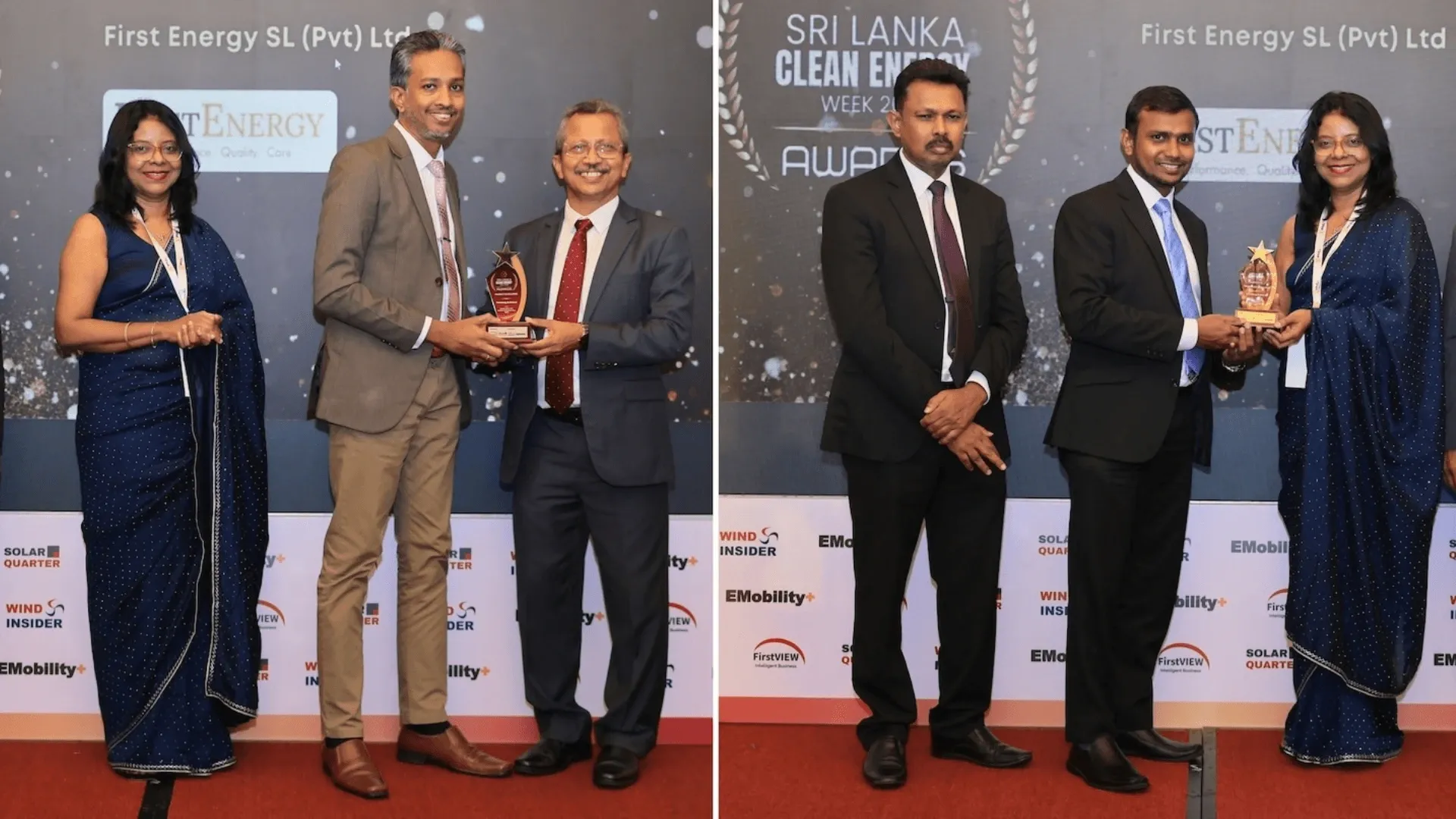
AI-generated illustration based on the reported awards ceremony, depicting a formal clean-energy recognition event in Sri Lanka. Branding: eLanka, bottom right; “AI generated based on source image”, bottom left.
First Energy’s decade of development
Founded in 2016, First Energy provides end-to-end engineering, procurement and construction services, together with long-term operations and maintenance support. The company has also expanded into battery energy storage systems and medium-voltage infrastructure.
First Energy states that it has delivered more than 100 MW of rooftop and ground-mounted solar capacity in Sri Lanka, with more than 75 per cent of its installed capacity coming from commercial, industrial and utility-scale projects.
The company has held ISO 9001, ISO 14001 and ISO 45001 accreditation continuously since 2023, holds a CIDA EM 2 grading and has been registered with the Sri Lanka Sustainable Energy Authority as a solar company for 10 years.
The People’s Bank system was installed shortly before Cyclone Ditwah struck Sri Lanka in late November 2025 and is now complete and operating. The awards therefore arrive during First Energy’s tenth year, marking a significant milestone in the company’s development and in the wider progression of Sri Lanka’s renewable-energy sector.
The company has identified Performance, Quality and Care as the three principles guiding its work during most of that decade. The award-winning installation at People’s Bank offers a clear example of how those principles can be applied to a technically demanding project in which energy generation, structural resilience and architectural design must operate together.
For Sri Lanka, the project represents more than an individual corporate achievement. It demonstrates that locally delivered renewable-energy solutions can extend beyond conventional solar deployment, while creating new possibilities for buildings designed to be more efficient, adaptable and environmentally responsible from the outset.
Further information about Sri Lanka and its global community is available through eLanka, which shares positive stories, business developments and achievements connected with Sri Lankans worldwide.
This article was written based on the source http://colombogazette.com/2026/09/27/first-energy-wins-two-national-awards-for-solar-roof-at-peoples-bank-head-office, kindly email us at info@eLanka.com.au if any information needs to be corrected.
This article was written based on the source https://www.lankatalks.com/post/first-energy-wins-two-national-awards-for-solar-roof-at-people-s-bank-head-office, kindly email us at info@eLanka.com.au if any information needs to be corrected.
At eLanka, we respect the rights of creators. If we have used an image you own and you’d like it removed, please email us at info@elanka.com.au and we’ll handle it promptly.