


Medical Practice Then and Now: Lessons from the Bedside-by Harold Gunatillake

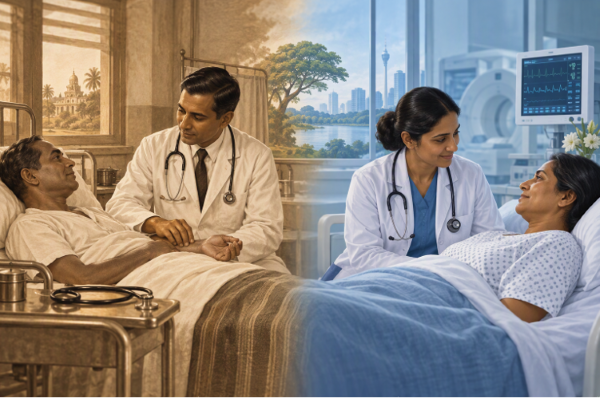
Medicine has always balanced two essential elements: clinical judgment and scientific investigation. During the middle of the twentieth century, diagnosis depended heavily on a physician’s ability to listen, observe, and examine the patient. Today, remarkable advances in technology have transformed healthcare, providing sophisticated tools that can detect disease with unprecedented accuracy. Yet many experienced clinicians worry that, in the process, some of the fundamental bedside skills that once formed the foundation of medical practice are being neglected.
The Art of Clinical Medicine in the 1950s
During my medical training in Colombo in the 1950s, our teachers emphasized careful clinical examination as the cornerstone of diagnosis. A consultation began with listening attentively to the patient’s story while taking the radial pulse. This was followed by a systematic physical examination.
Using a stethoscope, we listened carefully to the heart and lungs, noting crepitations, rales, murmurs, and other abnormal sounds. The abdomen was examined thoroughly by palpating all four quadrants, assessing the liver, spleen, and any abnormal masses. Neurologists carried simple but indispensable tools: a reflex hammer, an ophthalmoscope, cotton wool, and a pin to assess neurological function.
Only after a careful history and examination would we formulate a clinical diagnosis. Investigations such as blood tests, X-rays, and barium studies were used to confirm or refine our conclusions. Since computed tomography (CT) scans did not yet exist, barium meal examinations were invaluable in diagnosing gastrointestinal disorders.
A typical consultation often lasted around twenty minutes. This allowed doctors to establish a relationship with the patient while gathering the information needed for an accurate diagnosis.
The Rise of Technology
Over the decades, medicine has been transformed by technological innovation. CT scans, magnetic resonance imaging (MRI), ultrasound, endoscopy, and sophisticated laboratory testing have revolutionized diagnosis and treatment. These advances have undoubtedly saved countless lives and improved medical outcomes.
However, the increasing availability of diagnostic technology has also altered clinical practice. In many settings today, a patient may undergo a brief interview before being sent for investigations based on a suspected diagnosis. Physical examination is sometimes limited, and in some cases, even basic observations such as checking the pulse may be omitted.
The emphasis has shifted from forming a diagnosis through bedside assessment to obtaining a diagnosis through investigations. Physicians, often working under significant time pressures, may spend only a few minutes with each patient before moving on to the next consultation.
While technology has enhanced diagnostic capability, it has also created a risk: the possibility that clinical skills may gradually be overshadowed by reliance on machines and laboratory results.
A Personal Experience
A recent incident in Kandy reinforced my concerns about this changing pattern of medical practice.
A former army serviceman, employed as a hotel security officer, sought medical attention because he was unable to swallow food. According to his account, he attended an army hospital where he was referred directly to an endoscopy specialist without a detailed history or physical examination.
After waiting three weeks for his appointment, surviving largely on liquids and semi-solid food, he underwent endoscopy. The specialist reportedly found no abnormality in the throat or oesophagus that could explain the swallowing difficulty. Yet the patient remained unable to swallow solid food and was given no satisfactory explanation for his condition.
I happened to meet him shortly afterward. Although retired, I examined him with his consent using the methods I had been taught many years earlier.
The examination revealed an enlarged thyroid gland in the front of his neck. Subsequent thyroid function tests showed markedly reduced thyroxine levels and an elevated thyroid-stimulating hormone (TSH) level. The findings suggested significant thyroid dysfunction associated with gland enlargement.
After commencing daily thyroid hormone replacement, the patient’s condition improved dramatically. Within a week, he was able to swallow normally and appeared greatly relieved and encouraged.
Technology as Servant, Not Master
This experience is not presented as criticism of individual doctors. Modern physicians work under enormous pressures, managing large numbers of patients while navigating increasingly complex healthcare systems. Furthermore, modern diagnostic technologies are indispensable and have transformed the practice of medicine for the better.
The real concern lies in the potential erosion of clinical skills. Sophisticated investigations are most effective when guided by a careful history and physical examination. Machines can provide valuable information, but they cannot replace the insight gained from listening to a patient’s symptoms, observing physical signs, and applying clinical reasoning.
Throughout medical history, the most effective doctors have combined scientific knowledge with sound bedside judgment. Technology should serve as an extension of clinical skill, not as a substitute for it.
Conclusion
The evolution of medicine from the bedside-focused practice of the 1950s to the technology-driven environment of today represents one of the greatest transformations in healthcare. Modern diagnostic tools have brought enormous benefits, improving accuracy and expanding treatment possibilities. Yet the fundamentals of clinical medicine remain unchanged.
A careful history, thorough physical examination, and thoughtful clinical judgment continue to be essential components of good medical care. As medicine advances, the challenge for future generations of doctors will be to preserve these timeless skills while making the best use of modern technology. The ideal physician is not one who chooses between bedside medicine and technology, but one who combines both in the service of the patient.
——————————————————————————–
Insight for the Global Sri Lankan
Harold Pulse is an independent editorial platform offering clear, thoughtful analysis on Sri Lanka’s political direction, governance reforms, diaspora concerns, and the evolving health landscape of Sri Lankans living abroad. Built for global Sri Lankans who value informed perspectives, it clarifies the issues shaping the nation’s future—from domestic policy shifts to the well-being of expatriate communities navigating new health systems, lifestyles, and challenges worldwide.
Harold Pulse speaks to Sri Lankans everywhere: those shaping change at home, and those building lives overseas while staying deeply connected to the island’s progress. It is a space where political clarity, community insight, and diaspora health awareness come together to support a stronger, more informed global Sri Lankan identity.
At eLanka, we respect the rights of creators. If we have used an image you own and you’d like it removed, please email us at info@elanka.com.au and we’ll handle it promptly.
Thanks.
eLanka team
eLanka Disclaimer
Content published on eLanka may be created by the eLanka team, submitted by contributors or third parties, reproduced or adapted from other sources with appropriate source acknowledgement, or provided as promotional/advertising material by our clients. While eLanka takes reasonable care in preparing and publishing content, we do not warrant its completeness or accuracy. Views expressed are those of the respective authors or contributors and do not necessarily represent the views of eLanka. Third-party contributors, content providers and advertisers are responsible for the accuracy of material they supply and for ensuring they hold the necessary rights and permissions for its publication. Advertising and promotional content should not be regarded as an endorsement by eLanka of any product, service or claim.