Negombo’s Blue Lagoon under a Full Moon-by Juliet Coombe
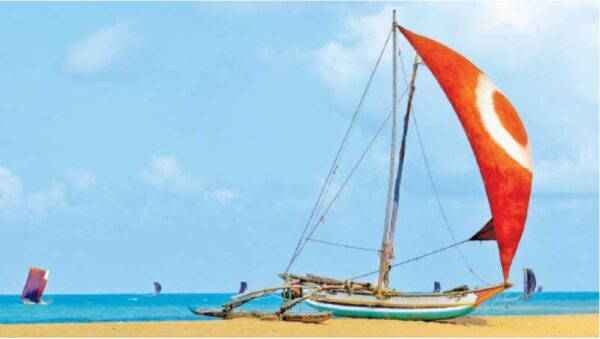
Negombo famous for its fish market
Source:Dailynews
Woken by the sound of the dawn chorus, a lively orchestra of cormorants perch on Lagoon fishing sticks, known as Athukutu or Masathu, with wings spread out like giant capes to catch the first rays of the sun, while egrets, gulls and herons cry out in Jurassic screeches to one another in mid flight to announce, to all that will listen, that a new day has begun – reminding us all, in age old tradition, that what is on our own front doorsteps is just as amazing and beautiful as travelling to the far corners of the world.
Negombo’s soul catching Lagoon always the most beautiful under a full moon has, for centuries, been drawing traders and travellers to this pearl in the Indian Ocean, and is today famous for being the nearest stopping off point to the international airport and one of the island’s most famous fishing markets. It’s a place where the early riser can buy the freshest catch of the day: tasty prawns, and mud crabs; and a deeply healing spot with its many historic churches and ancient village traditions that remind us that simplicity is simple to obtain, for those that know its true importance. A naturally varied watery paradise, with countless tributaries to explore by boat or on foot, it’s a stunning expanse of water surrounded by vibrant paddy fields, wild grasslands, thick mangrove swamps and coconut plantations that provide all the basics for a great meal, washed down by the ubiquitous elixir of life, juice from the King Coconut.
 Here, one steps out of one’s cyborg-like and hectic parallel universe, to marvel at the vast amounts of water, where small fishing boats cross, as if they were straight out of a Turner painting. Somehow, this time-locked gem is a storyteller’s haven, with its ancient myths and legends, made all the merrier with a glass of the local firewater. Here, churches old and new are fanned by palm trees and, along the waterfront, boats are anchored with wide eyes painted on them to protect the deeply superstitious fishermen from the evil eye. The boats bob up and down in the water in an unworldly scene that caught the imagination of the Dutch in the golden age of trade. Negombo, the home of the fishermen, is a mariner’s treasure trove, with fresh net hauls brought in daily and an agricultural system that goes back to ancient times, fed by rivers that pass over the land then filter back to the sea and allow the holistic cycle of life to go on unhindered by big industrial farming that has destroyed so much of the world’s rich wildlife and biodiversity.
The most thrilling and best way to see Negombo and its nature is by hiring a bike, or bringing your own, and heading out in the early morning to the old colonial fort, using wheel power, sun glasses and a good quality mask that will protect you from the dust and tiny insects that can fly at you from all directions, not to mention Covid 19. Here, you can start your tour of this fascinating lagoon and historic old town, going through the old entrance archway, with its majestic colonial clocktower, overlooked by St. Stephens Church. Remember to use hand sanitiser before going in and out of any building and to listen and respect the island’s latest travel rules and restrictions.
Back down the hill and away from the jail, head to the oval, and curve around it, past the historic law courts (where some fascinating cases have been tried), and take the second left, past the fish-themed sculptured lamp post, then stop and watch fishermen on the water, who might be fixing nets, drying fish or getting ready for their next trip out to sea. Go back and turn into Main Street and continue on until you see the lacework balconies of the British houses, where on the left you see the local registrar, and can enjoy impeccable old world charm and historic home of archways, lanterns and lacework balconies, reminiscent of Yemeni architecture in Sanaa, is a must see from the opposite side of the road. Turn left here and onto Sea Street where you turn right, passing the famous Dudley marketplace that has a range of stalls each Wednesday and Sunday, selling lush vegetables from the local farms, fresh bananas from people’s home gardens and backyards and useful handmade household goods, like colourfully woven mats. If you want a break from biking, there is no better way to truly relax than on one of Negombo’s beautiful white sandy beaches, which kids love, as they get to cover themselves in sand and build castles with their buckets and spades. Another option is just to sit overlooking the Lagoon with a sketch book and water colour paints to try and capture the voodoo of this mesmerising location.
Then, notebooks gathered up or left out to dry, head for Hamilton Canal, which was built by the British to stop salt water coming onto Muthurajawela land due to the Dutch Canal destroying much of the earlier Sri Lankan paddy cultivation. The meaning of the area is the King’s paddy field, which produced pearl-like rice and even today they say it is the king of the crops, if you can get it, and the secret to growing the best rice is to plant it under the full moon. Walking outside, wearing a sun hat, is perhaps one of the safest activities and the most fun, as you try to spot the huge variety of different birds, like the Blue-tailed Bee-eater, Lesser Whistling Ducks, grey herons wading majestically, Red Wattle Lapwings, and Whiskered Terns or if you fancy it having a go at planting rice. Here, all waterways including the sea lead to the Lagoon, an ever changing nature reserve with remnants of colonial style houses along smaller tributaries, where you can see ancient methods of fishing, including beating the water, which sends the fish into a circular frenzy – so watch out for those paddle beaters water flying in all directions! Another tradition is to throw branches of kadol in a circular pattern and leave them for one month to create a fake habitat and it is this ancient method of fishing that allows the Lagoon villagers to naturally replenish the area by not taking too much away from it. Fisherman also catch the sweet local prawns, lagoon fish and crabs that they serve at all the Negombo hotels.
Along the edge of the coconut palm-fringed canal, you will find kirila fruit for making juice, and the roots, which were once used for corks for both local Ayurveda treatments and toddy. On a late evening walk or bike ride other animals appear and vanish like the over-curious monkeys, and, from time to time, the Indian Brown Mongoose and monitors that some mistake as crocodiles. Thalahena is a particularly charming section of these ancient waterways with the added novelty of spitting fish, a lagoon version of Jaws that prays on unsuspecting insects, clinging for dear life to surrounding Lagoon foliage, only to be instantaneously knocked off their leaves by a spray of deadly water, that allows the fish to feast on them. Spend time talking to the villagers and you will discover how historically important these canals, tributaries and Lagoon were for moving dry fish and cinnamon spice around and how Covid19 has seen a revival in these old fashioned ways that, until the technology revolution, worked just fine for thousands of years. As the first island to go agrochemical-free in the world, it will be fascinating to track how quickly the wildlife diversity returns and how much better we will all feel eating chemical free food. After all nothing could be more natural than using ancient methods of farming that follows the cycle of the moon and the pull of the water that feeds our crops with everything they need to make us not only healthier as an island, but also mindful of our part in natures cycle of life.