RAJAGALA – THE LOST LEGACY OF ROYALTY – by Bernard VanCuylenburg
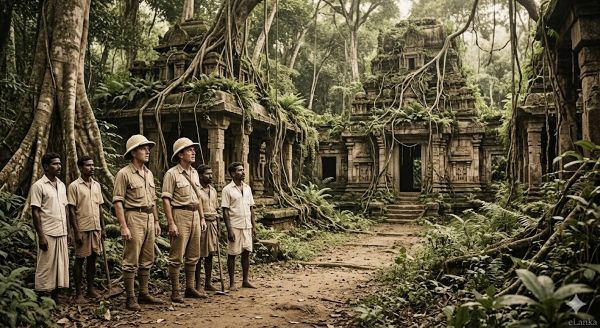
The two Archaeologists and their workmen stood mesmerized in silence at
the site which met their disbelieving eyes. Before them lay the ruins of a
temple complex wrapped in greenery smothered by the forest it once
commanded. The buildings were overhung by vines walled about with ferns
and shrubs. They were feasting their eyes on the legendary temple complex
of Rajagala (Rajagalatenna) which until that time had remained a memory
dimmed to the point of invisibility. The year was 1937 and when this stunning
discovery was made, the name “Rajagalatenna” had remained spectral for
over 2000 years – until this epic discovery. And thereby hangs a fascinating
historical tale……
I visited The Rajagala Monastic Complex/Archaeological site in March this
year, It is located on a mountain 1,038 ft. above sea level in the Amparai
district in an area which is very sparesly populated. Please pardon me if I
digress, but I recall on viewing the ruins, on this site – and there are over
600 – the words of the Egyptologist Howard Carter who discovered the tomb
of the Pharaoh Tutankhamen in 1922 came to mind. Said he “My eyes have
seen wonderful things…..” More than 600 prehistoric ruins and monuments
including ancient stupas grace this site. Although Buddhist monks lived
here since the 1st century BC. It was Prince Lanjatissa, the son of King
Saddhatissa and his family, who first patronized this temple. After Prince
Lanjatissa ascended the throne as King in 119 BC he embellished the
temple on a scale which surpassed all bounds. He ruled from 119 – 109 BC.
The temple from the outset was patronized by royalty of the highest order.
King Lanjatissa was the son of King Saddhatissa, who was the brother of
King Dutugemunu. The seal of royalty does not get much higher than that.
After King Lanjatissa’s death, some Kings who succeeded him, maintained
this noble tradition. To give them credit, they were King Vattagamani, King
Mahasena, King Aggabodhi the 1V, King Aggabodhi the V, King Sena 1st,
King Kassappa the 1V and King Kassappa the V to name a few. There are
rock inscriptions at the Rajagala site with the names of the Kings who by
their munificience, ensured that this complex lived in the collective memory
of generations down the ages. With the collapse of the Anuradhapura
Kingdom following repeated attacks from South India by the Cholas led by
Emperor Rajaraja the 1st in 1017 CE, the resplendent and glorious era of the
Anuradhapura Kingdom came to an end, and the capital was shifted to
Polonnaruwa. Thus began the long night of the soul for the Rajagala Temple
complex which which was lost to posterity, and became smothered by the
forest, where the statues stared out into the steamy jungle with not a single
human being remaining to worship them, the majority having fled to avoid the
marauding Chola war machine. The last ruling King at Anuradhapura Mahinda V and his family were taken in chains to India and he never saw his homeland again. In 1029 CE he died in captivity, twelve years after the fall of the Anuradhapura Kingdom. But the spiritual significance of Rajagala never
diminished through the ages.
Fast forward to the year 1937 with the island as a British colony. The
English by this time were fully conversant about ancient Lanka’s rich
cultural heritage and organized expeditions to various archaeological
sites. And thus Rajagala saw the light of day…….It must be stated that the
excavations at Rajagala were carried out with the assistance of the Deccan
university of India.Today Archaeologists can carbon date artifacts and
sequence DNA on computers. With laser new technology and mobile laser
scanners many new discoveries have been made, particularly in Egypt,
Italy and the United Kingdom to name a few countries. What wonders would
come to light if such technology could be used at Rajagala ! Anybody visiting
Rajagala today will come to the conclusion that this complex was the result
or product of a super advanced civilization, when the Kingdom of
Anuradhapura was at the height of her glory.
Priceless to Rajagala is that Arahat Mahinda who brought Buddhism to Sri
Lanka visited the Rajagala Temple. There is a rock inscription at the site
confirming his visit, making it the second rock inscription of his visit to the
island. The other inscription is at Mihintale.
It must be stated that there is a lot of work to be done before Rajagala can
accommodate “mass tourism” akin to Sigiriya today. First, the ascent to the
summit. The Archaeological Department maintains a small office here with
friendly staff whose heart is clearly in their work. I was greeted warmly, then
taken to a room where one member unfolded a wall map and gave me a
history of the complex. He then pointed out the stone steps which made up
the climb to the summit stating that the climb is one kilometer and has to be
done leisurely – the best way to do it is by climbing for about twenty minutes
and then take breaks of 10 – 15 minutes at regular intervals, drinking plenty
of water. However, my Guide who accompanied me counted 1800 steps and
insisted that the entire climb was two kilometers ! Having visited the ruins on
the summit one descends by another stone stairway on the other side of the
mountain. It must be pointed out that these “stone stairways” are roughly laid
and ascent and descent have to be done with extreme care.
Having completed my tour I visited the Archaeological Office before leaving. One Officer told me that there was a plan to build about six rooms on the
summit for the convenience of visitors who could visit all the ruins at
leisure by spending 2 – 3 nights on the mountain. Another idea being
considered is to have a cable car service from the entrance to the summit
which would facilitate visits, specially for visitors with health /chest problems.
When these plans would ultimately eventuate, only time will tell.
That King Lanjatissa thought of ever building this entire complex on the top of a mountain itself beggars belief. If those stones could talk what stories would they tell ! He almost flattened a gigantic mountain top, terracing part of it to
display the treasures now on display. On reaching the summit one observes that the ruins have been built on different elevated terraces and widely scattered, making the visit very easy. The cultural treasures here have the power to inflame the imagination and is a testament not only to the vitality of
Rajagiriya, but also to her longevity. The small tank which King Lanjatissa built for use of the monks in the temple is still in use and was full during my visit. What do we really know about the past?
Considering the long history of ancient Lanka, how many other archaeological sites have vanished, and all evidence of their existence lie still buried in the dust awaiting the archaeologists spade in the future ? I do not make this sentence lightly. This is the fourth tour I did to the lesser known or largely unknown historic sites in the island hardly visited by any visitors. On each visit I could not help wondering how many treasures are yet to be discovered. I left Rajagala with mixed emotions, my spirit enriched by what I had witnessed – bursting with pride of a civilization magnificient in its complexity and extent, but with sadness at the thought that the grand and glorious Kingdom that was Anuradhapura was heading into its full flowering days before the final catastrophe occurred – the invasion of the marauding Chola armies from India.
King Lanjatissa left posterity a legacy which was twofold – Engineering and Cultural. The best and the most beautiful things in the world cannot be “seen”
or even touched. They must be felt with the heart.
I remember reading that the sheer improbability of its location is why Sigiriya is flourishing today. Maybe in a distant future, this will apply to Rajagalatenna too.
Bernard VanCuylenburg.
.
Fast forward to the year 1937 under British colonial administration. The English
realizing the value of ancient Lanka’s rich cultural heritage began a
archaeological expeditions to various sites, breached the jungle fastness and
rediscovered the wonder of Rajagala.