News & Community eLanka

eLanka

Sunday, 26 Apr 2026
  • Home
  • Read History
  • Articles
    • eLanka Journalists
  • Events
  • Useful links
    • Obituaries
    • Seeking to Contact
    • eLanka Newsletters
    • Weekly Events and Advertisements
    • eLanka Testimonials
    • Sri Lanka Newspapers
    • Sri Lanka TV LIVE
    • Sri Lanka Radio
    • eLanka Recepies
  • Gallery
  • Contact
Newsletter
Sri lankan news
  • eLanka Weddings
  • Property
  • eLanka Shop
  • Business Directory
eLankaeLanka
Font ResizerAa
Search
  • Home
  • Read History
  • Articles
    • eLanka Journalists
  • Events
  • Useful links
    • Obituaries
    • Seeking to Contact
    • eLanka Newsletters
    • Weekly Events and Advertisements
    • eLanka Testimonials
    • Sri Lanka Newspapers
    • Sri Lanka TV LIVE
    • Sri Lanka Radio
    • eLanka Recepies
  • Gallery
  • Contact
Follow US
© 2005 – 2026 eLanka Pty Ltd. All Rights Reserved.
Home » Goodnews Stories Srilankan Expats » Articles » The Royal-Thomian Cricket Match: Its History-by Uthpala Wijesuriya
Articles

The Royal-Thomian Cricket Match: Its History-by Uthpala Wijesuriya

eLanka admin
Last updated: March 12, 2024 1:49 am
By
eLanka admin
ByeLanka admin
Follow:
Share
7 Min Read
SHARE
Views: 14

The Royal-Thomian Cricket Match: Its History-by Uthpala Wijesuriya

Source:Thuppahis

Uthpala Wijesuriya, in The Island, 17 March 2023,where the title presented is  “The Earth’s Greatest Rivalry” … while the highlighting in this presentation has been imposed by a Thuppahiyaaaaaaaaa.

The Royal-Thomian or the Battle of the Blues, the world’s second oldest uninterrupted cricket battle, will unveil for the 144th consecutive year this week. The encounter pits the boys bearing the crests of the Elephant and Palm Tree against those bearing the Cross and Dove.

elanka

The Royal-Thomian is in many ways greater and more epic than the three matches that can be most favorably compared to it: St Peters–Prince Alfred in Australia, Eton–Harrow in Britain, and the Ashes. This is particularly so in the annals of schoolboy cricket in Sri Lanka. Indeed, the history of Sri Lankan cricket cannot be written without the Battle of the Blues.

Chandana Panditharathna once observed, “The magic of the match has been retained through colonialism, world wars, independence, nationalism and yes, even terrorism.” Recently the tradition continued despite the Covid-19 pandemic and the economic crisis.

How did it all begin? An old boy of Westminster College and a graduate of the University of Cambridge came to the Colombo Academy in 1876 as a mathematics tutor. Soon he was appointed as Boarding Master at the school. This well experienced person sacrificed his time and expended his energy to develop cricket there. Having achieved his aim, he wrote a letter to the Sub Warden of S. Thomas’ College, suggesting an inter-collegiate encounter.

This talented tutor and cricketer, who initiated the big tradition, was Ashley Walker. He would later be called the Father of Ceylonese cricket.Though the first official encounter between the two schools was held in 1880, clashes between representatives of the two institutions had been held earlier.
elanka

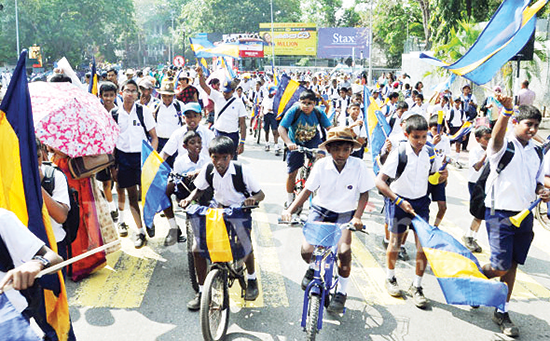
Cycle Parade

The match between the Colombo Academy and the College of St. Thomas the Apostle, Mutwal was known as “Academy vs. College Match” those days. After playing several matches at the Slave Island Green, in 1879 the first fully recorded fixture was held at Galle Face.

The Colombo Academy was then captained by Ashley Walker and the College of St. Thomas the Apostle was captained by Reverend S. J. Meyrick. Archibald Campbell of the Academy and the Reverend W. Falkner of the College also played as masters.

The two teams travelled by canoes through the Beira Lake with their gear. The Principal of Colombo Academy, John Barnabas Cull, declared a half day holiday. On that occasion, the Academy won the toss and elected to bat. The openers were de Silva and Van Cuylenburg. The Academy emerged as the winner, grabbing all six stumps.

The first official encounter took place in 1880 with only students. The Academy Team was captained by J. W. Silva and the College Team by F. W. McDonell. The Academy managed to retain victory with a 62-run lead. Since then, it has been a journey of success, a journey of friendly rivalry.

After giving birth to the island’s oldest cricket encounter, Walker proposed an encounter between the Ceylonese and local British officials, an episode that Nicholas Brookes has referred to in his book, “An Island’s Eleven.” 10 out of the 11 in the Team he founded came from either Royal or S. Thomas’. One can even consider this as the island’s first national cricket team.

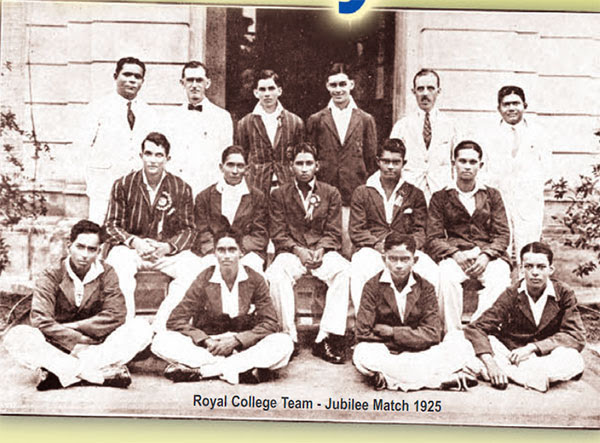
Malinda Seneviratne once observed that “the Royal-Thomian was not just a big match. It was THE BIG MATCH.” In 1979, this historical tradition celebrated its centenary. The Royal Team played under the captaincy of Ranjan Madugalle (who captained the Sri Lanka Team) and the S. Thomas’ Team played under the captaincy of Johan Peiris. It was after this that permission to hold the encounter for three days was granted, by the then President J. R. Jayewardene.
elanka

After Galle Face Green, the encounter was hosted in eventual succession at the Nomads Cricket Club in Victoria Park, the Colombo Oval, the Nondescript Cricket Club, and the Sinhalese Sports Club. Traditionally, the match has been played on Thursday, Friday, and Saturday.

The encounter has produced some of the country’s most prestigious personalities. The first Premier of Ceylon, D. S. Senanayake, captained the S. Thomas’ team in 1901 and 1902. The Senanayake Challenge Shield, as it came to be called then, was first played in 1928. In addition, the first Executive President of Sri Lanka, J. R. Jayewardene, played for Royal in 1925.

The Big Match season is one of the most anticipated periods in the Sri Lankan school calendar. The season consists of the Battle of the Blues, the Mini Battle, the Royal College Prefects vs S. Thomas’ College Prefects Match, the Teachers vs Prefects Match, the Cycle Parade, and others.

Of these the Cycle Parade occupies a special place among Royalists. Although there isn’t much information about its origins, there are reports that it was well established even in 1939. Back then it was only a “Cycle” Parade. Later, after the 1970s, it became a grand procession.

This blue-ribbon event in the school cricket calendar, the Great Inter-Collegiate Match, [recently celebrated] its 144th milepost. As Mervyn Casie Chetty once wrote, “In yearly friendly tussle – With rival tough and keen – The teams strain never and muscle – But fight the issue clean.” What one can look forward to in this encounter is celebration – not of victory, but of friendly rivalry.

Uthpala Wijesuriya is a history researcher. He can be reached at wijesuriyau6@gmail.com.

Click here to receive your free copy of the eLanka Newsletter twice a week delivered directly to your inbox!

Click here to receive your free copy of the eLanka Newsletter twice a week delivered directly to your inbox!

TAGGED:Chandana PanditharathnaNomads Cricket ClubRoyal-Thomian
Share This Article
Facebook Whatsapp Whatsapp LinkedIn Email Copy Link Print
Previous Article Cricket The Royal Thomian is the longest uninterrupted cricket series in the world
Next Article Diabetes - eLanka This bulletin focuses on managing type 2 diabetes and was created for Sri Lankans worldwide. – By Dr Harold Gunatillake
FacebookLike
YoutubeSubscribe
LinkedInFollow
Most Read
10 Pictures With Fascinating Stories Behind Them!

“A PICTURE SPEAKS A 1000 WORDS” – By Des Kelly

Look past your thoughts so you may drink the pure nectar of this moment

A Life Hack for when we’re Burnt Out & Broken Down – By Uma Panch

Narration of the History of our Proud Ancestral (Orang Jawa) Heritage. by Noor R. Rahim

eLanka Weddings

eLanka Marriage Proposals

Noel News

Noel News

Noel News

Noel News- By Noel Whittaker

Appreciation: Eileen Mary Sibelle De Silva

K.K.S. Cement Factory

Dr.Harold Gunatillake’s 90th Birthday party

Sri Lanka's women's cricket squad in Melbourne

Cricket: Sri Lanka’s women’s squad in Melbourne

- Advertisement -
Ad image
Related News
Articles Dr Harold Gunatillake

Enough magnesium in your body is really important and can truly help you prioritise your health. Magnesium plays a vital role in many bodily functions-by Harold Gunatillake

Lions Club Celebrates Avurudu with Music, Games, and Tradition-by Trevine Rodrigo
Articles Trevine Rodrigo

Lions Club Celebrates Avurudu with Music, Games, and Tradition-by Trevine Rodrigo

story of black dog
Articles

The Black Four-Legged Peace Walker: A Silent Guide on Day 4 in Sri Lanka

Ratnapura
Articles

“CITY OF GEMS” RATNAPURA Ratnapura, known as the “City of Gems” in Sri Lanka, derives its name from the Sanskrit words “ratna” (gemstone) and “pura” (town or city). As the hub of Sri Lanka’s gem mining industry. The name is derived from Sanskrit and Pali, languages that heavily influenced the region over 2000 years ago. The city earned this name because it has been the traditional center of Sri Lanka’s gem trade for over 2,000 years. It is the primary source of world-renowned precious stones, including blue sapphires, rubies, and cat’s eyes.Some historical accounts suggest a different origin linked to the Portuguese colonial era. There is a view that the name could be derived from the Portuguese word “Rapadura,” which refers to jaggery. Ratnapura is the heart of Sri Lanka’s gem industry, often called the “gem capital of the world” due to its incredible geological wealth and ancient trading history. The region is famous for producing over 40 of the 85 known gemstone varieties in the world. The most famous is the “Ceylon Sapphire,” prized for its vivid cornflower and royal blue hues. Other varieties include yellow, pink, and the rare orange-pink Padparadscha. Specialty Stones: Includes the rare Alexandrite (which changes color in different light), Cat’s Eye Chrysoberyl, Spinel, Tourmaline, Garnet, and Moonstone. The sapphire in Princess Diana’s Iconic engagement ring is a Ceylon sapphire from the Ratnapura area. Many world-renowned gems were unearthed in the Ratnapura district. One of the largest faceted blue sapphires ever found in Ratnapura, Blue Giant of the Orient is over 465 carats. The city features remains of a Portuguese-Dutch Fort, which now houses the National Gem and Jewellery Authority. Ratnapura is the starting point for the “classic” hard route (Gilimale route) to the sacred Sripada. Ratnapura district is home to a significant number of spectacular waterfalls, often described as having the highest concentration of waterfalls in Sri Lanka. – By Francis Paul Welangoda

Kirindi Ella Falls
Articles

Kirindi Ella Falls: Sri Lanka’s Majestic Multi-Tiered Wonder in Ratnapura – By Francis Paul Welangoda

  • Quick Links:
  • Articles
  • DESMOND KELLY
  • Dr Harold Gunatillake
  • English Videos
  • Sri Lanka
  • Sinhala Videos
  • eLanka Newsletters
  • Obituaries
  • Sunil Thenabadu
  • Dr. Harold Gunatillake
  • Tamil Videos
  • Sinhala Movies
  • Trevine Rodrigo
  • Photos
  • eLanka Newsletter

eLanka

Your Trusted Source for News & Community Stories: Stay connected with reliable updates, inspiring features, and breaking news. From politics and technology to culture, lifestyle, and events, eLanka brings you stories that matter — keeping you informed, engaged, and connected 24/7.
Kerrie road, Oatlands , NSW 2117 , Australia.
Email : info@eLanka.com.au / rasangivjes@gmail.com.
WhatsApp : +61402905275 / +94775882546
  • About eLanka
  • Terms & Conditions

Disclaimer:
eLanka is committed to sharing positive and community-focused stories. We do not publish or endorse political, religious, or ethnic viewpoints. The content published on eLanka, including articles and newsletters, reflects the opinions and views of the respective authors and not those of eLanka. eLanka accepts no responsibility or liability for the accuracy, completeness, or consequences of any content provided by contributors.

(c) 2005 – 2025 eLanka Pty Ltd. All Rights Reserved.