Wattamadu Grassland – center of an intensifying land-use conflict By Arundathie Abeysinghe

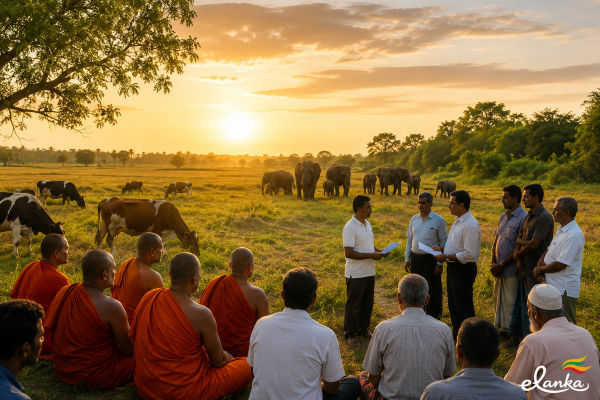
Along with Ven. Senapathiye Ananda, President of the Northern and Eastern Sinhala Organization, several Buddhist monks, members of the Wattamadu Dairy Farmers’ Association and some officials of the Alayadivembu Livestock and Dairy Farmers Agriculture Co-operative Society in Ampara District (Eastern Province) submitted a complaint to the Ampara District Office of the Human Rights Commission of Sri Lanka on June 27, alleging about a conspiracy to deprive them of their rights to the Wattamadu grassland. In 1974, Wattamadu Grassland had been allocated to dairy farmers by the then government through a Gazette. Covering an extent of 4,000 acres (approximately 1618 hectares), this is the only grassland in the Wattamadu area of Akkaraipattu in Ampara District.
If this were to happen, human rights of around 300 Sinhala, Tamil and Muslim dairy farmers engaged in cattle farming would be violated. The location is under the jurisdiction of the Thirukkovil Divisional Secretariat where dairy farmers and paddy farmers are at odds over access to grazing lands. It also serves as a crucial habitat for 250–300 wild elephants, preventing them from wandering into adjacent villages.
In 1972, the Department of Surveys demarcated and marked the boundaries of grazing land in the area. In 1974, Wattamadu was declared a designated pasture land covering 3,850 acres through boundary markings, maps and written orders.
The main issue for dairy farmers is that external crop cultivators have acquired traditional grazing lands as a whole. For centuries, these grasslands have served as crucial feeding grounds for dairy cattle. Yet, due to political interference by previous governments, the lands were forcibly taken over, frequently going against court orders in the process.
After submitting the complaint to the Ampara District Office, Ven. Senapathiye Ananda spoke to the media and said that “Wattamadu grassland, which had been allocated to dairy farmers has, following the period of terrorist conflict, become the target of attempts by an organised group to forcibly seize it and drive the dairy farmers away. If the grassland, home to over 30,000 dairy cattle, livelihoods of approximately 300 dairy farming families would also be placed at risk, including the lives of cattle that would be deprived of food and care.”
According to dairy farmers “in 2015, paddy farmers claiming ownership of the grassland had produced 525 land permits, claiming they had been issued by the Thirukkovil Divisional Secretariat. Yet, the Assistant Land Commissioner of Ampara had confirmed that those permits were forged and legally invalid. Instead of taking action against those who had allegedly attempted to fraudulently acquire state land, efforts are currently being made to allocate the mentioned land to them.”
“As the District Secretary granted unauthorized paddy farmers permission to cultivate portions of the land, this has led to conflicts among dairy farmers and paddy farmers, with dairy farmers and clergy staging protests to protect the pastures from being converted into rice paddies.”
According to senior officials of the National Livestock Development Board (NLDB), “the grassland provides habitat, protection and food to dairy cattle, and wild elephants. If this land is taken away from dairy farmers and distributed among paddy farmers, these wild elephants will also lose their habitat which will result in a human-elephant conflict as elephants may begin entering villages, resulting in serious destruction. If dairy farmers lose the grassland allocated to them, they will have no alternative but to graze their cattle in government forests. While the land was surveyed and gazetted in 1970s, entry to the areas was temporarily restricted during the civil war. While designated for pasture, it was never formally handed over to the Ministry of Livestock.”