World Tourism Day 2026: Sri Lanka Backs AI-Driven Tourism as ‘Around the Island’ Brings Nihal Sangabo Dias to Colombo

Image Source : bizenglish.adaderana.lk
Sri Lanka’s World Tourism Day 2026 programme has presented a compelling combination of technological ambition and cultural authenticity, with the Sri Lanka Tourism Development Authority placing artificial intelligence at the centre of the sector’s future while ITC Ratnadipa has chosen to celebrate the island through the paintings of Sri Lankan artist Nihal Sangabo Dias.
Together, the two initiatives indicate how Sri Lanka’s tourism industry is seeking to modernise its systems without losing sight of the landscapes, communities and everyday experiences that give the island its distinctive character. For visitors, the approach promises more responsive and personalised experiences; for Sri Lankans living overseas, it offers a contemporary view of a country whose identity continues to be shaped by both innovation and memory.
National World Tourism Day celebration places AI at the centre
The Sri Lanka Tourism Development Authority hosted the National Celebration of World Tourism Day 2026 on Friday, 25 September, at the Taj Samudra in Colombo. The event was conducted under the global theme, ‘Digital Agenda and Artificial Intelligence to Redesign Tourism’, and brought together representatives from government, the tourism industry, the private sector, academia, and technology and innovation communities.
The programme highlighted the transformative role of digital technologies and artificial intelligence in reshaping tourism, improving visitor experiences and creating new opportunities across the industry. Rather than presenting technology as a narrow administrative tool, the event positioned it as an instrument capable of influencing destination management, service delivery, marketing, accessibility and the way visitors engage with Sri Lanka.

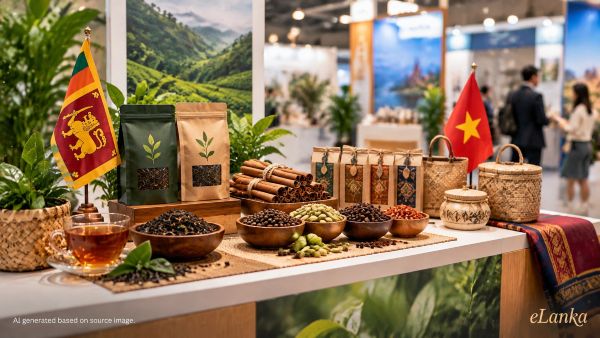
AI-generated illustration based on the supplied source material, representing collaboration between Sri Lanka’s tourism, technology and innovation sectors.
The emphasis is significant because tourism now depends upon a connected chain of services, ranging from the discovery of a destination and the booking of accommodation to navigation, interpretation, customer assistance and post-visit engagement. Artificial intelligence can support this chain by helping tourism organisations understand visitor needs, improve the distribution of information and develop more personalised experiences, provided that innovation is accompanied by responsible governance and appropriate protection of data.
According to the programme, Sri Lanka Tourism aims to strengthen the country’s competitiveness, improve destination management, enhance service delivery and create personalised visitor experiences through digital transformation. Such objectives are particularly relevant to an island with a wide range of tourism assets, including historic cities, religious sites, wildlife reserves, beaches, tea-growing regions, village communities and creative industries.

AI-generated illustration based on the supplied source image, featuring a contemporary Colombo hotel gallery and Sri Lankan-inspired artwork.
Tourism Start-Up Competition showcases local innovation
A key feature of the national celebration was the Tourism Start-Up Competition 2026, conducted under the theme ‘AI-Driven Innovation for the Future of Tourism’.
The competition attracted 52 applications across two categories: Tertiary Level and Commercial Level. The response demonstrated the creativity and entrepreneurial spirit of Sri Lanka’s youth and tourism innovators, while also indicating that artificial intelligence is being considered by emerging entrepreneurs as a practical means of addressing challenges within the visitor economy.
Following rigorous evaluation, 25 applications were shortlisted for the final stage. The shortlisted participants presented their AI-powered tourism solutions before an expert panel, allowing the ideas to be examined not only for their technical originality but also for their potential relevance to Sri Lanka’s tourism environment.
Ultimately, six winners from each category were selected, and the successful participants were formally honoured during the World Tourism Day celebration. The competition therefore served two purposes: it recognised promising solutions and created a public platform through which young innovators and commercial developers could contribute to the national conversation about tourism’s future.

AI-generated illustration based on the supplied source material, depicting the Tourism Start-Up Competition’s innovation-focused atmosphere.
The collaboration represented at the event is equally important. Sustainable digital development cannot be achieved by one institution operating alone, and the programme stressed the need for cooperation among the public sector, private enterprises, academic institutions and the technology community.
This partnership model could help ensure that future digital tools are grounded in the practical realities of Sri Lankan tourism, including the needs of small businesses, local guides, artists, accommodation providers, transport operators and communities located beyond the country’s principal urban centres. If effectively implemented, such an approach may enable technology to distribute opportunity more widely rather than concentrating its benefits within a limited number of established organisations.
‘Around the Island’ presents Sri Lanka through an artist’s eyes
Alongside the technology-led national celebration, ITC Ratnadipa has marked World Tourism Day through a quieter but equally meaningful cultural initiative. The hotel is presenting ‘Around the Island’, an exhibition by artist Nihal Sangabo Dias, at the WelcomGallery of ITC Ratnadipa from 25 September to 11 October 2026.
The exhibition presents Sri Lanka as a place that is observed, remembered and continually reinterpreted, rather than as a fixed landscape prepared solely for consumption by visitors. Dias’s work captures fishermen, village life and the landscapes of Galle and Kandy, drawing attention to the human presence and everyday settings through which the country is most authentically experienced.
The exhibition’s setting is also noteworthy. A luxury Colombo hotel is being used as a gallery and meeting point, allowing the work of a Sri Lankan artist to be encountered by local audiences as well as international travellers staying at ITC Ratnadipa. In this context, art becomes an additional form of cultural interpretation, complementing the formal systems of tourism promotion with personal observation and artistic memory.
Dilshi Fernando, Head of PR & Marketing at ITC Ratnadipa, said:
> “Since its launch in April this year, WelcomGallery has been envisioned as a platform for Sri Lankan artists to showcase their work to a wider audience, including the global travellers who visit ITC Ratnadipa. This exhibition is particularly special to us as it coincides with World Tourism Day. Through ‘Around the Island’, we celebrate the work of Nihal Sangabo Dias, who captures the beauty of Sri Lanka in its simplest and most authentic form, from fishermen and village life to the landscapes of Galle and Kandy. His work reminds us that the essence of Sri Lanka lies in these everyday moments and places. We warmly invite everyone to experience the exhibition and see our island through his eyes.”
Dias has described the purpose of the exhibition in similarly personal terms:
> “I hope these paintings offer a glimpse of Sri Lanka from the way I’ve seen its beauty, character, colours and the moments that have stayed with me. Through my work, I hope viewers will pause and look at the island a little differently, finding their own connection with the places, people and stories that make Sri Lanka so special.”
The exhibition is open for complimentary viewing, making it accessible to hotel guests, residents of Colombo, members of the global Sri Lankan community and visitors seeking a cultural experience beyond conventional sightseeing.
Technology and culture working together
The two World Tourism Day initiatives represent different methods of presenting Sri Lanka, but they are not contradictory. Artificial intelligence can help visitors discover, plan and navigate experiences, while art can deepen the meaning of those experiences by revealing the emotional and human dimensions of place.
For Sri Lankans living in Australia, the United Kingdom, Canada, New Zealand, the United States and elsewhere, this combination offers an encouraging picture of national progress. The island is being presented not only as a destination of natural beauty and heritage, but also as a country capable of developing new technologies, supporting young entrepreneurs and giving its artists a platform to reach wider audiences.
The central challenge will be to ensure that digital advancement remains connected to local identity. Sri Lanka’s strongest tourism proposition lies in the relationship between its natural environments, living traditions, creative talent and welcoming communities. Artificial intelligence may improve access and efficiency, but it is the distinctive character of the island that gives those systems something meaningful to communicate.
World Tourism Day 2026 has therefore offered a balanced message: Sri Lanka’s tourism future can be digitally enabled, commercially competitive and technologically ambitious, while still being grounded in the fishermen, villages, hills, historic cities and everyday moments that continue to define the island.
This article was written based on the sources https://bizenglish.adaderana.lk/sri-lanka-tourism-celebrates-world-tourism-day-2026-embracing-digital-transformation-and-artificial-intelligence/ and https://www.lankabusinessnews.com/itc-ratnadipa-celebrates-world-tourism-day-with-around-the-island-by-artist-nihal-sangabo-dias/, kindly email us at info@eLanka.com.au if any information needs to be corrected.
At eLanka, we respect the rights of creators. If we have used an image you own and you’d like it removed, please email us at info@elanka.com.au and we’ll handle it promptly.