The Ceylonese gypsy: the vanishing clan?-by Dishan Joseph
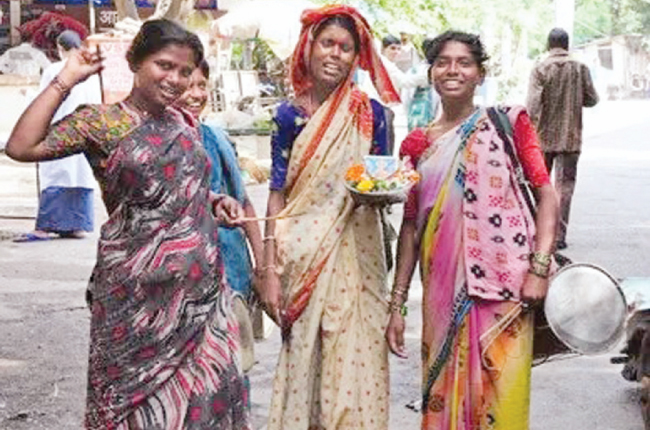
Image Source:Dailynews
Source:Dailynews
From snake charmers to shadowed memories
Secrets of Sri Lanka’s forgotten nomads
To many of us, one of the familiar sights around Colombo city were the sasthara women walking about with the proud proclamation of being able to tell your future by reading your palm. The women often aged between twenty and forty years were clad in printed sarees with their lips stained red by chewing beetle and wearing a mookuthi (nose ring). At times they were accompanied by males who displayed their prowess at ‘charming’ deadly snakes, including the King Cobra.
Other men with a cheerful spirit would mesmerize the children using a trained monkey: the creature performed a routine of stunts and then brought forth a hat to collect his dues. The few seniors from the ‘Ceylon’ vintage I have met talk about their gypsy encounters. So where are the mystic gypsy women and men now?
There is no recorded history about the entry of this clan of people. We can only ascertain they spoke Telugu and came from Andhra Pradesh, India. With time, they were classified as the Ahikuntika clan, the word deriving from Ahi which means serpent. The gypsy men were experts at snake charming. For decades they have lived as outcasts and nomads, in makeshift tents having no access to education.
Tracing gypsy roots
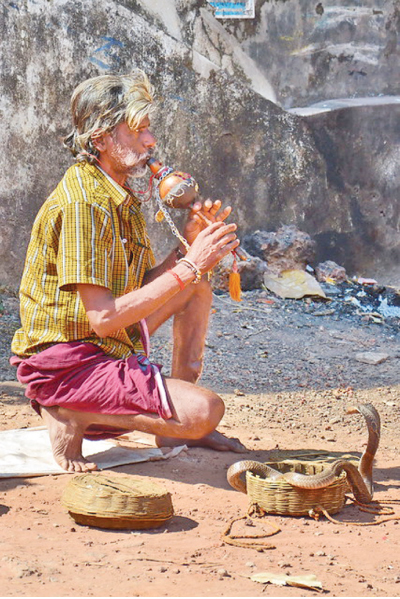
Image Source:Dailynews
India is a mega mix of many ethnic groups and perhaps the gypsies from old Ceylon came from the
Sapera clan in North India. Again, this tribe was considered an outcast in Hindu society. The gypsy tribe of Rajasthan is one of the nomad or vagabond communities in India. The origin of the tribe dates several centuries back. The people of this Rajasthan tribe belong to the lowest step of the socio-cultural and socio-economic ladder. They live a nomadic life and travel like a caravan from place to place. There is no permanent residence for them. They sleep under the open sky sometimes and in the shade of trees at times. The Bopa and the Kalbeliya are two surviving groups of the gypsy tribe. The Bopa is a group of musicians and singers, whereas the Kalbeliya is a group of dancers and snake charmers.
The entire village earned a living by snake charming and the selling of anti-venom. While it is difficult to find members of the ‘original’ clans we can find clusters of gypsy families residing in the remote villages of Anuradhapura, Akkaraipattu, Nawalapitiya, Puttalam, Chilaw, Trincomalee and Avissawella.
Some opine that the gypsy clan is somehow connected to the Rodiya, an old nomadic clan who later began to speak Sinhalese. It is assumed that the word Rodiya is from the Sanskrit word ‘rudra’ which means hunter. Similar tribes were found in Eastern India. The legend of the Rodiya is very bizarre as it has to do with an ancient Princess Ratnavalli. A hunter used to deliver venison to the palace and one day he is said to have given the king the flesh of a young boy. Thereafter Ratnavalli had desired to eat this meat again and the hunter obliged. When the king found out the truth, he is said to have banished his daughter and given her in marriage to a scavenger. The Rodiya are said to be her offspring. There is no evidence to prove this story. We can observe that the Rodiya never took the trade of charming snakes, like the Ahikuntika men.
Since ancient times, snakes have been associated with many cults and fertility rituals. Egyptian Pharaohs employed magicians and sorcerers. In the Old Testament of the Holy Bible, we find that the wise men of Egypt had mastered the art of controlling serpents. In later chapters, the Bible condemns and warns about dealing with fortune tellers and mediums (Leviticus 19.31 and Deuteronomy 18: 10-12). Women belonging to ancient cults used to dance seminude with serpents dangling on their shoulders. We cannot learn how these skills were mastered by the gypsy men. However, it is safe to assume that it was somehow passed down from the generations, perhaps, similar to the manner in which mahouts learn to control wild elephants.
We all thought that the snakes were captivated by the long notes of the flute (pungi) used by the gypsy. Today, we realize that snakes don’t have external ears, they only feel certain low-frequency rumbles. Herpetologists agree that the swaying motion of the reed flute captures the total attention of the serpent as he rears from the cane basket: he perceives this as a pending threat, although he has no capacity to inflict danger as the gypsy often removes the poison-laden fangs. So, the snake really gazes at the flute and is not really ‘charmed’ by the music. In India, this practice has brought much criticism from animal rights groups.
Palmistry in the tropics
Many Sri Lankans are obsessed with knowing what the future holds for them. It is the same in other nations, including the West. In the latter, the fortune-telling is done by sophisticated clairvoyants in air-conditioned comfort! Coming back to the sun-tanned ‘sasthara’ women they simply attempt to predict the future by reading a human’s dominant palm. The study of palm lines (chiromancy) has existed in ancient India, China, Persia, Tibet, Babylon and Palestine. The gypsy women look at seven lines on the hand: lifeline, head line, heart line, Venus line, sun line, Mercury line and fate line.
The Hindu sage Valmiki is said to have written 567 stanzas on the human palm lines. Back in the day, the gypsy accepted a portion of paddy or coconut as payment but with time, they began soliciting money. I have heard, that if the desired amount was not given the gypsy women would curse the client!
It is a strange twist that these clans who foretold the future of others did not realize that they would soon be reduced to memory. I have noticed a few ‘duplicate’ fortune tellers, trying to copycat the gypsy women (similar to the fake Veddah). Apart from the trades of snake charming and palm reading the gypsy community had no income: although some descendants of intermarriage are employed as labourers in the salterns of Puttalam. Others have taken to fishing and some odd jobs. The gypsy community had their own rites and rituals. Some spoke Tamil and some Sinhalese. We cannot establish their eating habits or native cuisine. We know for a fact that they have disappeared from Colombo city.