Trump’s War Talk vs Iran’s Strategic Depth-by K.K.S Perera

Source:Dailymirror
War has entered the second month. Donald Trump repeated his assertion that he is in talks with Iran to end the ongoing war, a claim Tehran denies. He went further, claiming that Iranian leaders had suggested he become their next Supreme Leader. The remark raised eyebrows and prompted widespread debate about his mental fitness. The world is in turmoil. From the bold claims of Donald Trump to the escalating U.S.–Israeli war on Iran, global politics is unpredictable.
Trump’s modus operandi, appearing to extend a hand for peace while preparing to strike with the other, now convinces very few. The much-touted pause in hostilities seems less a genuine diplomatic opening and more a logistical breather, despite his claim that Iran requested a seven day-pause while he “generously” offered ten. He has even gone so far as to rename the Strait of Hormuz after himself. Yet experts caution against rushing to judgement. Dr. Allen Frances, a leading psychiatrist who helped draft the Diagnostic and Statistical Manual of Mental Disorders(DSM), insists Trump does not meet the criteria for mental illness. According to Frances, what seems odd or exaggerated is better seen as political strategy.
Frances warns against the trend of using terms like narcissism or delusion around in political debates without medical basis. Trump’s use of provocative statements, from questioning Obama’s birthplace to attacking Hillary Clinton, has long been part of his playbook. His style is not a sign of decline but a method to capture attention and connect with audiences. In Frances’ view, Trump is “clever like a fox,” wielding words, controversy, and perception to his advantage.
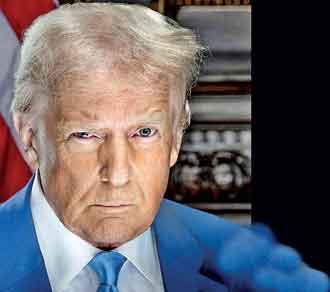
Trump’s style is not a sign of decline but a method to capture attention and connect with audiences
Machiavelli and the Modern Leader
Trump’s approach invites comparison to Niccolò Machiavelli, who advocated for strategic use of fear, control, and moral flexibility to maintain power. Both prioritise influence, yet differ in method. Machiavelli valued careful planning and state stability, while critics argue Trump acts impulsively, flouting norms that Machiavelli considered essential.
In today’s populist moment, sometimes called a “Cultural Backlash,” revisiting Machiavelli helps us understand the mechanics of modern leadership. Would the Florentine political thinker have considered Trump a “great prince”? Machiavelli’s lens shows how ambition, self-interest, and the manipulation of love, hate, and fear can shape leaders, lessons that are politically relevant for everyone, not just historians.
Middle East on Edge
American military power faces a determined and well-planned Iranian strategy. Third world nations like Sri Lanka find themselves walking a tightrope. How to survive in a world where power, perception, and conflict intersect has never been more urgent.The United States has proposed a 15-point ceasefire plan, which Tehran rejected outright. Observers note the plan offered no real compromise, reading more like a demand for surrender. Iran countered with its own conditions, including guarantees against future aggression, removal of U.S. military bases, and compensation for war damages. The gap between the two sides makes a ceasefire unlikely in the near term.
Trust remains a major obstacle. Iran questions whether the U.S. would honor any agreement, recalling past betrayals during prior talks. Israel appears to pursue a separate, long-term strategy, aiming not just to win the war but to reshape the region for strategic advantage.
Risk of Wider Conflict
The war’s potential to escalate is real. Pakistan, bound by a newdefence pact with Saudi Arabia, where an attack on one is treated as an attack on the other, could be drawn in. Pakistan currently acts as a mediator, attempting to broker peace, but escalation would force it into a delicate balancing act. On one hand, it faces treaty obligations to Saudi Arabia; on the other, it must weigh its relationship with China and the risk of internal unrest.
Domestic factors matter. Pakistan hosts one of the largest Shia populations outside Iran, while anti-U.S. sentiment among Sunni Muslims runs high. Many believe the U.S. and Israel are the principal adversaries of the Muslim world.
The Myth of Neutrality in a Time of Quiet Deals
Even distant from the battlefield, Sri Lanka has been drawn into the wider geopolitical tension. The government allowed two stranded Iranian ships to shelter in its ports while reportedly refusing a U.S. request to land military aircraft at Mattala Airport. These decisions reflect a cautious effort to maintain balance in a highly polarised environment.
Sri Lanka’s history offers lessons. War, once begun, is hard to control and harder to end. It drains resources, divides societies, and leaves lasting scars. For a small nation, avoiding external entanglement while strengthening internal stability is critical.
Many have praised Sri Lanka’s neutrality generously. But how neutral is neutral, really?
Reports have surfaced of a quietly negotiated agreement between Colombo and Washington, the precise terms of which remain undisclosed. It would not be the first time a small nation performed neutrality for the cameras while making very different arrangements behind closed doors.
True neutrality is the rarest condition in international affairs. Every small nation is aligned. The only question is how carefully it conceals the fact.Sri Lanka’s priority today is economic survival. The country is implementing IMF-backed reforms to rebuild reserves, reduce debt, and restore investor confidence. Any hint that it is taking sides in global conflicts could harm trade, investment, and recovery.Neutrality allows Sri Lanka to maintain constructive relations with energy suppliers in the Middle East, development partners like China, regional ties with India, and markets in the U.S. and Europe.
Neutrality does not mean silence. Sri Lanka can advocate for peace, dialogue, and international law, as it has historically. Practically, it requires careful diplomacy, transparency in port use and maritime security, and domestic resilience, energy security, food supplies, and diversified trade, to withstand shocks. Without internal strength, neutrality alone is insufficient.
Similarly, studying Trump through a Machiavellian lens shows how power, perception, and strategy operate in modern leadership.
Conclusion
In a world of escalating wars, nationalist populism, and economic uncertainty, understanding leadership and strategy is crucial. Trump’s political maneuvers reveal how ambition and perception can dominate discourse, while Sri Lanka’s careful neutrality illustrates how prudence, diplomacy, and internal resilience can safeguard national interests. From Washington to Colombo, the message is the same: in a complex and turbulent world, survival depends on strategy, balance, and the wisdom to act without being swept away by forces beyond one’s control.
Iran, often called the “land of the Aryans,” has a long and resilient history. For centuries, it has survived the rise and fall of empires—from the Persians to invasions by Alexander the Great and the Mongols, and later the decline of the British, Russian, and Ottoman empires.
Even today, removing leaders does not stop the system. Iran’s decentralised command allows it to keep fighting without relying on a single authority. This resilience worries strategists, as it makes Iran not only dangerous to provoke, but also hard to predict and control. However, given the strain on resources, logistics, and missile stocks on both sides, the conflict is unlikely to drag on indefinitely and may reach a breaking point within a month.