Hyperscale consumption on Weddings in Sri Lanka-by Harold Gunatillake

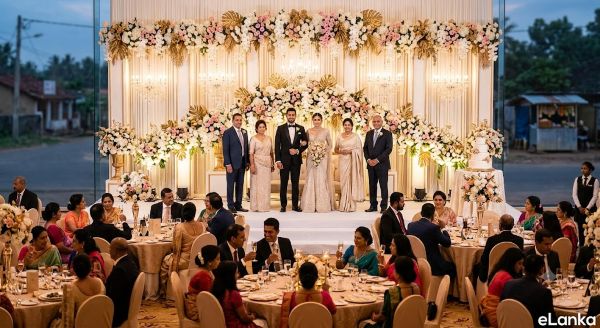
Chandre Dharma-wardana from Canada writes: Dr Harold Gunatillake’s article on a luxury wedding, and Janaka Perera’s intervention using an example of a “modest wedding” have given us an opportunity to review the question of hyperscale consumption and expenditure in luxury weddings and Tanashas that have become an increasing feature of Sri Lankan society even as it is in the process of moving down the precipice towards economic disaster, with the Rich-Poor gap becoming hyperscale. Today, even poor villagers’ parents are forced to celebrate children’s birthdays! This is also compounded by the demographic inversion that took place in 2022, examined in Dr. de Silva’s book on Sri Lanka’s demographic Doom at the University of Colombo.
Dr. Harold Gunatillake’s account was in the context of a wedding of one of his own family members, and hence it is not the moment, for him, to discuss the big picture. Furthermore, as the wedding was between two hotelier families, the expenses may have been much less than for those not in the business.
However, for us, he has opened the door for a very important discussion. Here I attach the summary of a longer analysis that I have written. It will be published elsewhere. The summary is given below.
Summary: Hyperscale Luxury weddings in Sri Lanka cost between US$50,000 to $80,000 for a one day event. While destination weddings from foreigners and expats may bring in some income, the trend to imitate the rich and to have pride weddings and dowries have been a crippling feature of South Asian society that is aggravated by these hyperscale consumption weddings. They set the trend even for other hyperscale birthday parties and celebrations. These are in stark economic and moral contradiction with the increased poverty and the rich-poor gap in these societies. In Sri Lanka, the recent Ditwah cyclone has left parts of the country crippled: (i) with 114,000 houses damaged or buried under mud, with nearly (ii) 65,000 households remaining displaced and unable to rebuild, (iii) more than 16,000 kilometres of roads and 480 road bridges were damaged or completely washed out, permanently bottlenecking economic recovery, (iv) 243 hospitals and medical facilities destroyed and still `under repair’. All these need continued attention but ignored by the government and local initiatives that have dried down. A similar contradictory situation exists in India, Pakistan etc., where charity and good will are mere empty words coupled with the extreme luxury of the 1% elite, loud and greedy. While the state struggles to find liquidity, elite “hyperscale” weddings continue to drain Sri Lanka’s fragile foreign exchange (FX) reserves – the Elites pressure polticians to import luxury cars while govt.
hospitals lack medicine. Lavish weddings are highly import-heavy. Everything from premium alcohol, imported gourmet foods, foreign event lighting, luxury fabrics, and international floristry, to the gasoline burned by large guest motorcades, requires spending scarce US dollars. Pakistan Government has introduced taxation to direct the profits from such luxury weddings to local development and disaster recovery. The Sri Lankan government also should introduce taxation for weddings exceeding $25,000 and use the money to set up a national disaster relief fund, to sensitize the elite rich to the tragedy facing Sri Lanka.
An additional narrative discusses the economic downturn of a country, emphasising that citizens should refrain from extravagant celebrations, as conveyed by expatriate Sri Lankans. When the nation demonstrates substantial progress and improved living standards, it is appropriate to celebrate personal milestones such as weddings. The subsequent article excerpt, however, is unrelated to Sri Lankan families celebrating such events.
The above article is entirely irrelevant when Sri Lankans observe weddings in accordance with their financial means.
Sri Lanka’s Economic Turnaround and the Debate on Social Spending: Why Personal Celebrations Must Be Seen in Context
Written by Dr harold Gunatillake as a reply to the above article forwarded by Chandre dharma-wardena from Canada.
Overview: Sri Lanka enters the second half of 2026 with a mixture of hard-won economic progress and persistent social anxieties.
The latest figures from the Ministry of Finance and the Export Development Board (EDB) reveal a nation that is gradually regaining economic momentum, even as public discourse continues to wrestle with questions of consumption, inequality, and cultural expectations. The tension between these two realities
— measurable national recovery and lived social pressures — forms the heart of the current debate on weddings, celebrations, and so-called “hyperscale consumption.”
A Nation Spending More — Because It Is Doing More
The 2026 Budget Presentation estimates Sri Lanka’s total government expenditure at Rs. 7,057 billion (LKR 7.06 trillion). This figure exceeds the Rs. 6,131 billion spent in 2024 and is marginally below the Rs. 7,190 billion allocated for 2025. The increase does not indicate excess but rather reflects the unavoidable costs of operating a modern state emerging from a crisis: debt servicing, public-sector remuneration, social protection, and development commitments.
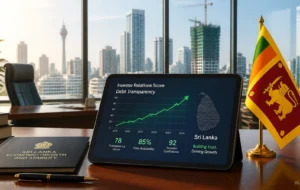
This growth in expenditure must be considered in conjunction with the country’s improving external sector performance. Sri Lanka’s total exports surpassed US$ 9 billion in the first half of 2026, with merchandise exports increasing by 8.95% year-on-year and services exports rising by 4.49%. The aggregate figure of US$ 9,012.24 million for January–June 2026 represents an 8% increase relative to the same period in the previous year.
These figures are significant. They indicate that Sri Lanka is not descending into economic despair; rather, it is making progress in recovery.
Economic Recovery and Personal Celebration: A Misplaced Critique
Against this backdrop, a concurrent discourse has arisen, predominantly propagated by expatriate Sri Lankans and social commentators: that citizens should refrain from extravagant celebrations, especially weddings, during periods of national hardship. This assertion reemerged subsequent to Dr. Harold Gunatillake’s personal recounting of a family wedding and Janaka Perera’s contrasting illustration of an understated ceremony. Nevertheless, this discussion is founded upon a flawed premise.
1. Personal celebrations do not determine national economic outcomes.
A wedding — whether modest or luxurious — does not influence macroeconomic indicators. It does not impact debt restructuring, export performance, or fiscal consolidation.
- Families celebrate according to their
Sri Lankans have consistently tailored their celebrations to align with their financial means. A hotelier family organising a wedding within its own industry context cannot be equated with a rural family facing financial hardships due to rising costs. To conflate these two scenarios is intellectually dishonest.
- Cultural celebrations are not “hyperscale ”
Weddings, birthdays, and religious ceremonies are deeply embedded in Sri Lankan life. They are expressions of identity, continuity, and community. To label them as irresponsible consumption ignores their cultural significance.
4. Economic recovery should promote individual achievements rather than hinder them.
When a nation begins to demonstrate progress—such as increasing exports, stabilising fiscal indicators, and enhancing investor confidence—it is natural for families to experience a sense of hope sufficient to celebrate life events.
The Fundamental Issue: Societal Pressure, Not Personal Choice
The more significant discourse resides elsewhere: the increasing societal pressure on families, particularly in rural regions, to organise lavish events beyond their financial capabilities. This phenomenon is not instigated by national economic policies nor by individual families with ample spending capacity. Instead, it is propelled by:
- Enhanced status competition driven by social media
- Commercialisation of cultural traditions
- The expanding disparity between the wealthy and the impoverished
- Demographic transformations and evolving family configurations, including the “demographic inversion” emphasised by de Silva
These represent sociological issues rather than economic transgressions. They necessitate community awareness and engagement, rather than moral shaming of families celebrating within their means.
Why the Critique of Luxury Weddings Misses the Point
The article criticising luxury weddings — invoking “hyperscale consumption” and “economic disaster” — is misplaced for several reasons:
- It conflates individual spending with national economic collapse, which is analytically
- It uses extreme examples to generalise about Sri Lankan
- It ignores the fact that many families in hospitality, tourism, and business sectors have access to venues, services, and networks that drastically reduce
- It fails to acknowledge that Sri Lanka’s economic indicators in 2026 show improvement, not
Most importantly, it is irrelevant to the lived reality of Sri Lankans who celebrate weddings according to their own financial capacity — not according to critics’ standards.
A More Balanced Perspective
Sri Lanka’s economic recovery is gradual yet tangible. Export activities are on the rise, and government expenditures continue to reflect essential national functions. Meanwhile, families persist in celebrating life events in accordance with their cultural values and financial capacities.
The primary discourse should focus on:
- Promoting financially responsible celebrations
- Alleviating social pressures on low-income households
- Encouraging community-based and affordable alternatives
- Acknowledging that personal joy does not constitute a national financial burden
Weddings, birthdays, and cultural ceremonies should not be regarded as signs of economic irresponsibility. Instead, they symbolize hope—a vital element for a nation in the process of rebuilding.
Conclusion
Sri Lanka’s progress in 2026 demonstrates resilience, discipline, and gradual recovery. In such a context, personal celebrations —
whether modest or grand — are not only acceptable but meaningful. They reflect confidence in the future.
The critique of luxury weddings is therefore misplaced. Sri Lankans will, and should, celebrate according to their means. What matters is not the scale of the celebration, but the stability of the nation — and the data shows that Sri Lanka is moving in the right direction.
End