A Tribute to Sir Christopher Ondaatje – A Diagonal Journey across Sri Lanka-by Lalith Seneviratne
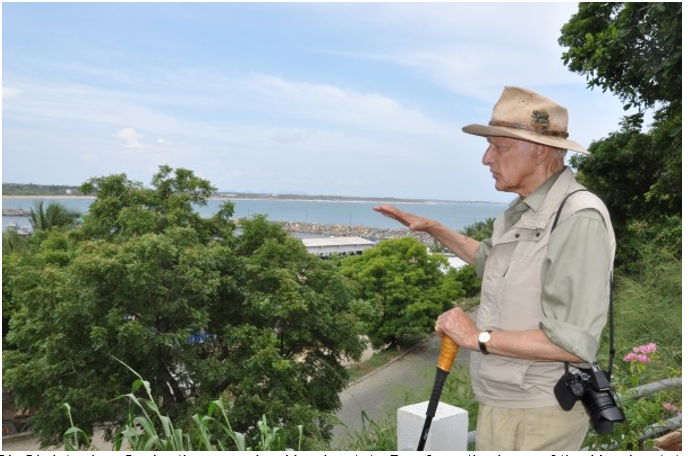
Sir Christopher Ondaatje surveying Hambantota Bay from the lawn of the Hambantota Resthouse – where he remarked that it was “probably the place that brings back most memories****”
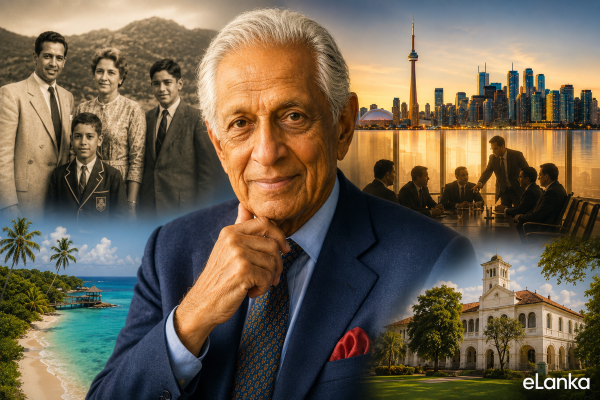
Sir Christopher Ondaatje was an enigmatic and illustrious figure, remembered as a financial magnate, a passionate explorer, a celebrated author, and perhaps the greatest ‘Global Ceylonese’. Born in Ceylon on 22nd February 1933, he left his homeland in 1947 to attend school in England. After spending five years in the City of London, he moved to Canada, where he built a vast fortune—first in finance, and later in publishing. At the height of his financial power, he bravely sold all his companies to return to his first passions: writing and exploration. His passing on 20th July 2026 marks the end of an era, but his profound legacy endures through his extensive literature, his philanthropy, and his devoted family.
I first met Christopher in 2004 when I was in London. He comes from the famous Ondaatje family. He has written a number of books, but the book closest to his heart was The Man-Eater of Punanai (1992), which recounts the tale of a man-eating leopard that terrorised the tiny village of Punanai in the early 20th century until an English tea planter, Shelton Agar, shot it.
Far from being only the story of this cunning leopard, Ondaatje uses the narrative of his return to Sri Lanka after thirty-eight years to pick up the pieces of his early family life. He uses the story of the man-eater as a metaphor for his relationship with his tyrannical but much-loved father. It is a classic parable and love story that has sold over a hundred thousand copies, describing a way of life that has now completely disappeared on the island he loved so much.
Christopher was a man of many colours. Although recognized as a respected Dutch-Burgher family, the Ondaatjes are in fact Brahmins from North India who followed Shah Jahan (who reigned from 1628 to 1658) and conquered South India. The original
Ondaatje was a man in Shah Jahan’s court who eventually became Physician to the King of Tanjore (present-day Thanjavur). In 1659, when the wife of the Dutch Governor of Ceylon, Adriaan van der Meyden, became incurably sick—presumably from cholera—he sent for Ondaatje, who came to Ceylon and cured her. In return, the Governor gave Ondaatje substantial land in Kotte. Ondaatje stayed on the island, married a Portuguese lady in court named Magdalena de Crooz, and thus began the Ondaatje dynasty. His original name was Ondachi, but he converted to Christianity, and the family became known for their intellect and commitment to literature, learning, and religion. One of his descendants was even the first person to translate the Bible into Tamil. The Ondaatjes frequently intermarried with Europeans, and almost certainly the most famous historical Ondaatje was Peter Philip Juriaan Quint Ondaatje. He left Ceylon when he was twelve years old on a scholarship to a university in The Hague. Sponsored by burgomaster Hendrik Hooft, he became head of the Patriot Party in Holland and led the uprising against the House of Orange (circa 1785). A powerful politician, he was exiled to France when the Patriot Party and the supporting Austrians were overthrown, but he returned to Holland with the advent of Louis Napoleon (Bonaparte’s brother) when Louis returned to power in 1806. At that time, Quint Ondaatje was one of the six most powerful people in Holland and briefly ran the Dutch East India Company. Eventually, Bonaparte—suspected of being jealous of his brother’s popularity in Holland—returned Louis to France and exiled Ondaatje to Java, where he died.
Sir Christopher Ondaatje was a direct descendant of the original Ondaatje (1659) and was immensely proud of his heritage. There have been many Ondaatjes in Ceylon and Sri Lanka—lawyers, politicians, authors, and members of the Church, particularly associated with St. Thomas’ in Gintupitiya. There is biographical information on many of these family members, the most recent of whom is Michael Ondaatje, Christopher’s younger brother, who wrote Running in the Family (1982). The best of Christopher Ondaatje’s books are The Man-Eater of Punanai and Woolf in Ceylon. Christopher switched between living in Canada, London, and The Bahamas with his wife, Valda. Their three children live in California and Greenwich, Connecticut, in the USA, and in England.
Given his love for the land of his birth, it wasn’t difficult for me to convince Christopher to return to Sri Lanka for a journey of discovery. The only challenges were when and for how long, as he was heavily involved with organizations like the Royal Geographical Society, the National Portrait Gallery, and the Somerset County Cricket Club.
It took fourteen years for me to organize this diagonal journey in 2018, binding together many of Christopher’s famous haunts: Yala National Park, Gal Oya Valley, Sigiriya, Anuradhapura, Wilpattu National Park, and eventually Colombo. This journey ultimately proved to be his last visit to the land of his birth.
We had not seen Christopher and Valda for four years. Then 85 years old, we were amazed to see that osteoarthritis had affected his feet, requiring him to walk with a stick. However, his enthusiasm remained undiminished, and we piled into our van for the long three-and-a-half-hour journey to Tangalle. Ever the practical explorer, Christopher insisted on having a roadside cobbler repair his old safari boots—which he hadn’t used since 2004—and visited a local ayurvedic dispensary for Mee tree seed oil, passionately believing in the healing powers of Sri Lankan ayurveda.
The journey took us to Yala National Park, where we met with wildlife personnel and visited the Ondaatje Bungalow, a property Christopher had gifted to the park in 1992.
Returning to Hambantota Rest House was an emotional event. The aftermath of the 2004 tsunami was shocking; the old pier had given way to a massive breakwater of stone across the mouth of the old Moorish harbour. The old crescent-shaped beach was still there, but not as beautiful as described by Leonard Woolf in the early 1900s. Here, Christopher nostalgically recounted how his father used to sit on the lawn to watch him swim as a twelve-year-old boy, remarking that the Rest House was “probably the place that brings back most memories”.
We then moved to the rugged terrains of Kumana, a picturesque haven for avifauna and migratory birds, offering an authentic and arduous camping experience. Heavy October rains turned the tracks to mud and made the tents damp, but Christopher thrived. He delighted in the camp food, roaring campfires, and daily safaris. We witnessed a rare sighting of the Ceylon Sloth Bear and watched in awe as veteran wildlife expert Shirley Perera calmly reasoned with an aggressive bull elephant, successfully asking the giant to step back and let the jeep pass. We spotted leopards in the rain and in a glade, prompting Christopher to remark, “This is the best life in the world”.
From Kumana we ventured to the Gal Oya Valley, rich with medicinal forests and ancient Veddha history. We spent hours exploring the immense Senanayake Samudraya reservoir by boat, marvelling at elephants swimming between islands and birds roosting on submerged trees. We then rested and wrote at the magnificently restored Ulagalla Walawwa near Anuradhapura, reminiscing about old friends and Sri Lanka’s past.
The final leg tested our endurance in Wilpattu National Park. Flooded causeways forced us to abandon our camping plans for a small, rented bungalow nearby. Despite heavy rains and rough game drives, spirits remained high as we tracked the Wilpattu leopard and shared tales of the mysterious ‘Devil-bird’. At Sigiriya, Christopher astutely observed that the oft-ignored north-eastern side of the rock clearly displays the full head and flowing mane of the lion for which it is named. He remained a visionary, endlessly fascinated by the island’s mysteries.
In Colombo, over final dinners shared with naturalists and friends, we reflected on Christopher’s profound impact. He demonstrated the importance of reinventing oneself and taught those around him the value of honour and returning generosity without expectation.
Sir Christopher Ondaatje’s illustrious life was defined by extreme experiences, bold adventures, and a deep love for his island home. Yet, his final parting words to us revealed his true priorities:
“My legacy is my family. If I am going to be remembered, I want to be remembered for my family. Nothing else matters. If I have failed with them – then I have failed in life – and that is a dangerous option.”
It is a fitting epitaph for a man who conquered the worlds of finance, literature, and exploration, yet understood that the truest measure of a life is the love and legacy left to one’s family. Sir Christopher Ondaatje will be deeply missed, but his indelible mark on Sri Lanka and the world will never be forgotten.