Yohani Turns India’s Ziro Festival into a Sinhala Sing-Along as Sri Lankan Music Travels Abroad

Yohani performing at the Ziro Festival of Music in Arunachal Pradesh, India. Photograph: Hiru News.
Sri Lankan singer Yohani has transformed an international music festival in India into a remarkable celebration of Sinhala-language music, after thousands of people joined her in singing “Chuttak Chuttak” and chanting “Aadarei” during her closing performance at the Ziro Festival of Music in Arunachal Pradesh.
The performance, held on 25 September 2026, took place on the festival’s Moon Stage in the scenic Ziro Valley, where Yohani presented a predominantly Sinhala-language set drawn from her original catalogue. Although many members of the audience did not speak Sinhala, the response demonstrated that music can establish an immediate connection across linguistic and geographical boundaries when it is presented with confidence, authenticity and artistic purpose.
A Sri Lankan flag was displayed prominently behind Yohani and her live band, adding a strong national and cultural dimension to an already significant international appearance. As “Chuttak Chuttak” reached its most recognisable passages, members of the audience sang along, while the concluding chants of “Aadarei” (the title of Yohani’s second album, meaning “love” in Sinhala) created one of the festival’s most memorable moments.

AI-generated illustration based on the reported Ziro Festival performance, with eLanka branding.
Sinhala music reaches a Himalayan audience
The significance of Yohani’s appearance lies not merely in the size of the audience or the atmosphere created at the close of the set, but in the language and identity that were carried onto the stage. Her performance was conducted primarily in Sinhala, rather than being reshaped into an English-language or broadly international format for the benefit of listeners outside Sri Lanka.
According to reports by NewsDive, citing Financial Chronicle Biz English, and Hiru News, the performance demonstrated Yohani’s continued commitment to creating and performing in Sinhala while reaching audiences beyond Sri Lanka. The response at Ziro offered an encouraging indication that music rooted in a specific language and culture can travel internationally without surrendering the qualities that make it distinctive.
For Sri Lankan listeners living in Australia, the United Kingdom, Canada, New Zealand, the United States and other parts of the world, the moment carried an additional resonance. Sinhala is frequently heard in homes, community halls, religious institutions and cultural celebrations far beyond Sri Lanka, yet its presence on a major international independent music stage, before a large and diverse audience, represented a particularly visible affirmation of the language’s creative potential.
Yohani reflected on the occasion by describing the audience response as one of the proudest moments of her career.
> “I have dreamt of many stages, but I never dreamt of hearing thousands of people who do not speak my language singing ‘Chuttak Chuttak’ back to me, and then shouting ‘Aadarei’ into the night. I sang for Sri Lanka, in front of our flag, in our language, and the world sang with us. This is the proudest night of my career, and it belongs to every Sri Lankan.”
The statement captures the central achievement of the performance: the audience did not merely receive an unfamiliar musical style from a distant country; it actively participated in a Sinhala-language experience, responding to the rhythm, melody and emotional character of the songs even when the lyrics were not fully understood.

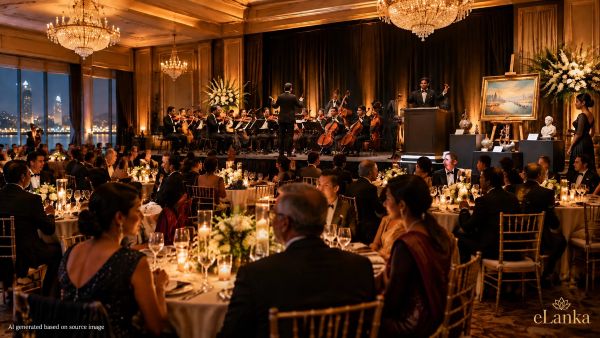
AI-generated illustration of Sinhala-language music reaching an international stage.
A festival built on cultural exchange
The Ziro Festival of Music was launched in 2012 and has developed into an independent celebration that brings artists and audiences from different cultural backgrounds together in the Ziro Valley. The valley is home to the indigenous Apatani community, and the festival’s location provides a distinctive setting in which independent music, local culture and international participation intersect.
The 2026 edition featured 41 performances from more than ten countries, placing Yohani’s appearance within a broad international programme rather than treating it as an isolated guest performance. The festival’s structure, which accommodates musicians from different traditions and parts of the world, created a suitable platform for an artist whose work has been shaped by Sri Lankan musical identity while also gaining recognition in international markets.
Yohani first became widely known beyond Sri Lanka through the viral success of “Manike Mage Hithe” in 2021. Since then, her catalogue has expanded through projects including “Kella”, “Aadarei” and “Sadde”, while international performances have continued to develop her standing as a Sri Lankan artist working across borders.
Her appearance at Ziro therefore represented a further stage in an international career that has not been separated from her linguistic roots. Instead, Sinhala remained central to the performance, allowing the audience to encounter Sri Lankan popular music on its own terms.

AI-generated illustration of the reported festival setting. Branding: eLanka.
Hard work behind the visible moment
Dilanjan Seneviratne, Founder and Chief Executive Officer of Outright Play, said the performance challenged the long-held assumption that artists from smaller nations must dilute their identity in order to gain international recognition.
“For years, it was believed that an artist from a smaller nation must compromise their unique identity to gain international recognition. Altering language, sound, or becoming less local,” he said, according to the reports. “However, on Friday night, a valley in the Himalayas resonated with Sinhala, and that misconception was challenged.”
Seneviratne also emphasised that the achievement was not the product of chance. Behind the visible performance, he noted, were years of recording, rehearsals and sustained work by a committed team that continued before there was any certainty that international audiences would take notice.
The response at Ziro provided a clear answer to that uncertainty. The world did take notice, and it did so with enthusiasm.
That observation is particularly relevant to artists from Sri Lanka and other smaller nations, for whom international recognition is sometimes presented as requiring a choice between local identity and global reach. Yohani’s performance suggests that the two objectives need not be treated as opposites. With careful production, consistent effort and a willingness to preserve artistic character, a language-specific musical identity can become an asset rather than an obstacle.
The achievement also reflects the importance of professional teams that invest in long-term development rather than depending solely on a single viral release. Recording, rights management, performance preparation, touring and international partnerships form an instrumental foundation beneath every apparently sudden breakthrough.
Further international announcements expected
Outright Play has indicated that additional international announcements connected with Yohani’s “Sadde” project are expected in the coming months. While details have not yet been released, the announcement suggests that the Ziro appearance forms part of a wider international direction rather than being an isolated festival engagement.
For Sri Lankan music, Yohani’s performance has already established a powerful image: a singer standing before the Sri Lankan flag in a Himalayan valley, performing in Sinhala while an international audience sings along. It was a moment in which national identity and international ambition were not placed in opposition, but were brought together through music.
The Ziro Festival performance consequently stands as an encouraging milestone for Sinhala-language popular music and for Sri Lankan artists seeking a wider audience. It demonstrates that cultural specificity can remain intact while artistic work travels, and that a song does not have to abandon its original language in order to be heard, remembered and celebrated abroad.
Readers interested in Sri Lankan music and cultural expression can also explore eLanka’s earlier feature, “Let’s Put a Baila No”, which reflects the continuing place of Sri Lankan musical traditions in international community life.
This article was written based on the source https://newsdive.net/2026/09/30/yohani-captivates-the-ziro-festival-audience-in-india-with-a-sinhala-sing-along-performance/, kindly email us at info@eLanka.com.au if any information needs to be corrected.
This article was written based on the source https://hirunews.lk/goldfmnews/491402/yohani-closes-ziro-festival-stage-in-india, kindly email us at info@eLanka.com.au if any information needs to be corrected.
At eLanka, we respect the rights of creators. If we have used an image you own and you’d like it removed, please email us at info@elanka.com.au and we’ll handle it promptly.
Thanks.
eLanka team
eLanka Disclaimer
Content published on eLanka may be created by the eLanka team, submitted by contributors or third parties, reproduced or adapted from other sources with appropriate source acknowledgement, or provided as promotional/advertising material by our clients. While eLanka takes reasonable care in preparing and publishing content, we do not warrant its completeness or accuracy. Views expressed are those of the respective authors or contributors and do not necessarily represent the views of eLanka. Third-party contributors, content providers and advertisers are responsible for the accuracy of material they supply and for ensuring they hold the necessary rights and permissions for its publication. Advertising and promotional content should not be regarded as an endorsement by eLanka of any product, service or claim.