



Ayomal Akalanka Finishes 5th in Asia in the 400m Hurdles at the Asian Games 2026
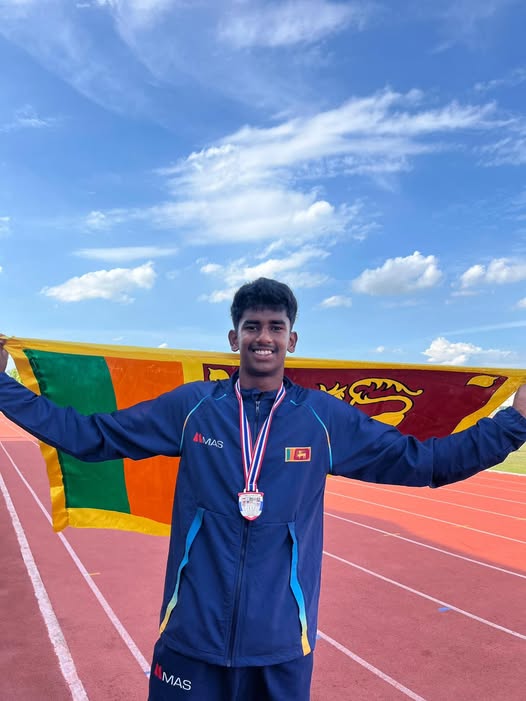
Ayomal Akalanka celebrates his silver medal for Sri Lanka. Photograph: Sporty.lk.
Sri Lankan athletics has received another encouraging international boost through the performance of Ayomal Akalanka, a 20-year-old first-year undergraduate of the Faculty of Humanities and Sciences at the Sri Lanka Institute of Information Technology (SLIIT), who finished fifth in the men’s 400m hurdles final at the 2026 Asian Games in Aichi-Nagoya, Japan.
Akalanka completed the demanding final in 49.37 seconds, placing fifth among Asia’s leading hurdlers and producing a performance that has been warmly recognised by SLIIT, which has proudly supported his development as both a student and an elite athlete. His result represents another significant step in a rapidly developing career, while also providing an inspiring example of how academic pursuits and international sporting commitments can be pursued together.
The Asian Games final was won by Qatar’s Bassem Beheida, who took the gold medal in 47.82 seconds. Japan secured the silver medal, while the bronze medal was claimed by an athlete representing Chinese Taipei. Against this highly competitive continental field, Akalanka’s fifth-place finish demonstrated the standard he has reached at just 20 years of age and confirmed his capacity to compete on one of Asia’s most important sporting stages.
A performance of growing significance
The 400m hurdles is an event that demands speed, rhythm, strength, flexibility and precise technical execution, because athletes must maintain a fast pace while negotiating ten hurdles over a full one-lap distance. A minor loss of balance or hesitation at any obstacle can affect the entire race, making a time of 49.37 seconds a notable achievement for a young athlete still establishing himself at senior level.
Akalanka’s Asian Games performance followed a landmark achievement earlier in 2026, when he won the silver medal in the men’s 400m hurdles at the inaugural Asian Under-23 Athletics Championships in Ordos, China. He recorded 49.03 seconds, setting a new Sri Lankan national record and becoming the first Sri Lankan athlete to win a medal at the Asian Under-23 Athletics Championships.
That record-breaking run carried considerable historical importance. Akalanka’s 49.03 seconds improved the previous Sri Lankan national record of 49.44 seconds, which had been set by Harijan Ratnayake in Jakarta 26 years earlier. The mark therefore connected a new generation of Sri Lankan athletics with a record that had stood for more than a quarter of a century.
The Ordos final was won by China’s Xinfeng Xu, who clocked 48.68 seconds, while his compatriot Anan Ye secured the bronze medal in 49.04 seconds. Akalanka’s silver medal, achieved between two Chinese athletes in a closely contested final, placed him firmly among the leading young 400m hurdlers in Asia.
Sri Lanka also celebrated another podium result at the same championship when Jithma Wijethunga won the bronze medal in the women’s 400m with a personal best of 53.10 seconds. The combined results provided an important indication of the potential within Sri Lankan junior and under-23 athletics, particularly when sustained coaching, competition exposure and institutional support are available.

AI-generated illustration based on source image. Branding: eLanka.
SLIIT celebrates a student-athlete
SLIIT has described Akalanka’s progress as an example of the possibilities available when young talent is encouraged to pursue excellence in more than one field. As a first-year undergraduate in the Faculty of Humanities and Sciences, he is undertaking university studies while managing the physical preparation, discipline and travel demands associated with international athletics.
The institution’s recognition of Akalanka reflects a broader understanding of the role universities can play in developing well-rounded young Sri Lankans. Academic institutions are not merely places of instruction; they can also provide the encouragement, flexibility and community support required for students who represent their country in sport, the arts, research and other demanding fields.
Akalanka’s progress is particularly meaningful because it demonstrates that sporting ambition and higher education need not be treated as competing priorities. The structure of a university environment can provide a valuable foundation for personal development, while the discipline learned through athletics can strengthen qualities such as time management, concentration, perseverance and responsibility.
SLIIT has stated that it is proud to recognise, nurture and support talented young individuals who aspire to excel in both academics and sport while representing Sri Lanka internationally. That message is especially relevant to students and families across Australia, the United Kingdom, the United States, Canada, New Zealand and other countries where Sri Lankan communities continue to encourage young people to maintain strong connections with their heritage while pursuing their own professional and personal goals.
The significance of such recognition extends beyond a single race. When a university stands behind a young athlete, the support communicates that achievement is measured not only by medals, but also by consistency, character, effort and the ability to contribute positively to the wider community.
A national record that opened a new chapter
Akalanka’s 49.03-second performance in Ordos represented more than an improvement on a statistical record. It showed that Sri Lankan athletes can challenge long-standing benchmarks when preparation and opportunity are aligned. The previous record, set by Harijan Ratnayake in Jakarta, had endured for 26 years, and its eventual improvement marked a significant transition in the national history of the event.
The record also provided a platform for Akalanka’s subsequent appearance at the Asian Games. Competing at a senior continental championship only months after winning an under-23 silver medal placed him in a demanding progression from emerging talent to established international competitor. His fifth-place finish in Aichi-Nagoya suggests that the national record was not an isolated achievement, but part of a continuing upward trajectory.
For Sri Lankan athletics, that trajectory is valuable at a time when young competitors require greater access to high-level meets, specialist coaching, sports science, injury management and educational support. Akalanka’s development demonstrates the potential benefits of creating a stronger pathway from school and university competition to Asian and global championships.

Ayomal Akalanka at the 2026 Asian Under-23 Athletics Championships in Ordos, China. Photograph: Daily Mirror.
An inspiration for young Sri Lankans worldwide
Akalanka’s achievements offer encouragement to young Sri Lankans both at home and overseas, particularly those attempting to balance education with demanding sporting or creative ambitions. His example demonstrates that international representation is built through a series of disciplined stages: developing basic skills, competing consistently, learning from stronger fields, maintaining academic commitments and responding constructively to each new challenge.
The support expressed by SLIIT also reinforces the importance of institutions that recognise the complete development of a young person. Sporting success can attract public attention, but the educational environment surrounding an athlete remains instrumental in shaping long-term opportunities and ensuring that progress continues beyond a single competition.
eLanka has previously highlighted the achievements of young Sri Lankan sportspeople competing internationally, including the success of Sri Lankan table-tennis players at the Pan American Table Tennis Championships. Akalanka’s journey belongs within that wider record of determination, discipline and international representation.
His fifth-place finish in the 400m hurdles final at the 2026 Asian Games, following the national record and under-23 silver medal in Ordos, has established an impressive foundation for the years ahead. With continued institutional support, appropriate preparation and further opportunities to compete against Asia’s strongest athletes, the young hurdler has already provided Sri Lanka with a performance of distinction and a story of considerable promise.
Source: https://sporty.lk/news/other-sports-news/akalanka-finishes-fifth-in-asian-games-400m-hurdles-final/
This article was written based on the source https://sporty.lk/news/other-sports-news/akalanka-finishes-fifth-in-asian-games-400m-hurdles-final/, kindly email us at info@eLanka.com.au if any information needs to be corrected.
Source: https://www.dailymirror.lk/sports/Ayomal-Breaks-26-Year-Record-Claims-U23-Asian-Silver/244-345490
This article was written based on the source https://www.dailymirror.lk/sports/Ayomal-Breaks-26-Year-Record-Claims-U23-Asian-Silver/244-345490, kindly email us at info@eLanka.com.au if any information needs to be corrected.
At eLanka, we respect the rights of creators. If we have used an image you own and you’d like it removed, please email us at info@elanka.com.au and we’ll handle it promptly.
Thanks.
eLanka team
eLanka Disclaimer
Content published on eLanka may be created by the eLanka team, submitted by contributors or third parties, reproduced or adapted from other sources with appropriate source acknowledgement, or provided as promotional/advertising material by our clients. While eLanka takes reasonable care in preparing and publishing content, we do not warrant its completeness or accuracy. Views expressed are those of the respective authors or contributors and do not necessarily represent the views of eLanka. Third-party contributors, content providers and advertisers are responsible for the accuracy of material they supply and for ensuring they hold the necessary rights and permissions for its publication. Advertising and promotional content should not be regarded as an endorsement by eLanka of any product, service or claim.