Story Of The Last Ceylonese Afgans & Their Struggle To Survive-By Tanmaya Das
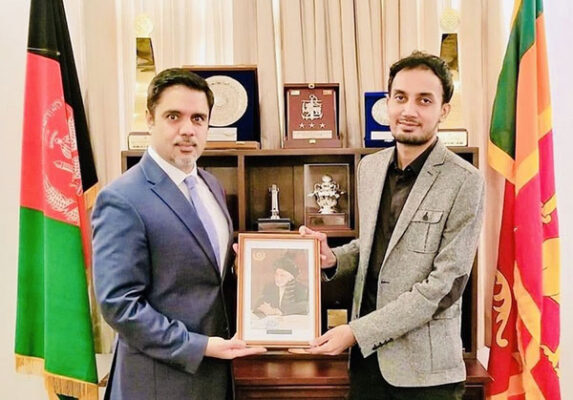
Dr Zameer-Careem being presented the signed autograph of President Ashraf Ghani, by Ambassador Ashraf Haidari
Source:Colombotelegraph

Sri Lanka is a great exponent of cultural diversity, but many living in the country aren’t aware of a minority group called the ‘Ceylonese Afghans’ whose history in the Island can be traced back to the early 15th century. During the British Colonial Era, many Afghans were brought to Ceylon to work as horse-keepers and labourers, and their descendants took to money-lending and rose to become an affluent community in twentieth century Ceylon. By 1970s, almost all Afghans had left the Island and there are only a handful of Afghan descendants living in Sri Lanka today. To learn more about this obscure minority in Sri Lanka, whose history is largely unknown, I met up with the foremost expert on this topic, Dr. Tuan M. Zameer Careem Khan, a Medical doctor and historian, whose paternal great-grandfather, Carim Gunney Baay Khan, a Pashtun (Afghan) coachman, came to Ceylon in the late nineteenth century, and eventually settled, following his marriage to a lady of mixed Ceylonese Malay and Indian descent. Over the past few years, Dr Careem has written extensively on the Afghan community in Sri Lanka, and his efforts to raise awareness about his people have been recognised and supported by His Excellency, M. Ashraf Haidari, Ambassador Extraordinary & Plenipotentiary of the Islamic Republic of Afghanistan to Sri Lanka.
How did Afghans land up in Sri Lanka?
Under the British rule, many immigrants from Afghanistan, the North Western Frontier Province and Balochistan (present-day, Pakistan) came to Sri Lanka to work as horse keepers and labourers. In Ceylon, they used the term ‘horse-keepers’ to identify grooms. The tall and muscular Afghans were put to work as labourers, some were involved in the construction of railway lines, and others worked as porters at the Railway stations. Their hefty look also qualified them to be employed as watchmen at the plantations and in private homes. Their origins in the country, however, can be traced back to the 15th century. In the words of Dr Zameer-Careem, “The advent of Afghans in Ceylon can be traced back to the early 15th century, when a schooner carrying Afghan (Pathan) merchants, was washed ashore by a storm in Batticaloa. According to the narrative, ‘Mattakkalappu Maanmiyam’ (Glory of Batticaloa), these valorous Afghans helped the Mukkuvar tribesmen redeem the villages of Eravur & Akkaraipattu, from the clutches of the Thimilars and coastal Veddhas. They also helped resolve the age-old feud between the Mukkuvars and other local tribes and many settled permanently in Sri Lanka, by marrying local women”. The descendants of these Pathans who settled in Batticaloa, are now part of the Batticaloa Moor (Muslim) community, who have, for over many centuries followed the matri-clan ‘kudi’ system in Sri Lanka. Dr Careem (2020) writes, “In 1762, an English envoy named John Pybus accompanied by two Pathan (Afghan) emissaries from the court of the Nawab of Arcot (Carnatic), visited Ceylon and met King Kirti Sri Rajasinghe in Kandy, where they remained for about forty days, living in Rammolle Adigar’s manor on Nagahavidiya”. The second wave of Afghans or Bhais as they were popularly called, came to Ceylon during the early years of British rule. When I asked Dr Careem, why the Afghans in Sri Lanka were called Bhais, he replied saying, “Most Afghans back then bore the title Khan, which was a popular surname among the highly influential Parsis. Hence, the British forbade the Afghans from using ‘Khan’;, therefore most Afghans used ‘Bhai’, meaning brother as their surname. But it should be noted however that the term ‘Bhai’ was also popular among other Indian minority groups, like the Bohras, Memons and Khojas, who rose to prominence in the twentieth century”. Many Sri Lankan authors, like Weerasooriya (1973), have used the term, ‘Bhai’ to identify the Afghans, a community that went from rags to riches, thanks to money-lending.
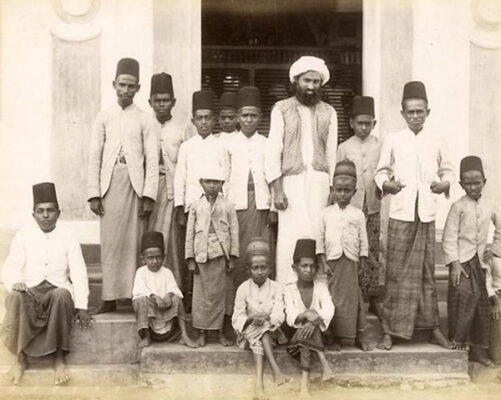
An Afghan man with Ceylon Moors
Rise of Afghan people during the British Colonial Era
They started lending money to the poor Sri Lankans at a high rate of interest. The Afghans lacked education, but they knew the art of persuasion. The Sri Lankan natives borrowed money and returned the money at double/triple rate to the Afghans. Although the Europeans operated banks during the colonial period, the banks provided loans only to richer people. Since the natives of Sri Lanka couldn’t approach the European-run Banks, they were mostly dependent on the Afghani people for their loans. The borrowing of money from Afghani people made Sri Lankans poorer. Many Ceylonese borrowed money from Pathans and couldn’t repay them. Since Pathans could save a large chunk of their salaries, they started lending money in huge amounts to Sri Lankan natives. At the same time, the poor Sri Lankans returned the money at a higher rate of interest. These business tricks made the Afghans (who worked as horse keepers) richer within a couple of years and eventually, they stopped working under Britishers and money-lending became their full time profession. The stories circulated that many Pathans waited for their debtors outside their workplaces on their paydays. The Pathans captured the houses of the poor debtors who couldn’t pay them back. They were also known to beat their debtors with sticks, and were have been described by Sri Lankan and British authors as an ‘aggressive. Money-craving tribe that preyed on innocent Sri Lankans’. When asked about this, Dr Careem replied, saying; “The Afghans weren’t infallible, they were rapacious money-lenders who subsisted on unconscionable usury, and yes, they always carried with them a truncheon, to clout their swindling debtors. In fact, In 1927, Lady Jean Lachore, donated a sum of 300 Pounds and established the Lady Lochore Loan Fund, to provide debt relief to those hassled by the Afghans. The Chetties, Moors, Jews and the Parsis were also engaged in money-lending, but no other community was subjected to such criticism and hatred as the Afghans, who were shunned, hounded and despised by the majority of Ceylonese, as evinced by authors like Cowell (1933), Menon (1981), De Souza (1919), Feinberg (2005) Schrader (1994) Tambiah (1908). In Ceylon, the Afghans suffered under the same hostility which the Jews experienced in other countries where the locals were improvident”. Dr Careem went on to add that, “Afghans in Ceylon were tough, and were known for their pugnacious attitude, yet they also had a friendly side to them. India’s first foreign secretary, K.P.S. Menon, during his time as the Agent of the Government of India in Ceylon, befriended an Afghan named Kabir Bhai, who became a close ally to his family. Menon, in his autobiography (1981), speaks fondly of his friendship with Kabir Bhai, who was both his confidante and Pashto teacher. Likewise, a painting by German artist, C.W. Allers (1899), depicts an Afghan moneylender playing ‘Dhaam’ with a local on the roadside, thus proving that not all Afghans were tyrants”.
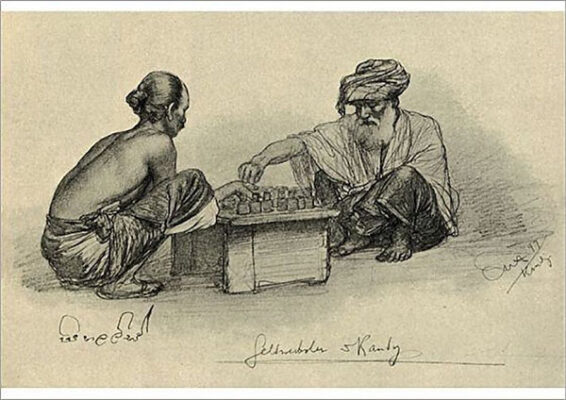
An illustration of an Afghan moneylender playing with a native of Ceylon by German artist Christian Wilhelm Allers. ca. 1899
Cultural Identity of Afghans
Sri Lankans identified Pathans, (Afghans) for their distinct clothing. The use of ‘Partug’ made them unique. The term, ‘Partug’, referred to the Pashtun Clothing, trousers with several pleats and an embroidered waistcoat. They also used to wear patterned boots with a turban on their heads. They carried a long stick and spoke Pashto, Dari, Sinhalese, Tamil and Sri Lankan Malay. The Afghans played sports like wrestling, goat pulling and many more. They used the ‘Jirga System’ (assembly) to resolve their disputes. “Afghans were also known for their religious fervour. The Hanafi Red Mosque on Castle Street Kandy was built upon the funds provided by the Afghans and Indian Moors. They also had a mosque on Shorts Road, Colombo. Most Afghans were Sunni Muslims, and some were Sufi mystics. Most of them believed in sainthood (wali). During Eid festivals and Nowruz the Afghans gathered together on Galle-face esplanade for their worship” said Dr Zameer-Careem, who shared some of the pictures of the old mosques and explained to me its rich history. He also spoke of the ‘Ceylon Pathan Association’ which had its branches in Colombo and Kandy.
End of Colonial Period
After the independence of Sri Lanka, the country introduced the Citizenship Act and Repatriation Bill in 1948 and 1949. Hence, most Afghans and their descendants were deported to India and Pakistan. Henceforth, many Afghans started moving out of Ceylon. To get Sri Lankan citizenship, the Afghans were supposed to prove that they were either third generation Immigrants if not had to prove their Lankan birth. As most Afghans didn’t have the necessary documents, they were repatriated. Because many had married local women, the birth certificates of their children usually recognised them as part of the wife’s family. For instance, if an Afghan got married to a Malay lady, the birth certificate of children had Malay as ethnicity, and the birth certificate never disclosed the identity of their Afghan father. Some of the Afghans adopted the wives surnames. When enquired about this, Dr Careem replied, saying “Yes it is true. My paternal grandfather, Alal (1902-1973) deliberately concealed his Afghan roots, and in the 1920s he changed his ethnic identity on the birth certificate to ‘Ceylon Malay’. He dropped ‘Bhai (Khan)’ and adopted ‘Careem’ as our surname. So did many others in his family. This was done, to ensure a better future for their descendants. Nevertheless, we haven’t forgotten our roots; we still love our Kabuli Palao, kebabs, mantus, yoghurt, almonds, dried fruits, nuts, Bonjan, Masteh etc and our Pashto mores have survived to this day. Just like our Afghan brethren, we too believe in sainthood and Sufism. Despite the checkered history, I am very proud of my Afghan, Indian and Malay roots, but I am through and through Sri Lankan”.
The relation between Afghanistan and Sri Lanka
After the comedown of Taliban rulers, Afghanistan became free, democratic and peaceful. The people of Afghanistan, believing in the ideas of democracy, regained their forces to improve international relations amongst other people. During this period, many countries supported Afghanistan and shook their hands to improve foreign policies. Afghanistan also promoted co-operative policies that help to win many countries and signed various deals and pacts with neighbouring countries. Both the countries signed many agreements and MOUs that involved the promises to improve the bilateral connections such as, trade, science and technology, economy and so on. The President of Afghanistan, Mohammad Ashraf Ghani was the first leader sending best wishes to President Gotabaya Rajapaksa for his electoral victory in Sri Lanka. The Afghan Ambassador, H.E. Ashraf Haidari, is playing an important role in strengthening and deepening the ties between Sri Lanka and Afghanistan, and over the past few months, many trade and educational agreements have been signed between the two countries, which have since ancient times maintained strong ties.
Special thanks go out to Dr Tuan M. Zameer Careem, MD, MPhil Candidate at the University of Colombo, for sharing information on his vibrant community. For more details on this community please read his articles and his recent book titled “Afghans of Sri Lanka: An Untold Story”.
*The Writer Tanmaya Das, is a proud Bengalee, who holds a Masters Degree in Philosophy, and did her internship at Times of India and Lokus Application.