A Brief History of Diyatalawa-by Anton Edema
Literally, “The Watered Plain”
Diyatalawa lies in a valley between Haputale and Bandarawela, approximately 1,250 metres (4,101 feet) above sea level, at 6.82° N, 80.90° E.
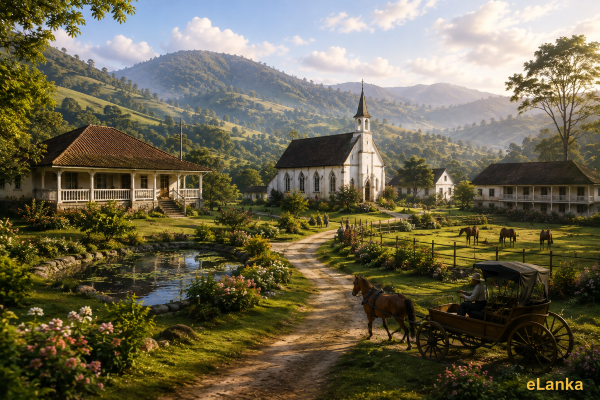
Before the end of the eighteenth century, the area was largely bare patana grassland and swamp. It was here that the Reverend Samuel Langdon and Mrs. Langdon, two Wesleyan (Methodist) missionaries, established an orphanage and an industrial school on what was then regarded as barren land.
The mission complex consisted of an orphanage, a mission house, a hospital and a chapel. The Wesleyan missionary settlement was named “Happy Valley.” The only other significant building in the vicinity was the Clubhouse on Wilson’s Plains. The picturesque Methodist Chapel stood on a site near what is today the Polo Grounds.
The Reverend Samuel Langdon was a hardworking and influential educator. He became the first principal of Richmond College, Galle, and was also associated with the establishment of Kandy High School.
The Development of the Tea Country
In time, tea plantations were established around the once-barren patana. Government land surrounding Happy Valley was leased for the construction of holiday bungalows, and Diyatalawa gradually began to develop as a hill-country retreat.
The Boer War and the Prisoner-of-War Camp
In 1900, Britain went to war with the South African Dutch-speaking farmers known as the Boers. The colonial government selected Happy Valley as one of the sites for the internment of Boer prisoners of war.
In April 1900, the Wesleyan Mission was asked to vacate Diyatalawa. A prisoner-of-war camp was then designed and constructed by the Public Works Department (PWD) under the supervision of the District Engineer, Kurunegala.
The camp occupied approximately five acres and was originally intended to accommodate 2,500 prisoners of war. The Public Works Department completed the construction in just three months.
The entire camp was enclosed by double barbed-wire fencing and trenches. Arc and flare lamps were installed to illuminate the barriers at night, while electric lighting was provided for the military and staff buildings.
A firewood chute was constructed alongside an aerial tramway, supported on pylon-like structures, to transport stores over a distance of approximately one mile from the railway head to the Quartermaster’s stores.
A metalled road was also constructed by the Public Works Department, connecting the railway station with the camp.
The first batch of Boer prisoners arrived in Colombo on 9 August 1900 aboard the ship Mohawk, while the final batch arrived in June 1901. A total of 5,089 prisoners were interned in Ceylon. As the Diyatalawa camp had not originally been designed to accommodate such a large number, additional prisoners had to be sent to other camps, including Urugasmanhandiya, Mount Lavinia, Hambantota and Ragama.
The prisoners were not all Afrikaners or Boers. Among them were highly educated men, as well as farmers and members of farming families.
The Boer Road and Cemetery
The lower road connecting Diyatalawa and Bandarawela became known as Boer Road.
Many prisoners died during their internment for various reasons. There was once a well-maintained Boer cemetery marked by white crosses. Sadly, the cemetery no longer survives in its original form.
As the camp expanded, the surrounding barrier of barbed-wire entanglements eventually extended to a circumference of nearly two miles.
The original camp was planned to accommodate 2,500 prisoners, with approximately 1,000 personnel required to guard and administer them, including staff and labourers.
Water for the camp was obtained from streams flowing down the hillsides through the Roehampton and Kahagolla estates. A pressure-break tank was constructed above the railway, together with four other service tanks in the vicinity of the camp.
It is said that the present Government “A” Bungalow was formerly associated with the Methodist Mission. It reportedly included a medical dispensary and dormitory. The “B” Bungalow later became the hospital for the Boer prisoners.
The present Post Office building was formerly known as Rose Cottage and was also used as a holiday bungalow.
From Prisoner-of-War Camp to Garrison Town
After the Boer War, the prisoners were repatriated to South Africa in 1902. Following their departure, Diyatalawa became something of a ghost town.
Various proposals were subsequently made concerning the future of the abandoned camp. Eventually, Governor Sir West Ridgeway authorised its use as a rest camp for the Military and Navy, as an encampment for the Ceylon Volunteers—later the Ceylon Defence Force (CDF)—and for the Ceylon Survey Department.
In 1903, the Volunteers’ Annual Camp was transferred from Urugasmanhandiya to Diyatalawa, and the duration of the camp was extended from eight to fifteen days.
Detachments from the Ceylon Mounted Infantry, Ceylon Planters’ Rifles, Ceylon Light Infantry, Ceylon Artillery Volunteers, Royal Navy and British regiments stationed in Ceylon—including the West Kent Regiment and the 98th Regiment—participated in the first camp.
With the establishment of the military, naval and survey camps, Diyatalawa gradually developed into a garrison town.
The military presence became so closely associated with the town that civilian businesses sometimes adopted military-themed names. Examples included Happy Valley Stores, Army & Navy Stores, and Emden Saloon.
The Ceylon Army and the Development of Military Training
After Independence, the Ceylon Army Recruit Training Depot, which had been located at Ratmalana, was transferred to Diyatalawa and established as CARTD on 6 February 1950.
The first batch of recruits passed out from CARTD on 2 June 1950. The establishment was later renamed the Army Training Centre (ATC), and officer-cadet training commenced in 1968.
The transformation of that small Ceylon Army Recruit Training Depot into the present-day Sri Lanka Military Academy is, however, another story in itself.
The Air Force Combat Training School was also transferred to Diyatalawa in 1952, and its first Wings Parade was held in 1954.
The Firing Ranges of Diyatalawa
Diyatalawa once had several important military firing ranges.
Artillery and Mortar Range
The artillery and mortar range covered an extensive area bounded by Bluff Hill, Needankanda New, Trig Point Needankanda 4222, the trig point at Udutara Hill, Gibraltar, Range Hill, One Tree Hill and Black Rock.
This range was used for artillery and mortar firing.
Field Firing Range
The field firing range was used for small-arms and mortar field-firing exercises. It extended across the area between Black Rock, the trig point at Gibraltar, the trig point at Flag Staff Hill and One Tree Hill.
300-Yard Firing Range
The 300-yard range was used exclusively for small-arms firing. It was situated between Range Hill, the trig point above the Boer Cemetery and the road junction near the Survey Camp.
1,000-Yard Firing Range
The 1,000-yard range was also used for small-arms firing. It was situated between the trig point at Gibraltar, Range Hill and the road junction outside the Survey Camp.
Volunteer Training Camps
Volunteer training camps at Diyatalawa were eagerly anticipated events, combining military training with recreation and regimental camaraderie.
Training included weapon handling, foot drill, cross-country marches and mock battles. Friendly football and rugby matches, athletic meets and other sporting activities were also an important part of camp life.
For Junior and Senior School Cadets, the annual camp at Diyatalawa was almost a pilgrimage. After months of hard training at their schools, cadets travelled to Diyatalawa to compete with other schools in drill on the famous Rendezvous Grounds, as well as in musketry, physical endurance and band music.
Anyone who travelled to Diyatalawa in those days will never forget the excitement of departing by special train and then marching to the CVF camp.
Those memorable train journeys and annual training camps are now a thing of the past.
Volunteers were also required to complete their Annual Weapon Training Course (AWTC) at Diyatalawa. Successful completion of the course entitled officers and soldiers to receive their annual bounty.
CLI Hill
The CLI Hill was named after the stone-built crest of the Ceylon Light Infantry (CLI), which was assembled on a hill near the feature known as Pepper Pots.
The exact date on which the crest was constructed is unknown, although it is believed to have been around 1940.
Today, the CLI Hill is covered with pine trees, and the original stone crest is no longer visible.
There was also a feature known as Gona Kanda, where the Cadet Corps insignia was formed using white stones laid out on the hillside.
Fox Hill — Nariya Kanda
Until 1913, the feature now known as Fox Hill was known as Black Rock.
Sailors from HMS Fox were brought to Diyatalawa to rest. Using hundreds of pieces of white quartz rock, they created the outline of a fox as though it were running, complete with tail, snout and erect ears.
The white quartz figure could be seen from many miles away.
Today, Fox Hill is famous throughout Sri Lanka for the Fox Hill Motor Races, which have become an important feature of Diyatalawa’s sporting heritage.
The 18-Hole Golf Course
Diyatalawa once had an 18-hole golf course around the famous Polo Grounds.
The present course has nine holes. It is regarded as one of the most beautiful golf courses in Sri Lanka, owing to its setting amid the hills and cool climate of Diyatalawa.
The Garrison Church
The Garrison Church remains another part of Diyatalawa’s long military heritage and is a reminder of the town’s transformation from a remote hill-country settlement into one of Sri Lanka’s best-known military centres.
Conclusion
The history of Diyatalawa is therefore much more than the story of a military town.
From the lonely patana and swamp of the eighteenth century, to the Wesleyan Mission’s Happy Valley, the Boer prisoner-of-war camp, the holiday bungalows, the Volunteer camps and military training establishments, Diyatalawa has passed through several remarkable phases.
Its landscape still carries traces of these successive chapters—some visible, some remembered only through names and stories, and others now lost altogether.
For generations of soldiers, officers, cadets, sportsmen and civilians, Diyatalawa has been a place of training, friendship, competition and memories. Its history is woven into the history of Ceylon and Sri Lanka itself.
References
- Rifle & Artillery Ranges Ordinance (Chapter 257), Gazette No. 6460, 1 September 1911.
- Gazette No. 7737, 4 October 1929.
- Gazette No. 10,260, 2 June 1951.
- The Firing Ranges and Military Training Act, No. 24 of 1951.