A snapshot of Basil D ‘Oliveira
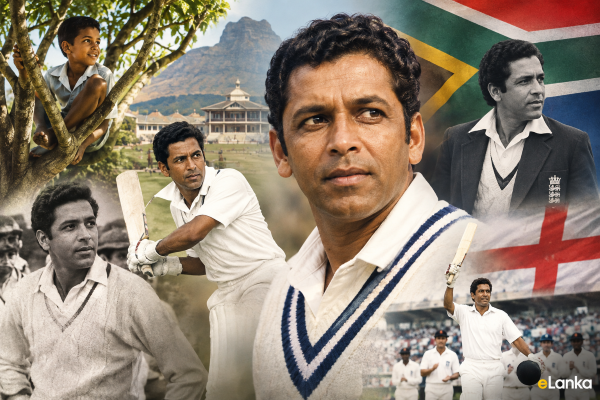
The Test series between England and South Africa carries a name with a story of its own — the Basil D’Oliveira Trophy. And it’s a fitting tribute to a man whose life went far beyond cricket, and whose story became deeply important to both nations.
Basil D’Oliveira was born on this day in 1931 in South Africa, and from a very young age, cricket was a huge part of his life. Growing up in Cape Town, he would even climb trees outside Newlands just to get a glimpse of the action. He had the talent and ambition to go a long way in the game. But there was one enormous obstacle — the colour of his skin.
This was apartheid-era South Africa. Classified as Cape Coloured, D ‘Oliveira was excluded from first-class cricket and denied the opportunity to play at the level his talent deserved.
But he refused to let that define his future.
With the encouragement of legendary broadcaster John Arlott and his local club, St Augustine’s, D ‘Oliveira moved to England in 1960. He started out playing league cricket, but it didn’t take long for people to notice what he could do. Worcestershire soon came calling, and then, remarkably, at the age of 34 — an age when many cricketers are already thinking about the latter stages of their careers — D ‘Oliveira finally made his Test debut for England at Lord’s against the West Indies.
His career would go on to become a mixture of achievement, controversy and history.
Despite establishing himself as a dependable all-rounder, D ‘Oliveira was initially left out of England’s squad for the 1968–69 tour of South Africa. When an injury later opened the door for his selection, the South African government made it clear that they would not accept him.
The consequences were enormous. The tour was cancelled, creating an international storm that became one of the defining moments in cricket’s eventual opposition to apartheid and contributed to South Africa’s sporting isolation for more than two decades.
On the field, D ‘Oliveira finished with 41 Test appearances, 2,484 runs at an average of 40.06, five centuries and 47 wickets.
But the numbers only tell part of the story.
What really made Basil D ‘Oliveira special was the way he carried himself. Through discrimination, political pressure and personal battles, he remained dignified, determined and quietly strong.
Later in life, he was diagnosed with Parkinson’s disease. He passed away in England in 2011, but by then his name had already become part of cricket history for reasons far greater than statistics.
Basil D ’Oliveira’s story is ultimately one of courage, resilience and dignity — a reminder that sometimes a cricketer’s greatest contribution to the game happens far beyond the boundary ropes.
At eLanka, we respect the rights of creators. If we have used an image you own and you’d like it removed, please email us at info@elanka.com.au and we’ll handle it promptly.
Thanks.
eLanka team
eLanka Disclaimer
Content published on eLanka may be created by the eLanka team, submitted by contributors or third parties, reproduced or adapted from other sources with appropriate source acknowledgement, or provided as promotional/advertising material by our clients. While eLanka takes reasonable care in preparing and publishing content, we do not warrant its completeness or accuracy. Views expressed are those of the respective authors or contributors and do not necessarily represent the views of eLanka. Third-party contributors, content providers and advertisers are responsible for the accuracy of material they supply and for ensuring they hold the necessary rights and permissions for its publication. Advertising and promotional content should not be regarded as an endorsement by eLanka of any product, service or claim.