




Confusion regarding the guidelines for the management of Dyslipidemia-by Harold Gunatillake

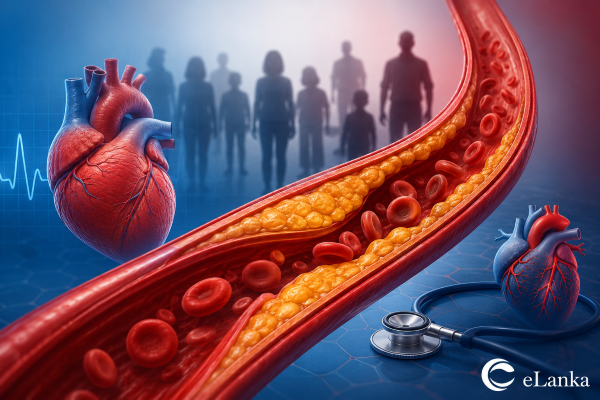
Earlier this year, the American College of Cardiology and the American Heart Association issued their revised guidelines, superseding the previous 2018 AHA/ACC Guideline on blood cholesterol management.
The revised guidelines reflect numerous shifts in how medical professionals approach cholesterol and cardiovascular disease. Recently, researchers at Mass General Brigham discovered that nearly one in three adults without heart disease in the United States exhibits LDL, or “bad,” cholesterol levels exceeding the targets established by the 2026 guideline.
It is a well-documented and unexpected clinical fact that approximately fifty to seventy-five per cent of patients hospitalised
due to myocardial infarctions do not present with elevated “bad” (LDL) cholesterol levels.
A landmark national study involving over 136,000 patients established that seventy-five per cent of those admitted for myocardial infarction had LDL cholesterol levels within the officially recommended “normal” guidelines, with more than half exhibiting LDL levels below 100 mg/dL.
While elevated cholesterol levels are a significant risk factor, standard cholesterol panels provide only a partial understanding. Cardiovascular disease is multifactorial, and assessing total or LDL cholesterol in isolation often overlooks underlying contributors to arterial plaque development.
The reasons why individuals with “normal” cholesterol levels experience heart attacks are multifaceted. Standard cholesterol blood tests quantify the total amount of cholesterol; however, they fail to consider the size, quantity, or behaviour of the particle carriers.
The particle count holds greater significance than the overall weight: an individual may possess a “normal” level of LDL cholesterol; however, if this quantity is distributed among numerous small, dense particles (Pattern B), the risk of cardiovascular events rises considerably. These diminutive particles can easily infiltrate and become embedded within the arterial walls, advancing to form plaques in conjunction with other constituents.
Advanced Blood Tests Exist
Standard lipid panels only measure the total weight of cholesterol inside the particles (expressed in mg/dL). They do not count the particles or evaluate their physical traits. However, your physician can order specific advanced panels:
NMR Lipo Profile: This test uses Nuclear Magnetic Resonance (NMR) spectroscopy to measure the exact number of LDL particles (LDL-P) and their average size.
Apolipoprotein B (ApoB): Every plaque-causing lipoprotein carries exactly one ApoB protein.
Measuring ApoB levels via blood test provides a direct count of the total number of traffic packets capable of entering your arterial walls.
Gradient Gel Electrophoresis: This lab technique physically separates lipoprotein fractions to identify the proportion of small, dense LDL vs large, buoyant LDL.
How Size and Particle Count Drive Plaque.
Your focus on particle dynamics is highly relevant to modern cardiology. The total mass of cholesterol is often a misleading metric because of how plaque actually forms:
The Discordance Problem: You can have a “normal” total LDL cholesterol number but a dangerously high number of individual particles. Small vs Large: Small, dense LDL particles act like tiny BB pellets.
They readily penetrate the endothelial lining of the arteries. Upon entry, they become lodged, oxidise, and initiate an inflammatory response that leads to plaque formation. Larger, buoyant particles are akin to fluffy beach balls that tend to bounce off the arterial walls, thereby facilitating more effective clearance.
Root causes are often linked to elevated levels of small, dense LDL particles, which are generally associated with insulin resistance, elevated triglycerides, obesity, and metabolic syndrome.
Chronic inflammation hampers plaque formation and rupture in the absence of an immune response. Persistent low-grade inflammation operates similarly to a fire within the arteries, resulting in the oxidation of circulating cholesterol—even at normal levels—and the subsequent entrapment and formation of dangerous blockages.
Metabolic Syndrome and Insulin Resistance: Many individuals diagnosed with cardiovascular disease who have low LDL cholesterol frequently also have reduced high-density lipoprotein (HDL), commonly known as “good” cholesterol, alongside elevated triglyceride levels. This phenotypic pattern is primarily affected by insulin resistance, type 2 diabetes mellitus, and central obesity.
Advanced Particle Vulnerability: Genetic factors determine the susceptibility of your particular blood vessels to damage.
Additional markers, such as elevated levels of Apolipoprotein B (ApoB) or Lipoprotein(a)—a highly inflammatory and genetically inherited particle—may lead to severe heart disease even if your conventional lipid profile appears entirely normal.
Better Health Markers to Track: If you or a loved one are tracking heart health, standard cholesterol numbers (Total and LDL-C) are not enough to confirm you are safe.
Consider asking a doctor about these advanced tests: Apolipoprotein B (ApoB): This measures the exact number of plaque-causing particles in your blood. It is a far more accurate predictor of heart disease than standard LDL.
High-Sensitivity C-Reactive Protein (hs-CRP): This blood test evaluates the overall level of active inflammation within the cardiovascular system.
Lipoprotein(a) or Lp(a): A unique genetic blood test. Elevated levels lead to premature plaque accumulation regardless of diet, exercise, or low baseline cholesterol.
Coronary Artery Calcium (CAC) Scan: A swift, non-invasive computed tomography (CT) procedure of the heart that methodically evaluates the presence of calcified plaque within the arteries, offering concrete evidence regarding the active progression of the disease.
Cholesterol does not serve as an antioxidant in older adults, and it remains a primary risk factor for heart disease regardless of age.
Although particular contentious studies indicate the existence of a “cholesterol paradox”—wherein elevated cholesterol levels are associated with increased longevity in the very elderly—this phenomenon is predominantly attributed to statistical anomalies, such as reverse causality or frailty selection, rather than implying that cholesterol confers a protective chemical barrier.
Leading medical institutions, such as the American Heart Association and the CDC, affirm that the management of low-density lipoprotein (LDL) cholesterol remains vital throughout an individual’s lifespan.
The concept of the “Cholesterol Paradox”—the notion that elevated cholesterol levels confer protection to older adults—often arises from misconceptions related to the collection and analysis of medical data.
Reverse Causality: In older individuals, diminished cholesterol levels are often a consequence of significant underlying health conditions such as undiagnosed cancer, severe frailty, or malnutrition.
As these critical illnesses often result in premature mortality, statistical models may erroneously portray high cholesterol as “protective” by comparison.
The Survivor Effect: People who have genetic traits that make them highly susceptible to cholesterol-driven heart attacks often develop cardiovascular complications earlier in life.
Individuals who surpass the age of 70 with elevated cholesterol levels inherently possess alternative protective genetic variations or resilient cardiovascular systems.
Diminishing Statistical Significance: The correlation between relative risk and total cholesterol in relation to heart attacks diminishes with advancing age.
Nevertheless, owing to the significant escalation in the absolute baseline risk of heart disease among older adults, reducing cholesterol levels results in a substantial overall decrease in absolute risk for the elderly.
What the Clinical Evidence Shows: The global medical consensus continues to emphasise active lipid management for seniors based on extensive trial data:
Proven Benefits for Seniors: Large-scale meta-analyses demonstrate that reducing LDL cholesterol levels in adults over the age of 75 diminishes the risk of heart attacks and major vascular events by approximately 26% for every 1 mmol/L decrease.
Actual Cardiovascular Antioxidants: Cholesterol itself is a lipid molecule prone to hazardous oxidation—forming the foundation of arterial plaque.
True protection derives from dietary antioxidants, including vitamin C, vitamin E, and Coenzyme Q10. These compounds are present in nutrient-dense foods and help prevent cellular damage and mitigate systemic inflammation.
Personalised Treatment Plans: Although cholesterol remains a consistent risk factor, management for older adults over the age of 75 predominantly emphasises their comprehensive health profile.
Physicians meticulously assess the potential side effects of medications, drug interactions, and overall quality of life before deciding on the prescription of intensive statin regimens.
It may be necessary to review this article multiple times to comprehend the subject matter fully.
Thank you for reviewing my researched topic. End