Cultural factors associated with Tamil Hindu New Year-by DR. SUBASHINI PATHMANATHAN
Source:Sundayobserver
Hindu Tamils in Sri Lanka are mostly connected to the South Indian festive culture and traditions. Each Hindu year has a particular name from ancient times. The total number of the Hindu Year is 60. The different 60 years routinely follow one after the other in the Hindu Panchaangam calendar (Hindu almanac.) Tamil Hindus from time immemorial have closely associated themselves with Astronomy and Astrology. Each New Year of the Hindu calendar is repeated after 60 years with the same name.
 Weeks before the New Year, people clean, whitewash and polish their houses and household items. They discard unwanted items with the expectation to bring in positive vibrations to the house.
Movements of Sun
The Hindu New Year normally falls around April 13 or 14 of every year. The month of April is known as Chithirai in Tamil. That’s why the New Year is known as the Tamil New Year which is commonly known in Tamil as “Chithirai Puthu Varudaperappu,” “Chithirai Varudaperappu” or “Puthuvarudam.” Among the planets in Hindu Astronomy and Astrology, the movements of the Sun occupy a significant role.
This is the period that the sun moves from Pisces (Meena) to Aries (Makara) in the Hindu calendar. That means the movement from the last house to the first house of the Zodiac in the Hindu calendar. According to Hindu astrology, there are 12 Rasis or signs. They are Aries, Taurus, Gemini, Cancer, Leo, Virgo, Libra, Scorpio, Sagittarius, Capricorn, Aquarius and Pisces.
The New Year is believed to be the dawn of Sun God (Surya Bhavan) to the earth. According to Hinduism, Sun God regulates and determines the seasons in the universe. In other words, it is believed that it is a day to express gratitude to Sun God whose cyclic movements determine and control the seasons in the universe ultimately bringing in prosperity to the world.
There is a particular period before and following the auspicious birth-time of the New Year which is known as “Vishu Punniya Kaalam.” During this time, people are supposed to observe certain well-defined traditional observations such as a Maruththu Neer head bath.
Especially after the birth of the traditional New Year, the people are supposed to take a traditional bath by applying Maruththu Neer (it is a variety of herbal and divine water). Maruththu Neer is prepared and distributed only at Hindu temples. It is made of numerous herbs, leaves, selected flowers and saffron. Such sacred and especially made water could be obtained only from Hindu temples.
The temple authorities make Maruththu Neer with certain flowers and divine leaves which are used for Pujas, Abhishek and Archannai. Fresh lotus flowers, pomegranate fruits, Arugham grass, Vilva leaves, Thulasi leaves along with saffron and Thipilli are used for the preparation of the sacred Maruththu Neer.
Herbal water
The people add Maruththu Neer water in their bathing water and take a bath with the belief that the herbal water purifies their bodies and induces good health, refresh the mind and generates positive thoughts. After taking the traditional Maruththu Neer head bath, they wear new clothes the colour of which is suggested by the Hindu auspicious calendar popularly known as “Panchaangam.”
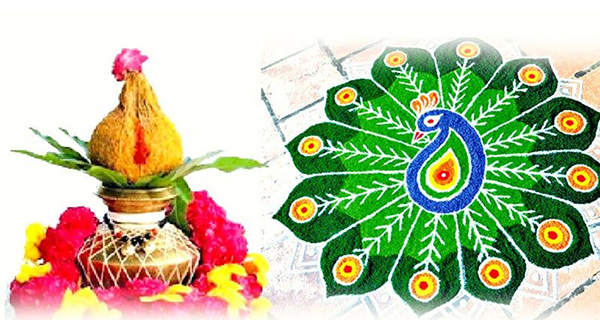
The head of the female member of the house cleans the front portion of the floor with turmeric water and draws the traditional Kolam with pure rice flour. But at present, people use artificial colour Kolam powder. In the middle of the Kolam, an effigy of Lord Ganesha is placed.
The idol of Lord Ganesha is traditionally made out of turmeric power and Arugham grass. In ancient times, the idol of Lord Ganesha was made out of cow dung. Even today at villages, the effigy of the Lord is still made out of cow dung. Keeping the idol of Lord Ganesha at the entrance of the house is to seek the blessing and protection of the residence from all the evil effects and to bring in happiness to the house.
To welcome the traditional New Year, they place a Purnakumpam at the main entrance of the house. It is a Hindu tradition to keep the Purnakumpam at the main entrance of the house. It is placed on a table along with lighted traditional silver or brass Kuthuvilakus (traditional Hindu oil lamps). The Kuthuvillakus are kept on both sides of Purnakumpam (a brass or silver pot filled with water, and top of the mouth of the pot a coconut is kept). Around the coconut, five, seven or nine mango leaves are decorated. Purnakumpam is always placed on the front edge of the banana leaf on which red raw rice is spread.
The Kuthuvilakus (traditional cultural oil lamps in brass or silver-plated lamps) are always used for the traditional occasion. Besides, to mark the traditional New Year in the auspicious manner, three to four trays are kept for different purposes. One tray contains Vibuthi (holy ashes), auspicious red Kumkum powder and sandalwood paste and Panneer water (a particular incense and herbal water).
Different customs
Nowadays, instead of Panneer water, artificial flavoured rose water is used in urban areas. Another tray has to be arranged for betel leaves with three, five or seven arecanuts with one ripe yellow lemon fruit. Another tray has to be kept with fresh flowers of different colours and a variety of fruits. All the practices are observed to welcome the traditional New Year in a Hindu customary manner.
The front entrance upper frame of the door has to be decorated with seven or nine fresh mango leaves. But at present, instead of fresh mango leaves, people prefer to use plastic mango leaves which are freely available in urban shops.
After finishing the socio-cultural formalities, the hearth has to be lit to cook the sweet milk rice (Pongal) and offer it to the Sun God and invoke its blessings. After the offering all the family members participate in a joint prayer in the shrine room. The traditional worship is performed with a lighted oil lamp in the shrine room with camphor Deepam, Sambrani smoke and incense sticks. They provide a divine atmosphere to the house.
After finishing their prayers and other ritual formalities, the head of the family offers Kaiveshaham to all family members. Kaiveshaham contains a currency note, raw rice grawins, lime fruit, fresh flower, red Kumkum and holy ashes kept on a fresh betel leaf. It implies the first money transaction between family members at home on the prescribed time of the auspicious day. It implies that the head of the family gives Kaiveshaham in a form of blessings to all of his family members for economic and financial prosperity of the forthcoming days and months of the New Year.
All the traditional activities of the New Year include taking the first bath, lighting the hearth, exchanging the Kaiveshaham, visiting temples, houses of friends and neighbours. Work has to be performed according to the guidelines given by the traditional Panchaanga calendar.