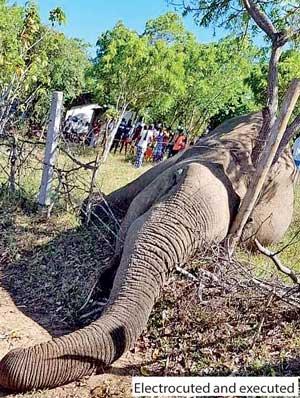
Electrocuted elephant near Nimalawa Sanctuary-by Kamanthi Wickramasinghe
Source:Dailymirror
- Suspect released due to lack of evidence
- FFPO says fine could be between Rs.150,000 and Rs.500,000
- Housing projects bordering national parks and sanctuaries
- Farmers continue to experience the brunt of HEC

Another elephant succumbed to injuries after being electrocuted near the Nimalawa Sanctuary recently. While most electric fences don’t necessarily have electricity, they are just a simulation to keep elephants away and protect crops. However, the postmortem report revealed that the elephant died of electrocution and a suspect was taken into custody. While it is illegal to draw electricity in this nature, under the Flora and Fauna Protection Ordinance (FFPO) fines and punishments could be imposed for those who harm protected species. But, the Department of Wildlife Conservation (DWC) had to release the suspect on the same day due to lack of evidence; hence the authorities weren’t able to prove him guilty. However, wildlife conservationists believe that community-based fences will be the most effective approach in mitigating human-elephant conflict (HEC). But many barriers exist.
According to Dr. Sumith Pilapitiya, Asian elephant expert and former Director General of the Wildlife Conservation Department, the location has no bearing on the offence. “The killing or injuring of an elephant by electrocution is a punishable offence where ever it takes place. Part II, Paragraph 20 (1) of the Fauna and Flora Protection Ordinance (FFPO) states that a person electrocuting an elephant “shall be guilty of an offence and shall on conviction be liable to a fine not less than one hundred and fifty thousand rupees and not exceeding five hundred thousand rupees or to an imprisonment of either description for a term not less than two years and not exceeding five years or to both such fine and imprisonment”. Considering that the electrocution results in the elephant dying virtually on the spot, finding the culprit who did this should not be too difficult. That person should be prosecuted to the maximum extent of the law, because this will then serve as a deterrent for future actions such as this,” he opined.
Housing projects aggravating HEC
According to him, there is no more than one or two small herds in Nimalawa Sanctuary. “But there are some adult males who tend to go out of the Nimalawa Sanctuary and enter areas of human settlements and crops. The community has problems only with these elephants,” said Dr.Pilapitiya.
However, during the previous regime, many housing projects were completed bordering wildlife sanctuaries and national parks. Dr. Pilapitiya questioned as to why housing projects are located in the areas bordering wildlife sanctuaries and national parks. “Isn’t it obvious that if a housing project is located on the boundary of a national park or sanctuary, there would be a problem posed by elephants to the communities? While this is obvious, housing projects continue to be located in such areas. A decision should be taken by the authorities that housing projects should NOT be located on the borders of national parks and sanctuaries. This is obviously easier to do than manage the conflict once the houses are constructed. Preventing a problem is always better than trying to solve one. For the housing schemes that are already constructed, the authorities should work with the communities to construct community based village electric fences. These are fences that surround the village and what we need to do is to protect villagers and their houses,” he explained.
For the housing schemes that are already constructed, the authorities should work with the communities to construct community based village electric fences Dr. Sumith
According to him, one of the biggest reasons for the failure of using electric fences is due to the lack of proper maintenance. “Community based fences, which I propose, will address this problem as the community undertakes its maintenance. After all, if the fence goes behind your house and there is a problem would you wait for the authorities to come and fix it or would you do it? You would do it because if an elephant comes, it is your house that would be damaged. Community based village electric fences have been pilot tested by the Centre for Conservation and Research (CCR) and have been operating successfully in the Kurunegala, Anuradhapura, Trincomalee and Hambanthota Districts for the last 8 years. While delegations from India, Malaysia, Myanmar and 13 African countries have visited these pilot sites and adopted the lessons learnt in human-elephant conflict mitigation in their countries, it is sad to note that our political authorities and bureaucrats are disinterested in visiting such sites and learning from the experiences of these successful projects; and instead stay mired in tried and failed approaches,” he added.
The Government’s role
“Protection for crops and settlements has to be provided to ensure that similar things to keep elephants away from crops do not happen,” he suggested. “We must first understand that fences are to protect settlements and crops and not elephants. Therefore, don’t you think that logically, the fences should be erected to surround settlements and crops and not within forests? The Government is looking for a plan to address the Human Elephant Conflict. I must commend the President for appointing a Presidential Committee to prepare a National Action Plan for Human Elephant Conflict Mitigation. The Committee is in the process of finalising its report for submission to the President. The report is based on science, and takes into consideration biological factors that affect elephant range, including the carrying capacity of protected areas, ecological requirements and behaviour of elephants and their response to management actions. In addition to electric fences on the boundaries of elephant habitat, community based village electric fences and community based seasonal agricultural fences around crop fields are a solution to keep elephants away from settlements and cultivations. As a member of the committee I strongly feel that if the Government implements this action plan fully, we would see a significant reduction in the extent of property damage and crop damage from elephants on the short-term and reduce human and elephant deaths in the longer-term. The concern I have is that successive Governments have a tendency to implement sections of action plans, mostly driven by political expediency, and not do so comprehensively. When that happens there is no solution to the human elephant conflict. Just to illustrate what I mean with a mundane example, if you are going to bake a cake, and look at the recipe, but add only 50% of the ingredients, would you get the cake that you wanted? Ad hoc implementation of the HEC action plans would produce the same result.” affirmed Dr.Pilapitiya.
Novel innovations to mitigate HEC
The Sri Lanka Inventors Commission (SLIC) together with the Ministry of Environment and Wildlife Resources and the DWC recently initiated a pilot project in the Karuwalagaswewa Divisional Secretariat. Following discussions, the Commission was briefed on the need to develop locally made energizers and other equipment required to mitigate HEC as means of cutting down the importation cost on similar equipment.
“Successive generations look at elephants as threats because of the damage to crops,” opined SLIC Commissioner Prof. Rangika Halwatura. Being a wildlife enthusiast himself. Prof. Halwatura believes that there needs to be a system to allow humans and wildlife to coexist. “Right now what’s happening is a dissociation between humans and wildlife. When we visited some of these areas we noticed that the tanks were used by humans. But during the dry season elephants need water and when they come to have some water from the tank, the problem starts. Then there’s a forest patch inside the village. So elephants drink water from the tank and hide in the forest patch,” said Prof. Halwatura.
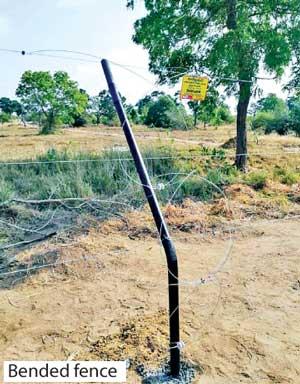
Having spent about two months in these villages, Prof. Halwatura and his team were able to preselect nine inventions for the piloting project. “However only two of them (the wire fence and the bended fence) deemed to be successful. Most of them weren’t successful because without knowing the hearing capacity of the elephant we cannot try out equipment like sound repellants.”
Right now what’s happening is a dissociation between humans and wildlife. When we visited some of these areas we noticed that the tanks were used by humans Prof. Rangika
According to him, elephants communicate through the ground and we are trying out bio-acoustic research as well. “If it succeeds, we don’t have to put up fences right around villages. We can put fences in patches and use bio-acoustic sound equipment in agricultural areas.” the professor said.
He further stressed on developing custom-made energizers to match the frequency of an elephant’s heartbeat, so that even though electric fences produce a current, they will only give a tiny shock to the elephant. Although the project cost between Rs. 1-2 million he said the cost could be reduced once equipment is manufactured locally. For that he invites students in technical colleges and those with technical backgrounds to think of creating startups to promote these equipment.
Suggestion from a farmer
Even though many research-based solutions could be tried and tested, it may not always be the perfect solution in a practical sense. M. Jayamanne, a farmer from Neelabamma, Karuwalagaswewa, is one of many farmers who are affected by the HEC. “By around 4.00 pm the herd comes to our cultivations. We initially thought that the new project would have some effect, but a day or two ago, the elephants had damaged it. The new fence is difficult to be fixed as it’s like a curtain,” said Jayamanne.
He however, has a suggestion that would effectively manage the conflict. “We suggest that they backhoe a deep drain between the agricultural plots and the road. Thereafter they can put up a fence on the new bank (wekanda). So the elephant therefore cannot step into the drain and will not be able to destroy the fence,” he said.
While appreciating the efforts taken by the Government and interested parties to mitigate HEC he said that practical solutions need to be implemented to save remaining crops as well as the elephants.