Dr Harsha Subasinghe, Elektrateq CEO (ABC Australia).
Sri Lankan engineering is being applied to one of the most recognisable vehicles on the country’s roads, as Elektrateq develops the ETX, a battery-powered three-wheeler intended to offer a cleaner, safer and more contemporary interpretation of the traditional tuktuk.
The vehicle and the people behind it were recently featured by ABC Australia in the Culture By Design series, which examined how a familiar form of urban transport could be reconsidered through industrial design, local manufacturing ambition and electric mobility. The feature presented the ETX as a work in progress with considerable potential, rather than as a completed solution to Sri Lanka’s transport and environmental challenges.
The project is being led by Elektrateq CEO Dr Harsha Subasinghe, whose team has sought to address the limitations of the conventional three-wheeler without discarding its practicality or cultural identity. Designer Dilnath Deegala also contributed to the vehicle’s design direction, explaining that the intention was not merely to replace a petrol engine with an electric motor, but to redefine what a three-wheeler could be.

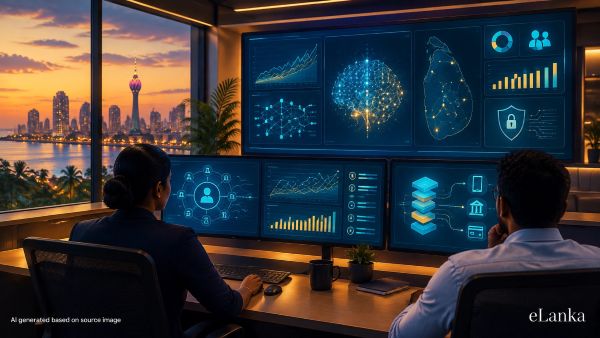
An AI-generated editorial illustration of engineers working on an electric three-wheeler frame. Image: eLanka.
A familiar vehicle reconsidered from the ground up
Tuktuks have long been embedded in the daily life of Sri Lanka, particularly in Colombo, where they are used for short-distance travel, commercial deliveries and small-scale business activity. Their compact dimensions allow them to move through congested streets, while their relatively modest operating costs have made them accessible to a broad section of the public.
Nevertheless, the conventional tuktuk has changed little over several decades. Its functional strengths have been accompanied by concerns relating to fuel consumption, emissions, occupant protection and the public perception of the vehicle itself.
According to the ABC Australia report, the ETX was designed from scratch rather than being created by converting an existing tuktuk into an electric model. That distinction is central to the project’s philosophy. By beginning with a new platform, the engineers were able to consider the vehicle’s body shape, structural strength, stability and passenger environment as interconnected elements.
“We wanted to redefine the three-wheeler,” Mr Deegala said in the feature. He explained that the team had not simply converted a traditional tuktuk, because the conventional design had remained largely unchanged for many years. Instead, a more futuristic vehicle was envisaged, one that would remain recognisably a three-wheeler while possessing a more distinctive and iconic appearance.
The approach reflects an increasingly important principle in sustainable transport: electrification is most effective when it is combined with thoughtful design. A vehicle that is cleaner to operate but difficult to use, unattractive to customers or poorly suited to local conditions is unlikely to achieve broad acceptance. Elektrateq’s stated ambition is therefore directed not only towards propulsion, but also towards desirability and social acceptance.
Environmental and economic potential
The environmental case for electric three-wheelers is particularly significant in Sri Lanka, where petrol-powered tuktuks form a substantial part of the road transport system. Dr Subasinghe told ABC Australia that replacing the country’s ageing fossil-fuel fleet with electric models could potentially reduce carbon dioxide emissions by six trillion kilograms per year.
He also referred to the possibility of reducing approximately US$1.8 billion in fuel imports, while noting that electric vehicles could potentially be powered through solar energy. These figures represent estimates and aspirations presented by the company, and they should not be interpreted as verified outcomes already achieved by the ETX or by Sri Lanka’s transport sector.
The potential benefits, however, indicate why the project has attracted attention beyond the automotive industry. A large-scale transition from petrol-powered three-wheelers to battery-powered alternatives could affect several areas simultaneously, including household transport costs, national fuel dependence, urban air quality and the development of renewable-energy infrastructure.
Solar power could be particularly relevant in a country with strong sunlight and an expanding interest in renewable energy. If charging systems were progressively connected with solar generation, the operating model for electric three-wheelers could become less dependent on imported fossil fuels. Such an outcome would require substantial investment in charging facilities, grid capacity, battery servicing, financing and maintenance, but the possibility demonstrates the wider systems-level value of locally designed electric transport.

An AI-generated illustration representing the potential relationship between electric transport and solar energy. Image: eLanka.
Safety placed alongside appearance
The ETX’s visual character is one of its most apparent differences from the traditional tuktuk, but the ABC feature also highlighted the attention given to safety and structural design.
The vehicle has a more aerodynamic form, while its chassis is reported to incorporate a stronger steel frame. A front crumple zone is intended to help manage impact forces, and the structure is designed to offer additional protection in the event of a rollover. Dr Subasinghe also stated that attempts to tip the vehicle demonstrated a high degree of resistance to overturning.
These reported features are important because three-wheelers operate in complex road environments, where traffic density, road surfaces, vehicle loading and driving conditions can vary considerably. Improved stability and occupant protection could contribute to a more reassuring experience for passengers and drivers, although independent testing, regulatory approval and real-world performance assessments remain essential before any safety claims can be fully evaluated.
Safety also forms part of the project’s wider mission to change how tuktuks are perceived. Dr Subasinghe told ABC Australia that the team wanted to challenge the idea that a tuktuk must be a tired or untidy-looking vehicle associated only with a particular segment of the transport market.
A more refined design could broaden the vehicle’s appeal, allowing it to be considered by a wider range of users, including families, professional operators and businesses seeking compact urban transport. In this sense, the ETX is being positioned not simply as an electric replacement, but as a reimagining of an established Sri Lankan vehicle.
Sri Lankan innovation with international relevance
The ETX is a positive example of Sri Lankan technical creativity being directed towards a practical national challenge. Rather than treating local transport conditions as an obstacle to innovation, the Elektrateq team has used the country’s most familiar three-wheeled vehicle as the starting point for a new design language.
The project also contributes to a broader conversation about how engineering solutions can be developed in emerging markets for local needs, rather than being imported unchanged from elsewhere. Colombo’s dense streets, the economic importance of three-wheeler operators and the country’s reliance on imported fuel create a distinctive context in which electric mobility must be affordable, durable and useful.
For Sri Lankan engineers and designers living locally and abroad, the ETX offers an encouraging illustration of how technical knowledge, industrial design and environmental responsibility can be combined in a recognisably Sri Lankan project. Its significance lies not only in the vehicle itself, but also in the confidence demonstrated by a team attempting to create an original product rather than adapting an established model.
The company’s environmental projections remain aspirations, and the broader transition to electric transport will depend on factors that include production scale, affordability, charging access, battery life and independent performance testing. Even so, the ETX represents an instrumental step in placing Sri Lankan design and engineering within an international discussion about cleaner urban transport.
As the country considers how its ageing vehicle fleet might eventually be modernised, the Elektrateq approach suggests that sustainability need not require the abandonment of cultural identity. With careful development, the familiar tuktuk could become an emblem of a cleaner and more technologically confident future.
For further positive stories about Sri Lankan innovation, business and achievement around the world, readers can explore the eLanka online community portal, which has connected Sri Lankans and their communities since 2005.
Source: https://www.abc.net.au/asia/culture-by-design-electric-tuktuk-from-colombo/107008266
This article was written based on the source https://www.abc.net.au/asia/culture-by-design-electric-tuktuk-from-colombo/107008266, kindly email us at info@eLanka.com.au if any information needs to be corrected.
(adsbygoogle = window.adsbygoogle || []).push({});
At eLanka, we respect the rights of creators. If we have used an image you own and you’d like it removed, please email us at info@elanka.com.au and we’ll handle it promptly.