Embedding creativity in every classroom: A regional conversation on the future of English language teaching
Free British Council online conference brings together leading educators from across South Asia to explore how creativity, inclusion and technology can help prepare learners for a rapidly changing world
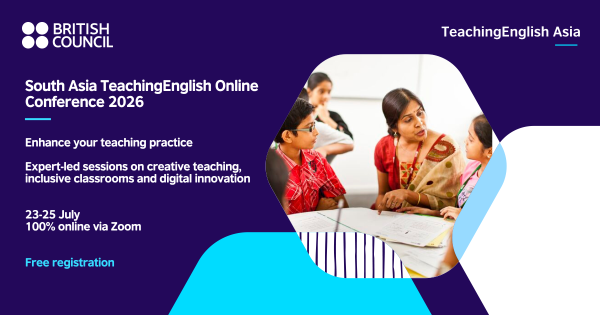
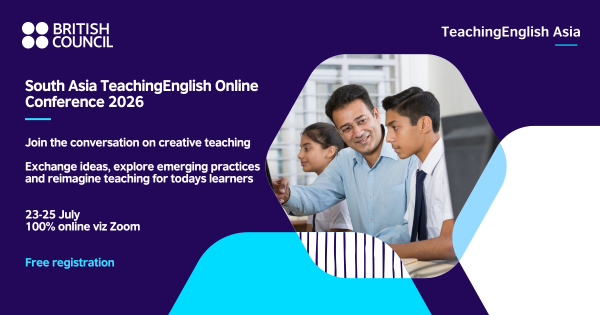
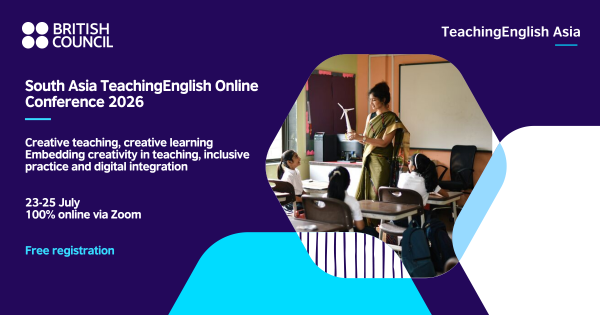
The British Council has announced the South Asia TeachingEnglish Online Conference 2026, a free three-day event that will convene educators, researchers and teacher educators from across the region to examine one of the most pressing questions facing education today: how can schools equip learners with the creativity, adaptability and communication skills needed to thrive in an increasingly complex world?
Taking place from 23–25 July 2026, the online conference comes at a time when education systems across South Asia are grappling with the challenge of balancing curriculum demands, assessment pressures and evolving learner needs. While English remains a critical gateway to academic and professional opportunities, educators are increasingly seeking approaches that move beyond language acquisition alone to foster critical thinking, collaboration, learner agency and participation.
Against this backdrop, the conference will bring together leading voices from Bangladesh, India, Nepal, Pakistan and Sri Lanka to explore the role of creativity as a catalyst for deeper learning. Discussions will examine how multilingual classrooms can become more inclusive, how learner voice can be strengthened through innovative pedagogies, and how emerging technologies, including artificial intelligence, can be harnessed to enhance rather than replace human-centred teaching.
Through keynote talks, practitioner-led discussions and classroom case studies, participants will gain insight into how educators across South Asia are responding to shared challenges with locally relevant solutions. The programme will spotlight practical approaches that are helping teachers create more engaging learning environments, encourage meaningful participation and expand opportunities for learners from diverse backgrounds.
Orlando Edwards, Country Director, British Council Sri Lanka said: “Creativity plays a vital role in helping learners develop the communication, collaboration and critical-thinking skills they need to succeed in today’s world. Through the South Asia TeachingEnglish Online Conference 2026, we are bringing together outstanding educators and teacher educators from across the region to share practical ideas, research-informed approaches and classroom strategies that teachers can adapt to their own contexts. We are delighted to offer this free professional development opportunity and look forward to welcoming educators from across South Asia and beyond.”
The South Asia TeachingEnglish Online Conference forms part of the British Council’s wider commitment to supporting teacher development and fostering dialogue on the future of English language education in South Asia, learn more here https://bit.ly/4ga30HU
About the Sri Lanka speakers
Anju Moses
An academic leader, educator, author and speaker with over 20 years of experience in education and leadership. She heads the English and Schools Education portfolio at the British Council Sri Lanka and has held diverse leadership roles across teacher development, digital learning and safeguarding.
Mithila Weerasinghe
A teacher trainer at the Regional English Support Centre, Sri Lanka, and curriculum developer with expertise in pedagogy and digital learning.
Imalka Kumari Wickramasinghe
A teacher of English at Thaksala Maha Vidyalaya with a passion for creative, interactive and inclusive English language teaching.
About the British Council
The British Council is the UK’s international organisation for cultural relations and educational opportunities. We support peace and prosperity by building connections, understanding and trust between people in the UK and countries worldwide. We do this through our work in arts and culture, education and the English language. We work with people in over 200 countries and territories and are on the ground in more than 100 countries. In 2024–25 we reached 599 million people.