Dalada Perahara-by Gamini Kariyawasam


Image Source:Getyourguide
Dynamic cultural representation of the Dalada Perahera and
The History of Tooth Relic .
May the Tooth Relic bless my country.May the Tooth Relic bless my country.A home filled with happiness is a paradise.
I inherited all this from birth
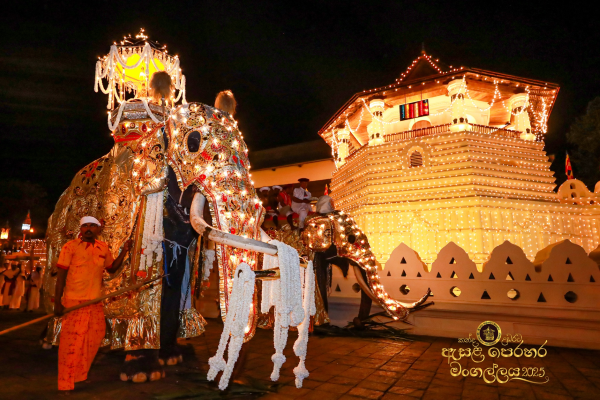
The 1716th Esala Perahera Maha Mangalya in the Kandyan Country will begin with the Kumbal Perahera on August 18, 2026.
The Kumbal Perahera will be held from August 18 to 22, and the Randoli Perahera from August 23 to 27. The Perahera will conclude with the afternoon Perahera on August 28. The annual Dalada Perahera, a celebration of cultural and Buddhist identity, will be heldOur ancestors called the month of Esala the “Perahera month”.
Scholars have concluded that there is some important reason for using the Esala Poya season as a ritual to hold the Dalada Perahera. The true philosophy was revealed to the world on an Esala Poya day. Since it was on an Esala Poya day that the Buddha preached the noble way of life called the Middle Way to the five monks in the Migadāya, it is worth appreciating the procession held at that time and paying homage to the Lord of the Tooth, which has been touched by the eighty-four thousand Sri Dharmaskandhas of the Peace Leader.
In accordance with ancient traditions, the Dalada Perahera is held based on auspicious signs. The task of preparing the auspicious signs is in charge of the auspicious signs. The task of preparing the auspicious signs is in charge of the auspicious signs.
Evidence suggests that the current Kandy Esala Perahera began in the mid-18th century AD. In the early days, this perahera was adorned only by the processions of the four great temples of Natha, Kataragama, Vishnu and Pattini. King Keerthi Sri Rajasinghe (1747-1782 AD) added a procession of the Temple of the Tooth to the perahera of the four temples, as advised by Venerable Weliwita Saranankara Sangharaja Thero, and the Esala Perahera began to shine with a Buddhist aspect.
Pottery procession
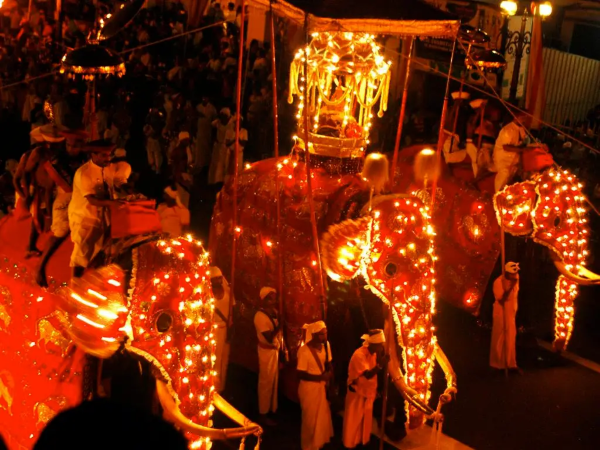
The “Kumbal Perahera” begins on the fifth day after the four great temple processions. The “Kumbal Perahera” is a five-day procession of elephants carrying the golden casket of the Golden Tooth. This procession was called the Kumbal Perahera because, according to legend, in the days of the previous kings, a potter carrying a new pot, or potter, walked in front of the procession before the first Dalada Perahera took to the streets.

Image Source:Amazinglanka
Randoli procession>
After the five-day Kumbal Perahera, the “Randoli Perahera” begins its street procession. It is said that this is called the Randoli Perahera because the king’s chief consort or “Randoliya” used to travel in this magnificent float during the reign of the King of Kandy.
It is an ancient tradition to bring the Randoli Dolavs, the sacred vessels of the four great temples, to the end of the Kumbal Perahera on the fifth day. The fifth or final day of the Randoli Perahera is called the “Great Randoli”.
The Randoli Perahera continues for five days. The Randoli Perahera, which can be considered the culmination of the Dalada Perahera, is colorful with the participation of Hevisi dancers, trumpeters, dancers, elephants, etc. A wealth of accurate information about the group of traditional artisans who make the Dalada Perahera colorful was obtained by inquiring with Neranjan Wijeratne, former Diyawadana Nilame.
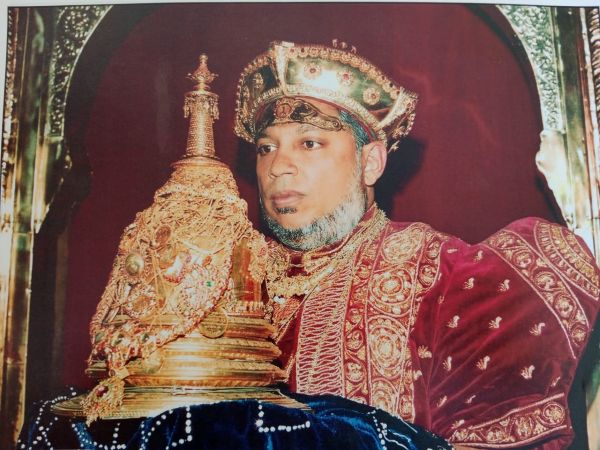
Neranjan Wijeratne, former Diyawadana Nilame[image.jpeg]
According to the information obtained from him, the group of traditional artisans who travel in the Dalada Perahera can be arranged as follows.
Whippers, Buddhist flag bearers, provincial flag bearers, sword bearers, fireball bearers, frontline rala, panikkiyan, Gajanayake Nilame, magul drum bearers, elephants, coconut flower dancers, trumpet players, tammattam players, daulwar players, talampota players, pathura dancers, savaran dancers, li keli dancers, panther dancers, hawadi dangaya, cane weavers, udakki players,
Tambourine dancers, knot drummers, Nayandi dancers,
Kandyan costume dances, Kariya Korala, Nagasingam playing,
The wedding elephant, the elephants in the forest, the poet’s hut, the water-lily-keeper,
The Natha Devalaya Perahera, Vishnu Devalaya Perahera, Kataragama Devalaya Perahera, Patthini Devalaya Perahera, and Dalada Perahera are colorful processions.
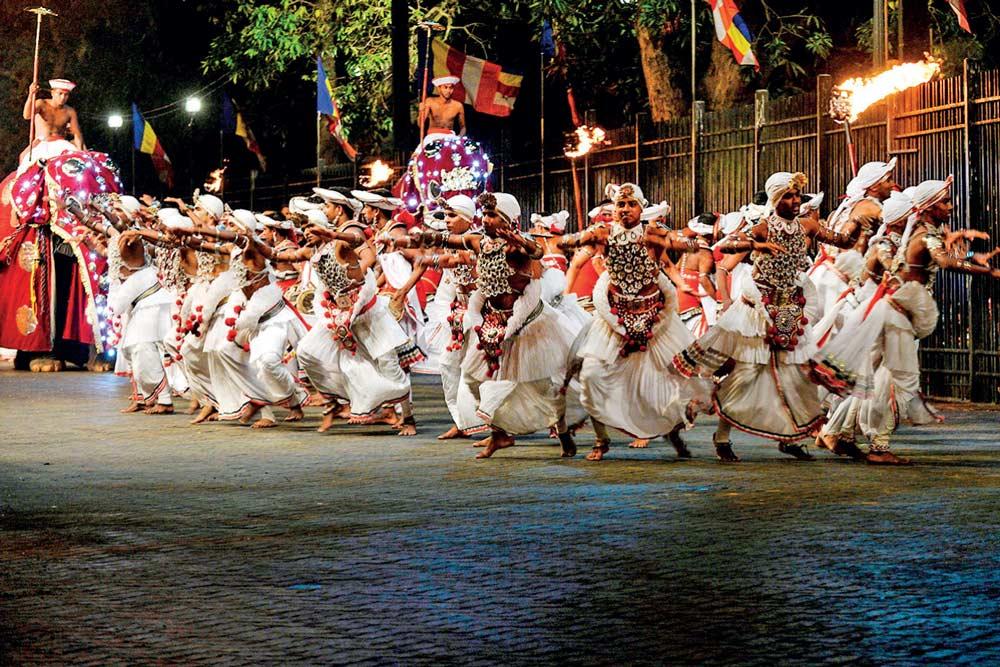
Image Source:Dailymirror
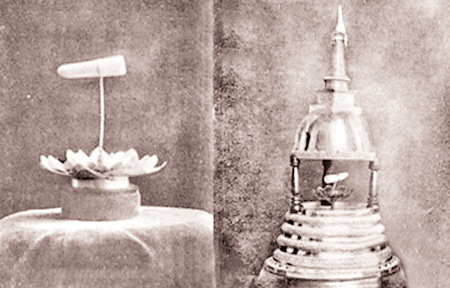
Image Source:Budusarana
Since ancient times, the route of the Dalada Perahera has been Dalada Street, Yatinuwara Street, Haras Street, Kotugodella Street, Kande Street and D.S. Senanayake Street.
The Dalada Perahera ends with the elephant carrying the relic casket entering the Temple of the Tooth Relic and carrying the relic casket back to the chamber where the Tooth Relic resides.
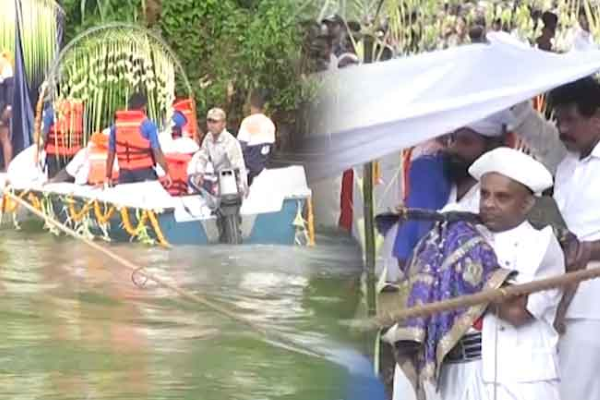
The final stage of the ritualistic rituals of the Dalada Perahera festival is,The water-cutting ceremony is performed with the auspicious image before the daytime procession. This ritual embodies the auspicious wish of timely rains and prosperity for the mud-land farming.
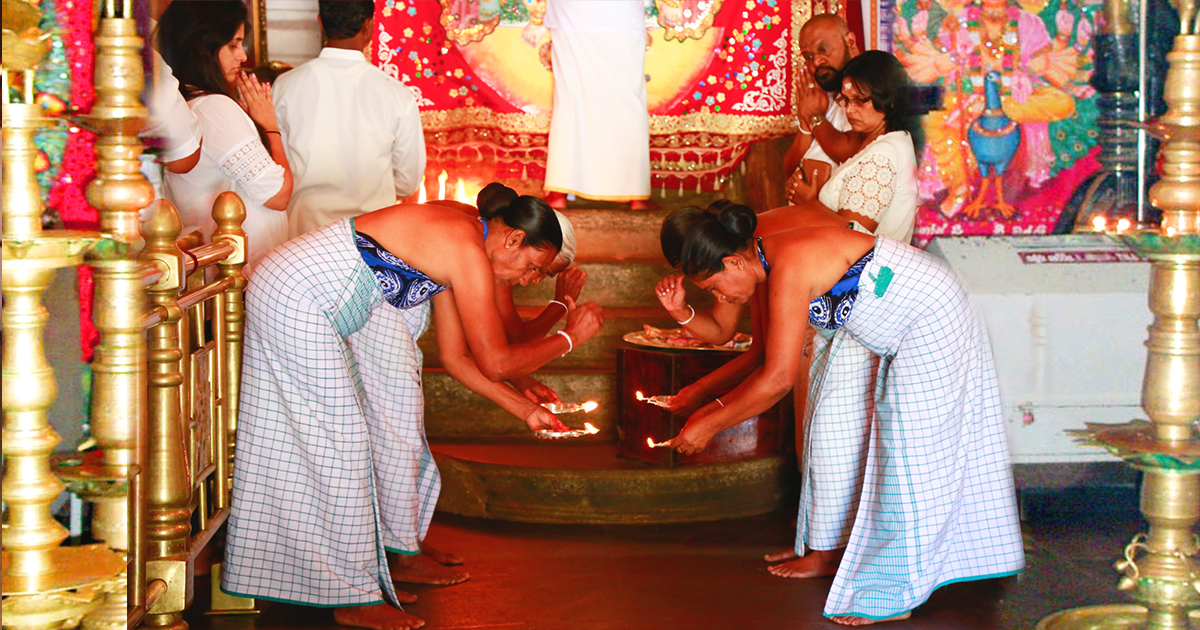
Image Source:Archive
(2024 The water-cutting ceremony) >
After the conclusion of the Dalada Perahera, the Diyawadana Nilame along with the Basnayake Nilames of the four temples met with the Head of State, the President, and assured him that the Perahera was conducted in accordance with proper procedures.
The Tooth Relic Purana.
We have discussed the splendor of the annual Dalada Perahera in homage to the Tooth Relic. At this juncture, it would be extremely important to examine the information about the Dalada Purana, including the arrival of the Tooth Relic, in order to broaden the reader’s horizons of knowledge.
As revealed in the Datavamsa, after the Parinirvana of Sri Sambuddha, one of the Tooth Relics was obtained by Shakya, and the other Tooth Relics were obtained by King Harshavardhana of Gandhara and the four Naga kings and performed a procession. The remaining Tooth Relic of the four Tooth Relics was presented by the great Arahant Khema to King Brahmadatta of Danthapura in Kaliguda in 433 BC. Brahmadatta built a magnificent and magnificent temple decorated with gold and placed the Tooth Relic there and worshipped it with great devotion. After his passing, the kings Kasi Raja, Sunanda, and Gubhasiva, who succeeded to the throne, also performed pujas protecting this precious sacred treasure with their lives. During the reign of King Subhasiva, the Tooth Relic was subjected to various attacks by the evil king Panadu. However, the Tooth Relic flourished in the Kaligu kingdom for almost 850 years without any harm.
A prince, the son of King Udeni, who came to the Tooth Relic, which was enshrined in the temple of the Tooth Relic in Kaligura under the protection of King Gubhasiva, was greatly pleased with the Tooth Relic and lived there, offering prayers to the Tooth Relic. He later became famous as Prince Dantha because of his dedication to the Tooth Relic. When the miracle of the Tooth Relic spread throughout the world, King Dambadiva Kshiradhara led an army and came to battle with Gubhasiva to take the Tooth Relic for himself. In order to rescue the Tooth Relic from the enemy kings, King Subhasiva summoned his daughter Hemamala and Prince Dantha and secretly took the Tooth Relic to his friend King Mahasena in Lanka. According to the author of the Datavamsa, some time before this incident, King Mahasena of Lanka had sent a letter to his friend King Gubhasiva asking him to send him at least some water containing the Tooth Relic. It is not surprising that the Kaligu kings remembered the Lord of Lanka at this critical time.
Princess Hemamala, disguised as a nun, sought the protection of the Tooth Relic and hid it in her long, blue hair and set foot on the island of Lanka in 362 AD. The Datavamsa reveals that on the way they were blocked by nagas, and until they were able to overcome the obstacles, they hid the Tooth Relic in the sand at a place called Dinnai on the banks of the Krishna River. First, Prince Dantha and Hemamaliya went to the Megha Giri Viharaya in Mahamevuna in Anuradhapura and met the great sages there and revealed all the news. By this time, King Mahasen, a friend of the Gubhasivas, had passed away, so his son Keerthi Sri Meghavarna offered to accept the Tooth Relic.
According to the chronology of the Mahavamsa, this memorable event occurred in the ninth year of the coronation of King Kithsiri Mevan. The author of the Chulavamsa states that in 460 AD, during the reign of King Upatissa, in order to save the country from a great drought, the king carried the Tooth Relic on an elephant and held a procession in the city of Anuradhapura, and that a great rain immediately fell. Between 516-526 AD, the king Vichala Dhatusena Maha Nirindu made a casket of red gold and offered it to the Tooth Relic. There is a lot of historical evidence to prove that the Tooth Relic remained safely in the kingdom of Anuradhapura for 701 years from the time of King Kithsiri Mevan until the tenth year of King Mahinda IV. The fourth king, Mahinda, had to face a powerful rebellion of the Keralans. King Mahinda, who was not powerful enough to suppress it, secretly fled to the land of Rohana, taking the Tooth Relic with him. After spending some time in Seedugala in the Rohana kingdom, he later built a small city at a place called Kapugala and enshrined the Tooth Relic and ruled as a regional king. When Prince Keerthi, who was the young king of Ruhuna, dethroned the Agarawa of Polonnaruwa in 1058-1174 AD and assumed the throne under the name of Vijayabahu I, a favorable period dawned for the Lord of the Tooth Relic. He brought the Tooth Relic, which had been hidden in the country of Ruhuna, to Polonnaruwa, enshrined it in a beautiful pacha and began to perform ancient rituals.
The city of Polonnaruwa, which had been under siege for 157 years, was also attacked by the Kalinga Maghayas. At this time, the Venerable Vachissara Maha Theranu hid the Tooth Relic and fled to Kotmale and buried it in the village of Malhewa in Puhulpitiya. After remaining there in secret for about twenty-one years, the Tooth Relic came into the possession of King Vathimi Vijayaba, who ascended the throne in 1220 AD. He built a temple at Beligala and enshrined the Tooth Relic there.
The great scholar of Kalikala literature, Parakramabahu Niridun, who established the kingdom of Dambadeniya in the Maya country, brought the Sri Dalada Maligawa Relic to his kingdom in 1224 AD and made the necessary arrangements to maintain the ancient rituals. The first king, Bhuvanekabahu, who came to Yapahuwa, also brought the Relic of the Tooth to Yapahuwa seeking prosperity for his kingdom.
In 1271 AD, the Padi general of the Indian king Kulasekara, Arya Chakravarti, who invaded Yapahu, kidnapped the Tooth Relic and the bowl, which had been the heart of the Sinhalese Buddhas for nearly a thousand years, and took it to the Padi city of Madura. The next king of Sri Lanka, King Parakramabahu III, strengthened his friendship with the Padi kings and succeeded in bringing the Tooth Relic and the bowl to Polonnaruwa. Soon after, Prince Bhuvanekabahu II defeated the third Parakumba and brought the Tooth Relic to Kurunegala and placed it in three and five floors.
Then the Tooth Relic was brought to the Niyamgam Paya site in Gampola. Here, the fourth Buwanekabahu Nirindu placed the Tooth Relic in a casket made of seven thousand silver pieces. King Thuthwana Wickramabahu offered Wendurupitiya to the Tooth Relic, which was brought from Gampaila to Pallepitiya.
It is reported that the Sri Tooth Relic, which was later located in Senkadagala and Gampala, was brought to Kotte by Weerabahu Nirindu Jayawardena after he established the kingdom of Kotte. The King of Kotte, Parakumbhavan, also performed a memorial service for the Tooth Relic. He also arranged to hold an annual procession in honor of the Tooth Relic. At that time, the procession was held during the Sinhala New Year, the national festival of the Sinhalese. Parakramabahu Nirindu also considered the Tooth Relic Perahera as a means of displaying his power and might. Sri Rahal Thero, spreading his mini-resins to his angelic wife, invites her to offer her devotion to the Tooth Relic Temple in Jayawardena, made of moonstone and shining with a golden dome, in a lively poetic painting.
The world is filled with white moons.
Give, give
The love of the golden lotus that I received is bound to my heart.
The three-story temple of the Sacred Tooth Relic was built in the
During the reign of King Buwanekaba VII, the Portuguese had become powerful in the Kotte kingdom and it was not appropriate to keep the Tooth Relic in Kotte at this time. At that time, the caretaker of the Tooth Relic was a man named Hiripitiye Rala. One day, a certain woman appeared to him in his sleep at night.
“Kotte Harale – Datha Medagan Raale”
It is said that he disappeared after whispering in his ear. The great monk Ratnalankara, who lived in Devanagala Monastery, interpreted the two verses he heard in his dream as “May you abandon the love of Kotte and take the Tooth Relic to the center of the country,” and immediately advised Hiripitiya Rala to take the Tooth Relic and flee Kotte. He made a model of the Tooth Relic from an ivory tusk, placed it in a casket in the palace of Jayawardenapura, and took the real Tooth Relic and went to Mayadunne, who had become the king of Sitawaka, and handed it over to him.
In 1574, when King Bainuwang of Pegu, Burma, sent a Burmese delegation to Kotte to escort a Sinhala princess, Don Juan Dharmapala’s storekeeper, Sembagapperumal, presented the Burmese delegation with a piece of ivory, a replica of the Tooth Relic, which had been kept in Kotte by the Rala of Giripitiya. The Burmese king, who was deceived into believing that it was the real Tooth Relic, promised to send a large amount of wealth and a shipload of rice to Ceylon every year as a token of gratitude.
Mayadunne, who had taken possession of the Tooth Relic, built a beautiful palace on a rock at Sandagiriya in the Hela Palla region of Sambaragamuwa and enshrined the Tooth Relic there. It is said that Mayadunne also placed several armed guards around Sandagiriya to protect the sacred object from the Portuguese. Later, the Tooth Relic was brought to the Delgamu Vihara for strict protection. According to legend, the Delgamu Vihara Thero, due to his unparalleled devotion to the Tooth Relic, resorted to a great strategy to protect the Tooth Relic. He made two artificial relics from ivory, placed one in the place where the Tooth Relic was located, and gave the other to Veediya Bandara, and hid the real Tooth Relic in his waist, fled to Palabathgala and lived there. Meanwhile, when the Portuguese invaded Seethawaka, a Portuguese officer named Constandasah took the artificial tooth there, as well as the artificial tooth that was in the possession of Veediya Bandara, who was arrested in Jaffna, and sent it to Goa, where it was burned and destroyed. This story is revealed in the book “Ceylon” by Emerson Tennant. Although historians such as Queros, who were misled by the incident of destroying the artificial tooth, mentioned in their historical works that the Portuguese destroyed the Tooth Relic in 1560.
After Mayadunne, his son, King Rajasinghe I, who took over the Seethawaka kingdom, continuously held a procession of the Tooth Relic for eleven years during his reign and transported the Tooth Relic from the Delgamu monastery to the Maha Saman Devalaya. The ancient Delgamu temple secretary’s meeting testifies that he donated twenty-two nintagams for the maintenance of the Tooth Relic and a large elephant to transport the Tooth Relic.
When Konappu Bandara fled to Goa, converted to Catholicism under the name Don Juan, and led a Portuguese army to fight the Rajasinghes, the Tooth Relic was removed from its golden casket and hidden in a hole in a rock in the Delgamu monastery. This rock, which was placed on a rocky slab attached to the back of the Buddha statue in the Delgamu monastery, can still be seen there today.

Image Source:Amazinglanka
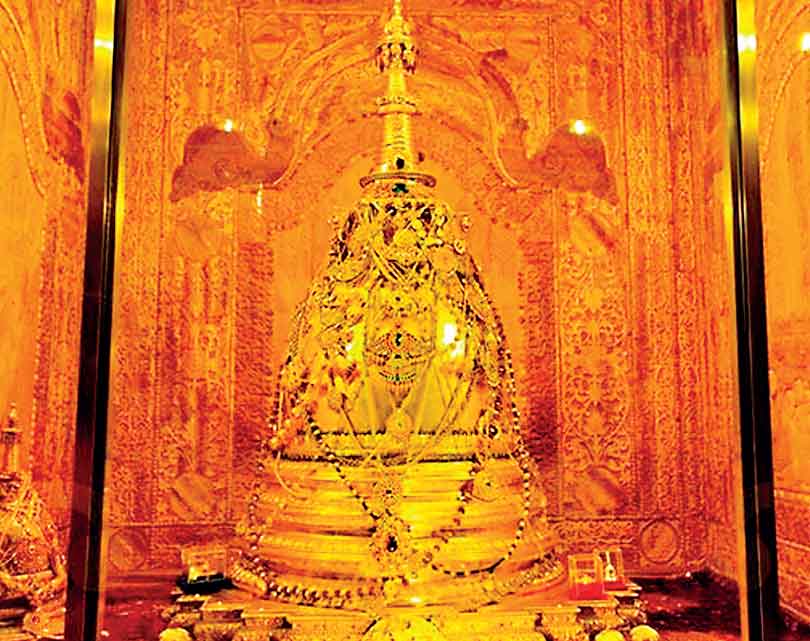
Image Source:FT
Delgamuwa Raja Maha Vehera, Kurahan Rock where the sacred relics were hidden
After Don Juan defeated Rajasinghe and suppressed the Portuguese power, embraced Buddhism and was ordained as the first Vimaladharmasuriya of the Kanda region, the Tooth Relic was entrusted to him. He had a casket made of new silk and placed the tooth relic in it. Today, the Tooth Relic resides in this casket, radiating its radiance. Its golden key is in the custody of the Asgiri Maha Vehera, and opening the casket with that key is a difficult task for those who have not been trained for generations.
During the 1818 uprising against the British, the Sinhalese removed the Tooth Relic from the palace and took it to a safe place. At this time, the great hero of Monarawila, Keppetipola, displayed the Tooth Relic in his custody to the public at a place called Hewaheta Godamune, and strong public support for the Sinhalese freedom struggle began to flow. It seems that the main reason for this was the strong belief among the people since ancient times that the one who possessed the Tooth Relic was the heir to the throne.
In 1856, the custody of the Tooth Relic was transferred to the Mahanayaka Mihivarun of the Malwathu Asgiri Ubhaya Vihara. According to the book Eleven Years of Ceylon written by Major Forbes, the first time the Tooth Relic was exhibited after the reign of King Keerthi Sri Rajasinghe was on 29 May 1828. Governor Edward Barnes attended this exhibition as the chief guest. During the Kurunegala Pura period, several works related to the Tooth Relic were added to the Sinhala literary family. Among these works, the one that was performed in 1325 AD during the reign of King Parakramabahu IV, the Devada Dam Pasanginavan, holds a prominent place. The subjects of the Dalada Siritha included a brief biography of the Buddha, history from the reign of King Kithsiri to the fourth Parakumba, and a set of rules and regulations that included the rituals and ceremonies to be performed for the Tooth Relic.
King Wimaladharmasuriya I brought the Tooth Relic, which resided in Delgamuwa, to Senkadagala and that night had it placed at the Maluwe Gedige Viharaya in Asgiriya. The next day, the tooth relic was taken to the royal palace in a grand procession. Since then, it has become a tradition of the Sinhalese to hold a procession during the Esala period every year to pay homage to the tooth relic.
In addition to the Dalada Perahera, four festivals are held in the vicinity of the Temple of the Tooth in a year. Also known as the Four Great Festivals, this series of festivals includes the New Rice Festival, the New Year Festival, the Vesak Festival and the Karthika Festival.
Previous kings have enacted regulations that the palace’s poet’s chamber, Nagasittam, tambourine and alatthi should be performed during festivals at the Temple of the Tooth, Poya days, and when the Tooth Relic is displayed.
“Gods, farewell to the Buddha.”
“Goodbye for a long time”
“A thousand Kapwans, farewell”
You may have come across such a procession when you enter the main gate of the Temple of the Sacred Tooth Relic with a sincere heart. As you approach the Temple of the Sacred Tooth Relic, you will be able to clearly see the two women carrying two silver lamps in their hands as they perform the procession. In the meantime, you can hear the pilgrims of the poet’s temple singing the ancient Dalada song to the tune of the tune.
The ritual performed by the two children is called Alaththi Bema. When we examine how this ancient ritual came to be associated with the Temple of the Tooth, we are suddenly reminded of the rituals practiced in the prosperous palaces of ancient kings.
In the past, when kings went to bed, it was customary for beautiful lalas to stand near the king, holding silver lamps in their palms and singing benedictions. Sinhala kings enjoyed the royal palace and made sure to perform every auspicious and auspicious event for the Lord of the Tooth Relic. Accordingly, it is said that by the order of the kings, the Alaththi Bama was included among the rituals of the Temple of the Tooth Relic.
[image.png]’Aalaththi’ is a word derived from the Tamil language and is a traditional female service that performs special rituals in Dalada Maligava and the inner courtyard of the palace.
The Alatthi women perform the ancient ritual of removing the amulets from the Temple of the Tooth.
The offering of the sacred tooth relic with five musical instruments during the three yamas is an important ritual that has been maintained since ancient times and continues to this day. In the fixed legal system of the palace, this musical instrument is known as Singarama. The Sinhalese kings had appointed four musical instrument leaders called Panikki from four provinces to carry out this task.
The duties of the Temple of the Tooth – To fulfill the duties of the temple, the kings of the Kandy era had appointed 21 officials in the inner palace, 18 in the outer palace and 41 officials including the Diyawadana Nilame. In the previous reign, the Maha Adhikaram was the chief administrator of the Temple of the Tooth. After 1853, that position was given to the Diyawadana Nilame.
A group of officials who have dedicated their entire lives to the service of the Temple of the Tooth by royal order.
The Kariya Korala, the Rala of the recipe, the Kankanam Rala, the Geba Rala, the Mohottala, the Kottal Badu Rala, the Arachchila, the Arachchila of the Dumbara Pidaville, the Murukara Wale Murukara, and the Hakgedi Kara Appu occupy an important place among these categories of workers.
The first official to be summoned by the Diyawadana Nilame in every matter of the palace is the Kariya Korala. It was his official duty to investigate the shortcomings of the palace and rectify them. As soon as the Kaththiyana Ralala leaves the palace carrying the alms basket called Hema Kada from the palace, the sound of Hakgedi spreads throughout the palace. This is the time when the Hakgedi Kara Appu performs the official duty assigned to him. In case of any emergency, the Hakgedi Kara Appu also carries a Hakgedi in his hand and is responsible for guarding the palace at night. It is confirmed from ancient documents that the kings of the Kandy era had given land and villages to these officials for their livelihood, who were always dedicated to performing the rituals for the Lord of the Tooth Relic.
The various sections of the temple are called Vyavaharitha. The hall where the relic is kept is called the Vyava Inna Mandapa. The Sala Pathala Mandapa is located right after climbing the stairs to the upper floor. Beyond that is the section called the Handuna Kudama. Devotees kneel down and worship the Lord from here.
Among the historical and important paraphernalia surrounding the Dalada Maligawa, the Patthirippuwa holds a special place. This captivating Patthirippuwa was built by Sri Wickrama Rajasinghe. In the old days, when the countrymen gathered in large numbers in the front courtyard to pay their respects to the king, the king would address his people from the Patthirippuwa. It was also a tradition for the king, who came to the Patthirippuwa during the exhibition of the Dalada Maligawa, to personally carry the Tooth Relic and present it to the people gathered in the courtyard. Due to the Dravidian influence during the Kandy period, the word Patthirippuwa came into use by combining the two Dravidian words Pattu + Irippu. The Patthiripuwa and the Temple of the Tooth, which belonged to the Maha Vasala, came under the control of the British after the Kandyans came under British rule. Doyle, who was in charge of the administration of the Kandy district under the British government, presented the Patthiripuwa and the Temple of the Tooth to the Malwathu Asgiri Viharaya on 13 April 1815.
2025 Dalada Randoli Perahera Live >