Flying Foxes: The Silent Guardians of the Night – by Bhanuka – eLanka
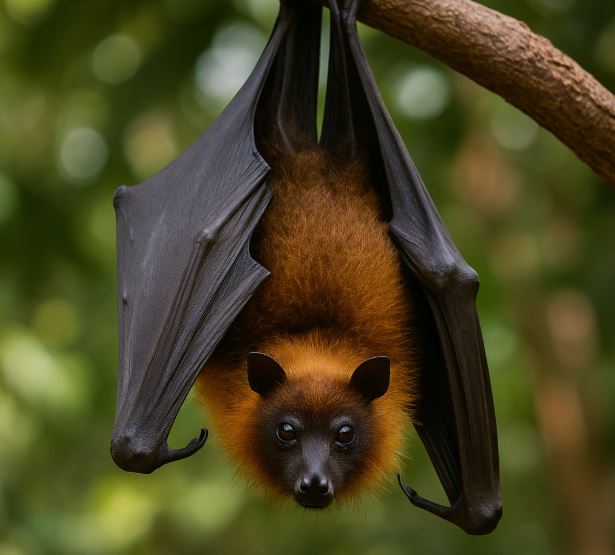
Among the many wonders of the natural world, few creatures inspire as much curiosity and awe as the flying fox. These magnificent bats, often mistaken for something out of a fantasy tale, are among the largest bats on earth, their vast wings stretching wide as they glide across the twilight skies. Known scientifically as members of the genus Pteropus, flying foxes inhabit much of Asia, Australia, and the Pacific islands, and their presence has shaped not only the ecosystems they call home but also the myths and folklore of human societies that live alongside them.
To see a flying fox in motion is to witness a paradox of elegance and power. With wingspans that can exceed five feet, they are giants among bats, yet their flight is marked by a fluid grace as they soar between fruiting trees under the cover of dusk. Their faces, strikingly fox-like with large eyes and pointed muzzles, give them an appearance that is more endearing than frightening. Unlike many of their smaller bat cousins, flying foxes feed not on insects but on nectar, flowers, and fruit. They are pollinators and seed dispersers of extraordinary importance, helping forests regenerate and plant species thrive. In fact, many tropical trees owe their survival and distribution directly to these nocturnal gardeners of the sky.
The role of flying foxes in maintaining ecological balance cannot be overstated. As they travel great distances in search of food, they spread seeds far from the parent trees, ensuring genetic diversity and forest expansion. Their feeding habits on nectar also make them essential pollinators, carrying pollen across wide ranges and linking plant populations that would otherwise remain isolated. Without the nightly labors of flying foxes, countless ecosystems would falter, and the diversity of life in tropical and subtropical forests would decline. They are silent guardians, their value hidden from the untrained eye, but deeply felt across landscapes.
Despite their ecological significance, flying foxes often find themselves at odds with human populations. In agricultural regions, their fondness for fruit trees sometimes brings them into conflict with farmers, who see them as pests. Orchards of mangoes, bananas, or guavas can attract large colonies, and the sight of dozens of bats descending upon ripening fruit can spark frustration. This tension has, in many places, led to persecution, hunting, and even mass culls. Yet the loss of flying fox populations ultimately harms the very landscapes humans depend on, for without these bats, the forests that regulate climate, provide water, and sustain countless species—including humans—begin to weaken. Conservationists argue that the challenge is not to remove flying foxes, but to find harmony with them, recognizing their services and mitigating conflicts in ways that allow coexistence.
Cultural attitudes toward flying foxes vary widely. In some societies, they are revered as symbols of longevity and good fortune. In parts of China, bats are traditionally linked to blessings and prosperity, and the flying fox, with its impressive size, stands as a powerful emblem of vitality. In contrast, in other places, bats have been burdened by associations with darkness, fear, and superstition. The truth of flying foxes, however, lies beyond myth or misunderstanding. They are neither omens of doom nor mystical spirits; they are keystone species whose quiet presence shapes the living world.
One of the most fascinating aspects of flying foxes is their highly social nature. Colonies, or “camps,” can number in the thousands, with bats clustering together during the day in large roosting sites. The trees that host these colonies often become landmarks, filled with the chatter and movement of countless bats. At dusk, the colony stirs, and the air becomes alive with wings as wave after wave of flying foxes takes to the skies. The sight of such a mass emergence is unforgettable: a river of wings flowing across the fading light, each bat setting out on its own journey, yet together forming one of the great spectacles of the natural world.
These bats are also surprisingly intelligent. Their large brains relative to body size suggest advanced problem-solving abilities, and researchers have observed behaviors that hint at complex social interactions. Mothers are known to care tenderly for their pups, carrying them until they are strong enough to cling to the roosts on their own. Young bats learn not only to fly but also to navigate the intricate networks of food sources and safe resting places. The continuity of bat knowledge, passed from generation to generation, ensures the survival of their colonies even in changing environments.
Sadly, flying foxes face significant threats across their range. Habitat loss is among the most pressing. As forests are cleared for development or agriculture, roosting sites vanish and feeding grounds diminish. Climate change, too, poses challenges, with extreme heat events in recent years killing tens of thousands of bats in Australia alone. Disease outbreaks and hunting for bushmeat in some regions further reduce populations. Each of these pressures chips away at their numbers, and the disappearance of flying foxes would spell disaster for ecosystems that rely on them.
Efforts to conserve flying foxes are growing, driven by both scientific understanding and public awareness. Protected areas that safeguard roosting and feeding sites are critical, as are education campaigns that shift perceptions from fear to respect. Some farmers are experimenting with netting and other methods to protect fruit crops without harming bats. Communities that once viewed flying foxes solely as pests are learning to value them as allies in sustaining healthy landscapes. International cooperation is also vital, since flying foxes are long-distance travelers whose survival depends on the health of ecosystems that span across borders.
To spend time in the presence of flying foxes is to be reminded of nature’s interdependence. Their nightly flights stitch together the fabric of forests, carrying life from tree to tree, valley to valley. They embody the idea that strength lies not in isolation but in connection, for their existence ensures the flourishing of countless other species. In a world where biodiversity is under threat, flying foxes stand as powerful symbols of resilience and guardianship.
In the end, the story of the flying fox is not just about bats. It is about the hidden threads that bind ecosystems, the often overlooked actors who sustain the drama of life. It is about the responsibility of humans to see beyond narrow interests and recognize the greater whole to which we belong. When we protect flying foxes, we protect forests, water, air, and climate. We protect ourselves. These gentle giants of the night are not merely creatures of curiosity—they are living reminders of balance, beauty, and the quiet power of nature’s design.