




Four Tugs Bring Stricken 23,000-Tonne Cargo Ship Safely into Hambantota
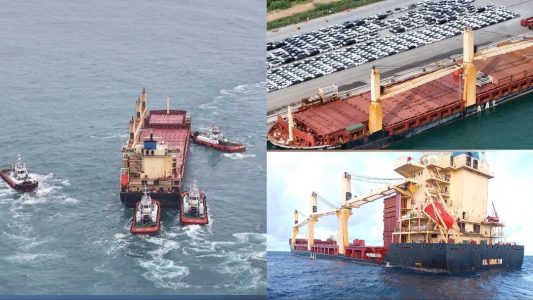
Featured photograph: Newswire.
The Cyprus-flagged cargo vessel MV AAL Gibraltar has been safely towed to Hambantota International Port after suffering an engine failure approximately 12 nautical miles off Hambantota, in an operation involving four rescue tugboats and recommendations from Sri Lanka’s maritime and environmental authorities.
The vessel, which measures 159.99 metres in length and was carrying nearly 23,000 tonnes of cargo, is now at the port, where technical services and other necessary facilities are being provided to support repairs. Those repairs are underway, according to Newswire’s report published on 26 November 2026.
The account is brief, but the operation highlights an important aspect of maritime readiness: a disabled vessel needs a safe route to support and repair, and bringing it into port calls for the involvement of people and institutions with responsibilities for shipping, the marine environment and harbour operations.
A measured response off Hambantota
Newswire reported that MV AAL Gibraltar experienced engine failure around 12 nautical miles from Hambantota. The vessel was then towed to Hambantota International Port using four rescue tugboats.
The operation was carried out following recommendations from the Director General of Merchant Shipping, the Marine Environment Protection Authority (MEPA) and the Harbour Master. The report does not provide further operational detail, so the circumstances of the engine failure, the duration of the tow and the identities of the tug operators are not included here.
What is established is the result: a large cargo vessel that could not proceed under its own engine power was brought safely to port, and support for its repairs is now in place. The facts point to a practical response, rather than a need for dramatic description. Four rescue tugboats were used, and the relevant authorities’ recommendations formed part of the process.

AI-generated illustration based on the reported operation. It is not a photograph of MV AAL Gibraltar or the actual tow.
The importance of coordination
Maritime incidents can involve several distinct areas of responsibility. In this case, Newswire identifies recommendations from the Director General of Merchant Shipping, MEPA and the Harbour Master. Their inclusion in the report underscores the value of coordination between shipping oversight, environmental protection and port operations when a vessel requires assistance.
The source does not describe the decision-making process or assign specific tasks to each authority. It does, however, establish that their recommendations were part of the operation. That institutional involvement, together with the use of four rescue tugboats, provides a clear outline of how the vessel was brought in without adding unreported details.
The work did not end when the ship reached the port. Hambantota International Port has provided technical services and other necessary facilities to support the repairs, which are now underway. That follow-through is an essential part of the response: reaching a place of support enables the vessel’s repair work to proceed, while the port’s stated assistance provides the practical facilities needed for that next stage.
The report does not give a repair schedule or indicate when the vessel may be ready to resume its voyage. At present, the confirmed update is that repairs are underway with support from the port.
Hambantota’s maritime setting
Hambantota lies on Sri Lanka’s southern coast, near the east–west shipping corridor across the Indian Ocean, a route commonly recognised as one of the world’s busiest. That geographical context gives maritime response capability in the area significance beyond the immediate needs of a single vessel: ports and supporting services can be important points of assistance for shipping moving across a major international waterway.
That broader setting should not be confused with details of this particular operation. Newswire’s report focuses on the engine failure, the tow into Hambantota International Port and the repair support being provided. It does not describe the vessel’s intended route or destination, nor does it specify the type of cargo on board. The reported facts are sufficient to show why reliable port services matter: when a vessel cannot continue under its own power, access to a port and the facilities available there can provide a practical setting for repairs.
Hambantota International Port’s role in this account is therefore both specific and concrete. Four rescue tugboats were used to tow MV AAL Gibraltar to the port, after recommendations from the relevant authorities, and technical services and other necessary facilities are now supporting the repair work.
A quiet demonstration of port capability
The safe arrival of a 159.99-metre vessel carrying nearly 23,000 tonnes of cargo represents a significant operational undertaking, but the public account does not call for embellishment. It records an engine failure offshore, the use of four rescue tugboats, the involvement of maritime and environmental authorities, and a port response that has moved into the repair phase.
That sequence offers a measured illustration of seamanship and institutional capability. The significance lies not in speculation about what might have happened, but in what is known: the vessel was towed safely to Hambantota, and the port is providing support while repairs proceed.
For Sri Lanka, a port situated close to an important Indian Ocean shipping corridor has a practical role in maritime activity. This incident demonstrates how that role can extend beyond routine port services to include assistance for a vessel requiring technical support. The contribution described by Newswire is straightforward and valuable: the ship has been brought to a place where the repair process can continue.
As repairs proceed, further information about the vessel’s condition or next steps may be reported by the relevant organisations. Until then, the confirmed account remains clear. MV AAL Gibraltar, a Cyprus-flagged cargo vessel, suffered an engine failure approximately 12 nautical miles off Hambantota; four rescue tugboats brought it safely to Hambantota International Port; and technical services and other necessary facilities are supporting repairs that are now underway.
Source: Newswire, “Sri Lanka rescues cargo ship carrying nearly 23,000 tonnes of cargo”, 26 November 2026
This article was written based on the source https://www.newswire.lk/2026/11/26/sri-lanka-rescues-cargo-ship-carrying-nearly-23000-tonnes-of-cargo/, kindly email us at info@eLanka.com.au if any information needs to be corrected.
At eLanka, we respect the rights of creators. If we have used an image you own and you’d like it removed, please email us at info@elanka.com.au and we’ll handle it promptly.
Thanks.
eLanka team
eLanka Disclaimer
Content published on eLanka may be created by the eLanka team, submitted by contributors or third parties, reproduced or adapted from other sources with appropriate source acknowledgement, or provided as promotional/advertising material by our clients. While eLanka takes reasonable care in preparing and publishing content, we do not warrant its completeness or accuracy. Views expressed are those of the respective authors or contributors and do not necessarily represent the views of eLanka. Third-party contributors, content providers and advertisers are responsible for the accuracy of material they supply and for ensuring they hold the necessary rights and permissions for its publication. Advertising and promotional content should not be regarded as an endorsement by eLanka of any product, service or claim.