Galle: A Heritage city under threat– Interview with dr. Uditha Jinadasa-by Doreen van den Boogaart & Luc Bulten
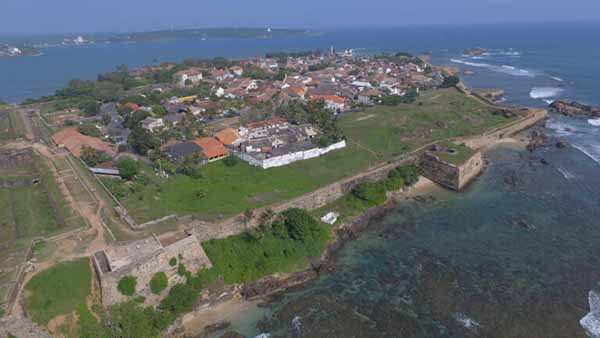
Aerial view of Galle, ©Uditha Jinadasa
Source:Stichtingnederlandsrilanka
In Spring 2020 Dr. Uditha Jinadasa defended her dissertation ‘Changes in the Cultural Landscape and their Impacts on Heritage Management: A Study of Dutch Fort at Galle, Sri Lanka’ and earned her PhD from the Faculty of Archaeology, Leiden University. The fortified town of Galle is a living heritage city, but this status is threated by gentrification. Dr. Jinadasa researched what has happened to the architecture, demography, economy, and city culture since the Fort has become UNESCO World Heritage in 1988. Luc Bulten and Doreen van den Boogaart, young ambassadors of the Netherlands Sri Lanka Foundation, interviewed her about her thesis and her view on heritage management in Sri Lanka.
Q: In your PhD thesis you note that on the one hand the current ongoing gentrification of Galle fort has caused many local inhabitants to be forced to leave, while at the same time it provides a stable method of income for the local community. We were wondering, who could stay, and who had to move, and why?
‘In the gentrification process of the fortress, I identified three waves. It all started with the Galle Fort’s UNESCO World Heritage recognition in 1988. The land prices gradually went up and the local people sold their properties. These were the ordinary people in need of money in that very moment. During the second wave the middle class started to sell their properties too, for better prices as the land increased in worth. In contrast to what happened during the first wave, the residents saw the economic benefits as from 1988 foreign investors bought properties in the Fort. People sold or rented out their properties, others started business to meet the wishes of the influx of tourists. In the third wave none of the local community sold their properties; they stayed, started tourist business, or leased out their houses. In thirty years, the number of residents in the town decreased by two-thirds.’
The text continues after the documentary made by Uditha Jinadasa in which she speaks with several (former) residents of the Fort.
‘Unfortunately, the residents of Galle Fort who moved out in the earliest wave, are hit twice as hard.’ Jinadasa puts her attention to the impact of the gentrification of Galle Fort on the former residents. ‘They regret losing their houses and if they had sold their land later on, they could have sold it for a far better price.’ The feeling of loss is a recurring topic in the documentary ‘Another Story of Galle Fort, A UNESCO World Heritage City’. One of the main characters is a person who sold his house to a foreign investor in 2011. He regrets selling his property in the Fort, because his former house at the Pedlar Street contains a lot of his memories. ‘Not only the ones moving out are sorry for the changes the fortress goes through.’ Jinadasa continues, ‘The influx of tourists and (foreign) investors changed the environment in the city. However, in 2019, the majority of the local residents were earning their living in the tourist industry, with B&Bs, souvenir shops, restaurants, etc.T hey experience the financial benefit of the current situation and accept it.’
‘Despite the changes, the (former) inhabitants still like the place. Some people who moved out still visit the fort in the evenings to look at the sunset. Many have a very personal connection to the city, which has not faded away after they left. Others, like a banker Jinadasa asked what Galle meant to him, never wants to leave. He spoke about the Fort as gama (village): ‘I was born in this place, I worked in this place and I want to die in this place.’
Q: Next to the people, a large part of your doctoral research focused on the buildings. Your research pointed out that a minority of the buildings within the fort is still true to the original colonial architecture (36%, opposed to 44% that can no longer be considered as such), would you argue that the influx of domestic and foreign tourists is the prime factor contributing to this ‘loss’?
Yes, there were around 350 buildings in 1988, now there are nearly 500, including the subdivisions and the new infill. Foreign and local investors moved their attention to Galle. Not to live there, they needed space for their business. The buildings consequently developed towards the tourist industry: they became luxury villas, hotels, shops, galleries. You must not forget’, Uditha Jinadasa explains, ‘that the buildings were very old, which do meet the modern living requirements. These buildings had to the building development regulations of Galle Fort. Experts had identified several colonial elements of Galle, like verandas, pillars, internal courtyards. As a result, around 40 percent of the buildings were developed, many according to the regulations and the rest were illegal developments.
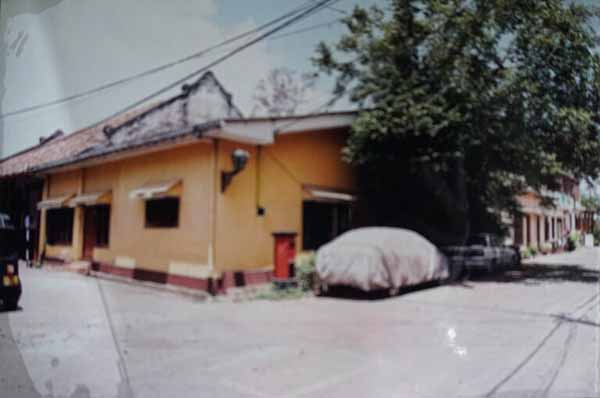
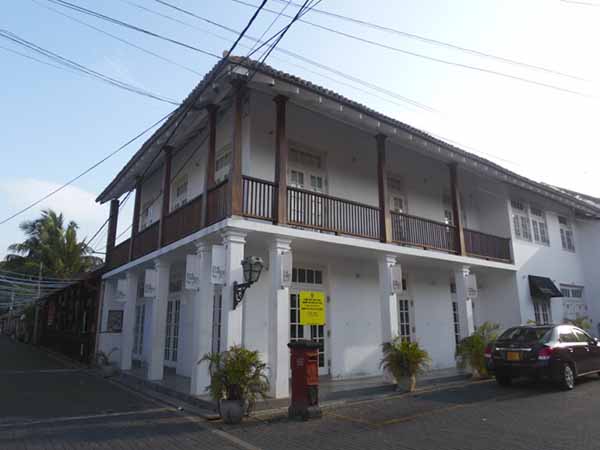
A comparison between the original house, and the building it was replaced with within Galle fort. ©Uditha Jinadasa
Q: In the documentary the (then-)director of the Department of Archeology mentions that they cannot stop the gentrification from taking place, as you cannot deny people from selling their property. Do you believe there is a way the local authorities could negate this process and allow local people to stay?
‘We could shift to a community-centered approach and encourage people to stay. For example, by giving people the (financial) support to develop their property. Developing property is very expensive as accordingly to the regulations an architect needs to be consulted, whose service fees are to high. In any case we should make laws that are community friendly and not laws that are beneficial for investors.’
Q: Is it at all important for historical heritage sites like Galle to maintain its ‘authenticity’? Or should it predominantly serve the contemporary purpose of tourism, education, and recreation? In other words, is it that bad if the original architecture is lost if it contributes to its economic function [e.g. swimming pools for hotels]?
‘Let us take the canal area of Amsterdam as an example: People visit the Canal Ring precisely because of its historic buildings. If there are no historic buildings left in Amsterdam or Galle Fort, why do we still visit the places then? Moreover, since the fort is a living heritage site, the local people should benefit from it and be able to enjoy the place as it was before. So yes, the authenticity needs to be preserved to a certain extent.’
Q: In several other cases in Sri Lanka, particularly in Colombo, old and decaying heritage was rebuilt and repurposed – particularly into (high-end) shopping malls like Dutch hospital and Arcade Independence Square – often saving it from demolition. Do you think this is a good way to save historical buildings and heritage?
‘Sri Lanka has a long history of old preserving buildings and monuments. The Department of Archeology issued the antiquities ordinance already in 1940. According to the law buildings over 100 years can be regarded as a monument. Now people are considering monuments, either local or colonial, as something to be preserved. Looking at it as an ordinary person, I would say that it adds diversity to Colombo with it colonial, traditional, and modern buildings. You should look at it like it is in the Netherlands; people visit the city of Rotterdam as one can find there very different buildings than in other big Dutch cities. In that way tourists and locals enjoy visiting former colonial places in Colombo.’
Q: Learning from the aforementioned examples, and other such situations worldwide, what would be the ideal method to ensure that the heritage site would get a sustainable, yet economically feasible purpose that would be beneficial to local communities without it losing its historical value? Could perhaps name some examples of near-perfect practices surrounding heritage site around the world?
‘The World Heritage program started in the 1970s,’ Jinadasa explains, ‘Many World Heritage listed historic cities experience gentrification today. An example to successful heritage site with regards to the local communities is said to be the City of Vigan, in the Philippines. However, a good start does not guarantee a good outcome. And the other way around is true as well!’ Dr. Uditha Jinadasa ends on a happy note: ‘We should make use of the best practices that are introduced in our time, such as a community-centered approach and see what happens…’
———————————————————————————————–
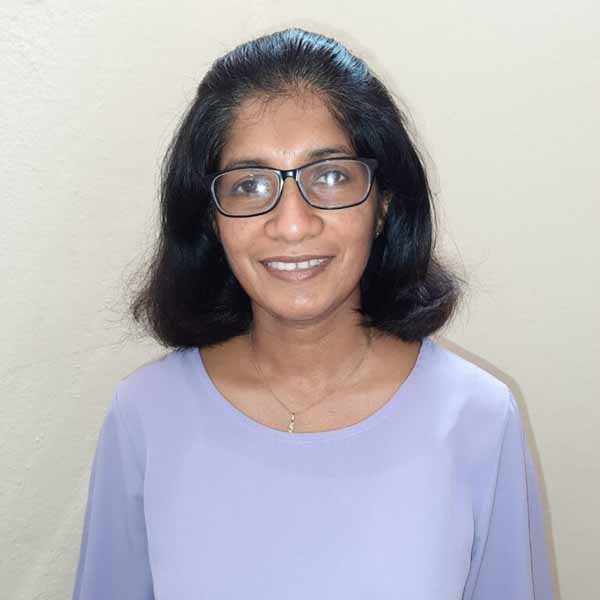
Uditha Jinadasa was born in Bulathkohupitiya, Sri Lanka in 1979. In 2005, she completed a bachelor’s degree in archaeology with First Class Honours at the University of Peradeniya, Sri Lanka. Since its completion, she has worked in the local and national heritage sector and trained as a researcher at the Central Cultural Fund, the country’s second most important heritage institution, which manages its state-owned World Heritage-listed cultural sites. In 2009, she completed a MSc in GIS, GPS and Remote Sensing at the University of Peradeniya. In the same year, she joined the Sri Lanka Department of Archaeology—the country’s national archaeology institution—as a research officer. Uditha started her PhD in October 2014 at the Faculty of Archaeology, Leiden University, funded by the Dutch organisation NUFFIC. She completed her PhD in March 2020 and currently serves as a lecturer at the University of Peradeniya, Sri Lanka.