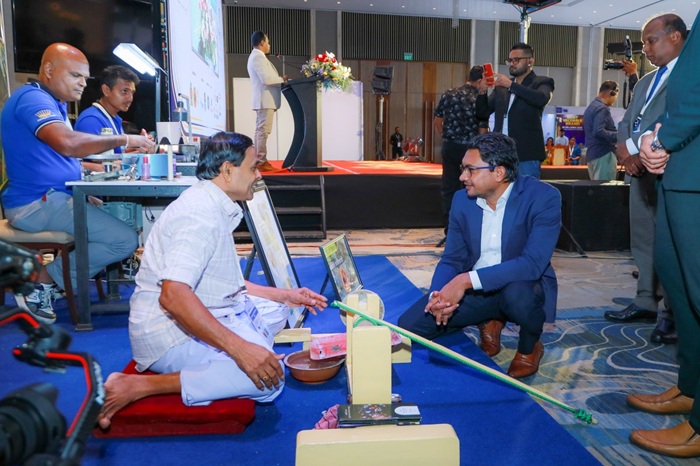
Deputy Minister of Industry Chathuranga Abeysinghe at the Gem City Ratnapura International Gem and Jewellery Exhibition 2026. Image: Newswire.
The Gem City Ratnapura International Gem and Jewellery Exhibition 2026, held from 31 August to 2 September, has concluded successfully, with strong international participation and renewed confidence reported across Sri Lanka’s gem and jewellery industry.
The three-day exhibition provided a platform for Sri Lankan gem traders, miners, manufacturers and jewellery entrepreneurs to present their products and capabilities to an international audience, while also reinforcing Ratnapura’s historic identity as the country’s principal centre for gemstones.
At the closing ceremony, Deputy Minister of Industry Chathuranga Abeysinghe said the increased turnout compared with the previous year reflected a revival in the sector. The stronger participation was presented not merely as an indicator of interest in a single exhibition, but as evidence that Sri Lanka’s gem industry possesses considerable potential for structured growth, improved international engagement and greater value creation.
Ratnapura positioned for international growth
Ratnapura, widely recognised as Sri Lanka’s “City of Gems”, has long been associated with the extraction and trading of precious stones, particularly sapphires and other varieties found within the island’s mineral-rich geological formations. Although mining remains an important foundation of the industry, the Government’s stated ambition is to develop a more comprehensive and internationally competitive value chain.
Deputy Minister Abeysinghe said the Government aims to transform Ratnapura into a major international hub for the gem industry, linking the different stages of production more effectively, from mining and processing to value addition, manufacturing and exports.
Such an approach would allow a greater proportion of the industry’s economic value to be generated within Sri Lanka. Rather than relying primarily on the sale of unprocessed or minimally processed stones, the proposed direction places greater emphasis on gem cutting, polishing, jewellery design, manufacturing, certification, research and international branding.
The Deputy Minister referred to the sector’s estimated US$3 billion potential, presenting the figure as an indication of the opportunity available if Sri Lanka’s gem industry can be modernised and supported through stronger institutions, improved infrastructure and more efficient commercial systems. The figure represents estimated potential, rather than exports or sales achieved through the 2026 exhibition.

Sri Lankan gemstones and professional gem-testing tools. AI generated based on source image.
International participation strengthens market connections
Entrepreneurs from India, Pakistan, Thailand, the United States, China, Japan, Poland and other countries participated in Gem City Ratnapura 2026. Their presence gave local businesses an opportunity to establish commercial relationships, introduce their products to new audiences and explore access to international markets.
For Sri Lankan entrepreneurs, international exhibitions of this nature are instrumental because they bring producers and buyers into a shared professional environment. Direct engagement can assist businesses in understanding overseas requirements, identifying changing consumer preferences and presenting Sri Lankan craftsmanship beyond established trading networks.
The participation of representatives from multiple countries also demonstrated the broad international relevance of Sri Lanka’s gem sector. The industry is connected to a global chain involving miners, dealers, gemmologists, designers, manufacturers, retailers and collectors, and Ratnapura’s ability to attract international interest will be important if the city is to develop into a recognised centre for this activity.
The exhibition therefore served two complementary purposes: it showcased Sri Lanka’s gemstones and jewellery, while also giving domestic enterprises a platform from which to pursue wider commercial opportunities.
Traceability and confidence identified as priorities
One of the key areas highlighted by Deputy Minister Abeysinghe was the need to strengthen traceability within the industry. Traceability enables the origin and movement of a gemstone to be documented through the different stages of its journey, providing greater transparency for traders, regulators and international customers.
Improved traceability could enhance confidence in Sri Lankan gemstones by helping to establish clearer information about their provenance, processing and certification. In a competitive global market, such confidence is increasingly important, particularly for buyers and institutions seeking reliable information about the stones they purchase.
A stronger traceability framework could also support responsible commercial practices and improve the reputation of Sri Lankan gems in international markets. For Ratnapura, this would be an important step towards moving from a historically renowned mining centre to a modern hub supported by recognised standards, professional documentation and dependable quality assurance.
The Government has also identified the simplification of import and export procedures as part of the broader development agenda. More efficient procedures could assist legitimate businesses by reducing administrative delays and making cross-border trade more accessible, while appropriate regulations and facilities could provide a more structured operating environment for the sector.
Building skills for the next generation
The proposed development of Ratnapura’s gem industry also includes a focus on youth skills. Gemstone evaluation, lapidary work, jewellery design, manufacturing, laboratory testing and digital commerce all require specialised knowledge, and a modern industry will depend on a workforce capable of combining traditional expertise with contemporary techniques.

Skills development and technical training will be important to the future of Sri Lanka’s gem and jewellery industry. AI generated based on source image.
Greater opportunities for training could help younger Sri Lankans enter skilled employment and entrepreneurship within the sector. It could also assist in preserving practical knowledge that has been passed through generations, while ensuring that established methods are complemented by modern equipment, scientific testing and international design practices.
The expansion of research and knowledge was similarly identified as an important requirement. Gemmological research can contribute to improved identification, grading, treatment detection, geological understanding and product development. A stronger relationship between industry, educational institutions and research organisations could therefore support both commercial progress and professional standards.
From natural resource to value-added industry
Sri Lanka’s gem industry possesses an advantage that is both natural and cultural: the country is internationally associated with high-quality gemstones, while its craftsmen and traders have developed a long-standing understanding of the stones’ characteristics and commercial value.
However, natural resources alone do not guarantee sustained international success. The value generated by an industry depends on the systems surrounding those resources, including regulation, skills, infrastructure, research, certification, marketing and access to markets.
The Government’s stated programme for Ratnapura recognises this broader reality. By strengthening the chain from mining to value addition, manufacturing and exports, Sri Lanka could develop a more resilient industry in which miners, processors, designers, manufacturers and exporters benefit from a coordinated commercial environment.

Traceability, documentation and professional examination can help strengthen confidence in Sri Lankan gemstones. AI generated based on source image.
The success of Gem City Ratnapura 2026 provides a positive foundation for that ambition. The event’s increased participation and international reach have shown that there is interest in Sri Lanka’s gem and jewellery capabilities, while the Government’s proposed reforms indicate an opportunity to convert that interest into longer-term industry development.
Deputy Minister Abeysinghe expressed appreciation to the National Gem and Jewellery Authority, the Sri Lanka Gem and Jewellery Traders and Miners Association, and all other stakeholders who contributed to the exhibition’s success.
With continued cooperation between public institutions, industry associations, entrepreneurs, researchers and skilled workers, Ratnapura could become more than a historic centre of gemstone mining. It could evolve into a sophisticated international destination for gem knowledge, responsible trade, jewellery manufacturing and Sri Lankan craftsmanship.
For the global Sri Lankan community, the renewed focus on Ratnapura represents an encouraging example of local heritage being connected to international enterprise. The conclusion of Gem City Ratnapura 2026 has placed the industry’s potential in clearer view, while the next stage will depend on whether the proposed improvements can be implemented consistently and translated into lasting opportunities for Sri Lankan businesses and young professionals.
Source: https://www.newswire.lk/2026/09/03/gem-city-ratnapura-2026-concludes-govt-eyes-global-hub-status/
This article was written based on the source https://www.newswire.lk/2026/09/03/gem-city-ratnapura-2026-concludes-govt-eyes-global-hub-status/, kindly email us at info@eLanka.com.au if any information needs to be corrected.
(adsbygoogle = window.adsbygoogle || []).push({});
At eLanka, we respect the rights of creators. If we have used an image you own and you’d like it removed, please email us at info@elanka.com.au and we’ll handle it promptly.