




Having the Giants with Science — Sri Lanka Leads with Compassion-by Harold Gunatillake

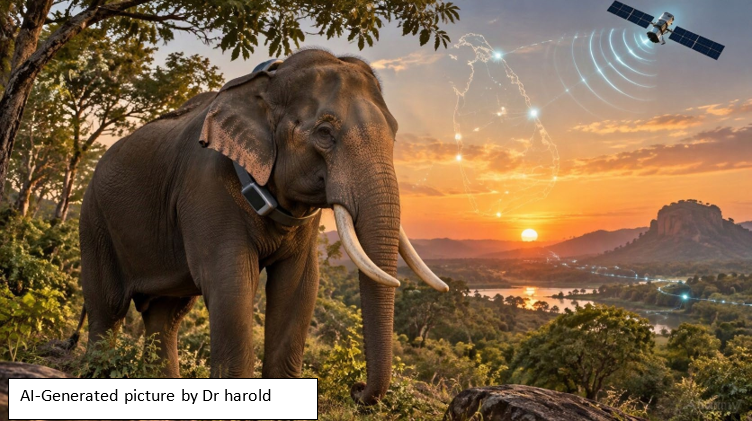
For years the headlines have been heartbreaking: 300 elephants dead, 100 farmers killed, paddy fields ruined, trains derailed — the devastating Human-Elephant Conflict.
Villagers fear the elephant, yet we also love him. He is part of our religion, our temples and our Perahera.
Now, at last, the Forest and Wildlife Departments are using modern science to protect both people and elephants — something our diaspora can be proud of.
What are they doing?
- GPS Radio Collars — From Oyamaduwa to Wilpattu
In January 2025, the Department of Wildlife Conservation, supported by the Sri Lanka Navy and local villagers, began the programme at Oyamaduwa in Anuradhapura — one of the worst conflict areas.
Wild elephants are being fitted with GPS collars, each carrying a GPS unit, a VHF beacon and a GSM transmitter. A collar reports its
location in real time every 8 hours, runs on a 2-year battery and unlocks itself when that ends.
Under the ADB-funded Mahaweli Water Security Investment Programme, 75 elephants along the 95.8 km North Central Canal, from Moragahakanda to Mahakanadarawa, will be collared. Sixty collars are already procured and stored at the Giritale Training Centre, with US$ 4 million allocated.
Why? Not to chase elephants away. But to understand: What is their home range?
Where are their traditional corridors?
Where do they cross railway lines and roads? How do they raid crops?
With that knowledge, we can build 160 km of electric fences around paddy fields rather than across corridors, create 650 hectares of grassland and water holes inside the jungle so elephants have no need to leave it, and gazette new safe routes in Mahakanadarawa, Nachchaduwa and Mahawilachchiya.
2. Saving Elephants from Trains — AI Sensors
Two elephants have died on the tracks this year, and 21 died last year. Cameras mounted on trains did not solve the problem, as they cannot see around a bend.
Now Clean Sri Lanka engineers and the Forest Conservation Department have built a brilliant new system:
At the 13 most dangerous places on the northern line, they have installed three-beam sensors, seismic sensors and passive infrared detectors along the track. These sensors pick up the vibration of an elephant’s footsteps and record its sound. AI then tells an elephant from a buffalo and sends instant SMS and light warnings to train drivers and station masters.
The Department of Forest Conservation is also clearing 100 feet of forest on both sides of the track for 2 miles at each crossing, so drivers can see elephants in time, and digging new water holes inside the forest so elephants have no need to cross for water.
2. Technology Guided by Metta
Following the tragic killing of tuskers such as Kawanthissa in October 2026, the government has responded decisively: a six-member expert committee has been appointed, armed forces are being deployed against organised poaching gangs, and new Elephant Transit Homes are planned.
Yet this programme succeeds not through guns and fences, but through understanding.
For 20 years, Dr Prithiviraj Fernando’s Centre for Conservation and Research tracked about 60 elephants. Its findings proved that elephants cannot be kept inside parks; they must roam. Block their paths, and they will break our fences, and we will end up killing them.
Now that science is government policy
To our children in Sydney, Toronto and London, this is the Sri Lanka we hope you will see: not a nation that kills its national treasure, but one that uses GPS, AI and satellite mapping to coexist compassionately with its 7,500 wild elephants.
Let us back the Forest Department and give it the funds it needs. The elephant protected our culture; now science must protect the elephant.
Insight for the Global Sri Lankan
Harold Pulse is an independent editorial platform offering clear, thoughtful analysis on Sri Lanka’s political direction, governance reforms, diaspora concerns, and the evolving health landscape of Sri Lankans living abroad. Built for global Sri Lankans who value informed perspectives, it clarifies the issues shaping the nation’s future—from domestic policy shifts to the well-being of expatriate communities navigating new health systems, lifestyles, and challenges worldwide.
Harold Pulse speaks to Sri Lankans everywhere: those shaping change at home, and those building lives overseas while staying deeply connected to the island’s progress. It is a space where political clarity, community insight, and diaspora health awareness come together to support a stronger, more informed global Sri Lankan identity.
At eLanka, we respect the rights of creators. If we have used an image you own and you’d like it removed, please email us at info@elanka.com.au and we’ll handle it promptly.
Thanks.
eLanka team
eLanka Disclaimer
Content published on eLanka may be created by the eLanka team, submitted by contributors or third parties, reproduced or adapted from other sources with appropriate source acknowledgement, or provided as promotional/advertising material by our clients. While eLanka takes reasonable care in preparing and publishing content, we do not warrant its completeness or accuracy. Views expressed are those of the respective authors or contributors and do not necessarily represent the views of eLanka. Third-party contributors, content providers and advertisers are responsible for the accuracy of material they supply and for ensuring they hold the necessary rights and permissions for its publication. Advertising and promotional content should not be regarded as an endorsement by eLanka of any product, service or claim.