HOW A SRI LANKAN LAY PERSON SPREAD BUDDHISM TO THE WEST – by Thomas Pavey
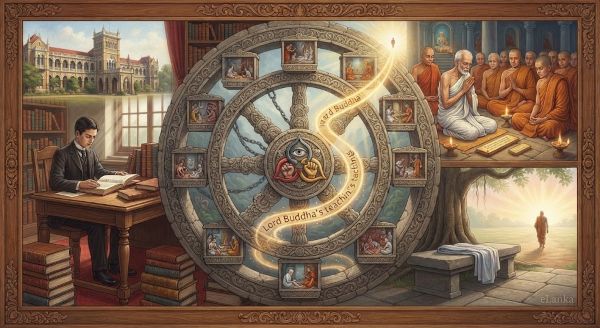
According to Buddhist cosmology, life is suffering, experienced within the cycle of birth, death and rebirth and this Ferris wheel of “samsara” (rebirth) rotates on the hub of three “poisons”, namely, ignorance, anger and attachment. The way to exit this mirthless “Amusement Park” ride, are the teachings of the Lord Buddha.
A boy named David Hewavitharne, born 29th April, 1933 to a wealthy Sri Lankan family in Colombo, was to take this, the Buddha’s message, to the Western world.
David was first educated at an Anglican primary school in Kotte, followed by St. Thomas’ College, where he gained a high standard of English and discipline. He was also known to study the European classics in his own time at the Colombo Public Library. If anything kept him within the Buddhist fold it was the Buddhist virtues of tolerance and respect for other religions and cultures, together with the deep influence of his parents. In January ???, David took the high ordination of upasampada in spite of recurring ill-health, and took the name Sri Devamitta Dhammapala. He passed away the same year.
As fate had it, the founders of the Theosophical movement in New York, Colonel Henry Steel Olcott and Madame Blavatsky arrived in Galle in May 1880 to explore Buddhism and were looking for someone who could help them as a translator. David, having a good command of both Sinhalese and English, volunteered and a strong bond of friendship blossomed. Both Col. Ollcott and Madame Blavatsky became the first known Westerner’s to adopt Buddhism. It marked a new epoch in the history of Ceylon Buddhism. David, moved by their love for the Buddha’s teachings, became very devoted himself and took Brachmachariya (celibate) vows, changing his name to Anagarika (Homeless one; person who commits to Buddhist practice).
In 1886 Col. Olcott and a Christian Pastor, Rev. C. M. Leadbeater funded a Buddhist revival movement in Ceylon and Anagarika travelled with them by bullock cart through villages, setting up schools. During this time Anagarika and Olcott established the “Sandarasa” a Sinhalese magazine and “The Buddha” in English, under the editorship of the Rev. Leadbetter. The latter became the organ of the YMBA and has a history of seventy five years of continues service to Buddhism.
Olcott and Anagarika left for Japan in 1889 and their visit played a vital role in the Buddhist revival of all Asia. In 1891. Angarika took a Japanese Buddhist monk, Kozen Gunaratna to Buddha Gaya in India. He found the Temple there neglected and worked hard for its eventual management by a Committee of Hindus and Buddhists.
Anagarika’s major benefactress was a Mrs. Mary Foster of Hawaii. Mary gave Anagarika vast sums of money, and even asked him to consider her, his foster mother.
Without Mary Foster’s abundant charitable assistance Anagarika could not have carried out his work, which included the establishment of the Maha Bodhi Society in Colombo (shifted to Calcutta in 1891) the extant MBS Journal, an Ayurvedic Hospital in Colombo, the Sri Dharmarajika Chaitiya Vihara in Calcutta and his crowning achievement, the Mulagadhakuti Vihara at Saranath, India, where the Buddha preached his first sermon.
In 1893 Anagarika attended the World Parliament of Religions in Chicago and delivered a paper titled: “The World’s Debt to the Buddha”, which caught the ear and interest of the American public. On his second visit to the USA, at the invitation of the Philosopher and promoter of Inter Faith dialogue, Dr. Paul Carus, Anagarika had the satisfaction of holding the first Vesak celebration in New York City in 1897. He had also visited England several times and met with Sir Edwin Arnold (Author “The Light of Asia”), with whom, he called on the Secretary of State for India, Lord Kimberley, regarding the Budha Gaya Temple. Today there stands the London Buddhist Vihara, a monument to Anagarika’s earlier ground work.
Finally, to end in the present: at the time of writing the British Library in London, is having an exhibition of Buddhist manuscripts featuring scrolls, artifacts and illuminated books spanning over 2,000 years. The early Buddhist works written in Pali, on Ola leaves are displayed and as people exit the exhibition, there is a large Temple bell and visitors are invited to strike it with a mallet. If Angarika’s talks resonated a characteristic Buddhist “sound”, this must be it; deep, clear and thrilling. A sound of “awakening” the West, to the teachings of the Buddha.
Anagarika Dharmapala Quotes:
Source: Buddhist Publication Society Buddhadhasa P. Kirthisinghe. New York.
Sayings: Collected by Bhikshu Sangharakshita. Maha Bodhi Journals