News & Community eLanka

eLanka

Monday, 29 Jun 2026
  • Home
  • Read History
  • Articles
    • eLanka Journalists
  • Events
  • Useful links
    • Obituaries
    • Seeking to Contact
    • eLanka Newsletters
    • Weekly Events and Advertisements
    • eLanka Testimonials
    • Sri Lanka Newspapers
    • Sri Lanka TV LIVE
    • Sri Lanka Radio
    • eLanka Recepies
  • Gallery
  • Contact
Newsletter
Sri lankan news
  • eLanka Weddings
  • Property
  • eLanka Shop
  • Business Directory
eLankaeLanka
Font ResizerAa
Search
  • Home
  • Read History
  • Articles
    • eLanka Journalists
  • Events
  • Useful links
    • Obituaries
    • Seeking to Contact
    • eLanka Newsletters
    • Weekly Events and Advertisements
    • eLanka Testimonials
    • Sri Lanka Newspapers
    • Sri Lanka TV LIVE
    • Sri Lanka Radio
    • eLanka Recepies
  • Gallery
  • Contact
Follow US
© 2005 – 2026 eLanka Pty Ltd. All Rights Reserved.
Home » Goodnews Stories Srilankan Expats » Articles » In her fortnightly travel series Juliet Coombe takes a walk among the ruins of a great civilization that can still shed light on modern life
Articles

In her fortnightly travel series Juliet Coombe takes a walk among the ruins of a great civilization that can still shed light on modern life

eLanka admin
Last updated: September 23, 2022 5:19 pm
By
eLanka admin
ByeLanka admin
Follow:
Share
10 Min Read
SHARE
Views: 25

In her fortnightly travel series Juliet Coombe takes a walk among the ruins of a great civilization that can still shed light on modern life

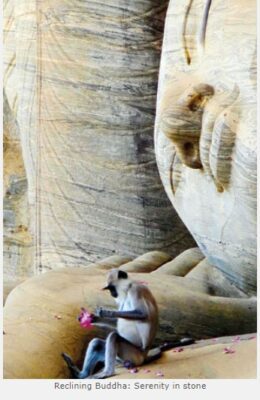
Reclining Buddha

Source:Sundaytimes

I mount a silver vintage 1930s Singer bike to explore Polonnaruwa, a surreal awe-inspiring ancient city in the dry zone where troops of Toque monkeys have taken over the once thriving kingdom. An extraordinary ruined city, a hot spot for curious travellers, like many visitors I want to learn more about this highly advanced hydraulic civilisation still operating and feeding the surrounding paddy fields.

Polonnaruwa which became the second capital of Lanka in 1070 CE after the fall of Anuradhapura, was a city devoted to the Buddha and his teachings, to science, advanced irrigation systems, inter-connecting tanks for movement of small trading boats, traditional medicine, complete with a giant carved stone book and grand architectural buildings like the seven-storey palace now in ruins, which must have been impressive, judging from the materials left behind.

Biking and walking is the best way to see the many different parts of this historic site especially in the early morning, as villagers make pujas at sacred trees, with hand carved Buddhas hidden within and over the tank, a myriad of different birds dive for fish. For primate lovers, the mischievous Toque monkeys only add to the experience of biking through the ruins of the temples, palaces, library and the original Ayurveda hospital where the human shaped treatment room to cure snake bite with a herbal bath still can be seen.

Grandeur of ruins and guardstones

As you learn about these huge monastery complexes from the knowledgeable national guides, you realise how spiritually advanced the King was, not to waste even a drop of water and be a part of nature, not apart from it. Abandoned for around 700 years by man, but not by beast, the Toque Macaque monkeys (one of three species of Macaque found in Sri Lanka), now live in the jungle ruins of this UNESCO World Heritage site. Even though the forest is under threat, as the numbers of trees are declining, they have found new ways to survive and thrive here.

I leave my bicycle at the entrances of the different sites, so I can walk around at my own pace, observing the fascinating buildings lost to the outside world until they were rediscovered, quite by accident, by the British army in 1820. A Lieutenant Fagan, commanding a brigade from Batticaloa to Minneriya through the jungle came face to face with Polonnaruwa’s Gal Vihara sleeping and standing Buddhas carved from the living granite rock.

Galpotha describes some of the rules of Polonnaruwa

Before the great kingdom was destroyed, Polonnaruwa had been famed for its ingenuity with water and regard for nature in general. Exploring the ruins, I learn how the Romans traded here for gems, the Arabs for spices and even the Iranians came to do business, as revealed in an archaeological dig of the market area, that produced a lot of pottery from Iranian antiquity. “Not even a single drop of water that comes from the rain must flow in to the ocean without being made useful to man”  – King Parakramabahu’s decrees were discovered in ancient temple books, making him one of the first recorded recyclers and inventors of a fully hydraulic off-the-grid civilisation. He also built three huge river dams, so that water could be controlled for the use of all the inhabitants, and extended the canal so that the three large irrigation tanks of Minneri, Kaudulu and Kantale were linked. Thus, he completed an impressive array of water engineering feats both highly technical and beautiful to behold, described as “a giant blue ribbon wrapped around a mystical garden city that even by today’s standards was ahead of its time,” and on a huge scale, “It is of such a width that it is impossible to stand upon one shore and view the other side.” Other canals were constructed to discharge additional water from swampy lands to make them suitable for paddy rice cultivation and to inter-

link tanks and small rivers all the way to the ocean.

As well as farming hundreds of different types of rice, known today as heirloom varieties, (now being reintroduced into pockets around the country), they also harvested honey from bees, both to eat, but also, interestingly, to seal their frescos in the picture houses and on caves, as honey is a well known preservative and can last for millennia in the right mix and light conditions. Living as part of nature, this civilization would have been aware of the dangers of monoculture and the need for diversity of cropping to support all the different creatures within an ecosystem.

As I explore the magnificent complex, I realise the king’s skills and those of his people go beyond these hydraulic marvels and in some cases tap into them, like the arrangement of gravity-fed pipes and water channels that are used for creating open air domestic showers downstream of the dams or from the vast water tanks. The thick walled rooms of these ancient palaces and temples were also built to last with the added bonus of having excellent insulation qualities that negate the need for aircon in the dry zone, as even in the heat of the day, the thickness of the walls keeps the rooms cool. Similarly, houses were, to some extent, built with open ends to facilitate the free flow of air, both to keep them cool and to prevent the build-up of harmful house dust. Today such cross ventilation would stop the spread of harmful viruses.
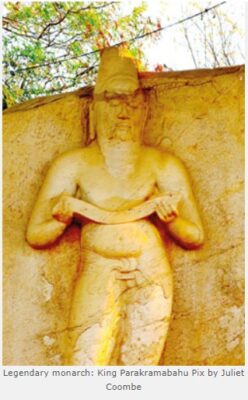
King Parakramabahu Pix by Juliet Coombe

Another extraordinarily visionary invention involved the strategic placement of statues opposite windows within houses and inserting gemstones in their eyes, which would reflect the light from the moon and sun, entering through the windows as it rises, and sending light around the room, so brightening it –  a free lighting supply.

As with many great civilizations, they left records, via stone inscriptions on giant rocks, the most famous of which is the ‘galpotha’ (stone book), weighing 25 tons, which was carried 90 km from Mihintale by elephants, and rolled on logs. It took just over a year to get it to the city and it is a fascinating read as it covers many aspects from wars that were waged, to the city’s rules and regulations.


This was a very advanced civilization that fully appreciated and lived within its needs and nature’s constraints, recognizing too the importance of spirituality as a key part of the healing process along with herbal potions and natural oils. Some say the great king was inspired by ancient Pali inscriptions from temples in the area.

                                                                                                                                The bathing area

So take this walk back in time and you will, with the right guide receive a king’s scholarly tour of one of the greatest living civilizations of the ancient world. An education that might even encourage you to build your next home differently and perhaps even look at gemstone lighting as an alternative to electricity.
 

TAGGED:hydraulic civilisationPolonnaruwa’s Gal Vihara
Share This Article
Facebook Whatsapp Whatsapp LinkedIn Email Copy Link Print
Previous Article mental-health “Serious Suicides”
Next Article new stamps mark Peradeniya Gardens Four new stamps mark Peradeniya Gardens’ bicentennial bloom-By L.B. Senaratne
FacebookLike
YoutubeSubscribe
LinkedInFollow
- Advertisement -
Luxury Apartments & An Exclusive Duplex Penthouse for Sale in BAY ONE Residences Colombo-eLanka
- Advertisement -
eLankaproperty - sell property in Sri Lanka, Sri Lanka property for sale, Sri Lanka real estate, Sri Lanka property listings, property marketplace Sri Lanka, land for sale Sri Lanka, houses for sale Sri Lanka, apartments for sale Sri Lanka, commercial property Sri Lanka, luxury villas Sri Lanka, Sri Lankan property investment, buy property in Sri Lanka, Colombo property for sale, beachfront property Sri Lanka, development land Sri Lanka, investment property Sri Lanka, property advertising Sri Lanka, real estate agents Sri Lanka, property brokers Sri Lanka, overseas Sri Lankan property buyers, Sri Lanka property website, list property online Sri Lanka, affordable property listings Sri Lanka, Sri Lanka homes for sale, Sri Lanka land investment, property developers Sri Lanka, real estate marketplace Sri Lanka, Sri Lanka commercial real estate, sell land in Sri Lanka, sell house in Sri Lanka, Sri Lanka property portal, global property marketplace Sri Lanka, Sri Lankan real estate investment, property management Sri Lanka, buy land Sri Lanka, residential property Sri Lanka, holiday homes Sri Lanka, Sri Lanka investment opportunities, real estate advertising Sri Lanka, eLankaProperty
- Advertisement -
ALTAIR
- Advertisement -
Ad image
eLanka Wedding
Most Read
My breakfast today-by Harold Gunatillake

My breakfast today-by Harold Gunatillake

Inside a Sri Lankan Buddhist Temple in the UK

Inside a Sri Lankan Buddhist Temple in the UK: What Vesak Really Looks Like

Poson Poya 2026, Poson Festival, Poson Full Moon, Buddhism in Sri Lanka, Mahinda Thera, Arahat Mahinda, King Devanampiyatissa, Mihintale, Anuradhapura, Buddhist festival Sri Lanka, Sri Lankan culture, Buddhist traditions, Poson celebrations, Poson Dansal, Dana, Buddhist heritage, Sri Lanka history, Buddhist pilgrimage, Mihintale pilgrimage, Buddhist teachings, Theravada Buddhism, Poson lanterns, Poson religious observance, Buddhist temples Sri Lanka, Poson significance, Poson customs, Sri Lankan festivals, Full Moon Poya Day, Poson article, Global Sri Lankan community

eLanka Newsletter -28th June 2026 – 4th Edition – Sri Lankans In Australia

Sir Harry Dias Bandaranaike , Bandaranaike family history , Sri Lankan colonial history , first Sinhalese barrister , Ceylon Supreme Court judges

Sir Harry Dias Bandaranaike: The Trailblazing Pioneer Who Opened Doors for Generations

IMF Sri Lanka , Sri Lanka IMF , IMF US$695 million , Sri Lanka economic reforms , IMF Extended Fund Facility

US$695 Million IMF Disbursement Credited to Sri Lanka Treasury – A Major Economic Boost

Related News
Zydus Sunshine Lifesciences , Zydus Lifesciences , Sunshine Healthcare Lanka , Sri Lanka pharmaceutical industry , pharmaceutical manufacturing Sri Lanka
Articles

Zydus Lifesciences & Sunshine Healthcare Launch $20 Million Pharmaceutical Plant in Sri Lanka

Sri Lanka rooftop solar, Virtual Net Metering Sri Lanka, Asian Development Bank, renewable energy Sri Lanka, clean energy Sri Lanka, solar power Sri Lanka, green energy investment, rooftop solar aggregation, LECO Sri Lanka, Electricity Distribution Lanka, renewable electricity, sustainable energy Sri Lanka, climate action Sri Lanka, greenhouse gas reduction, distributed solar energy, Sri Lanka power sector, smart grid Sri Lanka,
Articles

ADB Approves $57.4 Million for Clean Energy: Rooftop Solar & Virtual Net Metering Coming to Sri Lanka

Campaign Asia-Pacific 40 Under 40 , Campaign APAC 40 Under 40 2026 , Sri Lankan marketing leader , First Sri Lankan woman Campaign APAC 40 Under 40
Articles

Praveena Perera Makes History as First Sri Lankan Woman in Campaign APAC’s 40 Under 40

The Ceylon Society of Australia (CSA) Reborn
Articles

The Ceylon Society of Australia (CSA) Reborn – By Nimal Chandrasena and Jitto Arulampalam

High Commission of Sri Lanka in Canberra
Articles

Sri Lankan Passport Renewal from Australia: A Complete Step-by-Step Guide

  • Quick Links:
  • Articles
  • DESMOND KELLY
  • Dr Harold Gunatillake
  • English Videos
  • Sri Lanka
  • Sinhala Videos
  • eLanka Newsletters
  • Obituaries
  • Sunil Thenabadu
  • Dr. Harold Gunatillake
  • Tamil Videos
  • Trevine Rodrigo
  • Sinhala Movies
  • eLanka Newsletter
  • Photos

eLanka

Your Trusted Source for News & Community Stories: Stay connected with reliable updates, inspiring features, and breaking news. From politics and technology to culture, lifestyle, and events, eLanka brings you stories that matter — keeping you informed, engaged, and connected 24/7.
Kerrie road, Oatlands , NSW 2117 , Australia.
Email : info@eLanka.com.au / rasangivjes@gmail.com.
WhatsApp : +61402905275 / +94775882546
  • About eLanka
  • Terms & Conditions

Disclaimer:
eLanka is committed to sharing positive and community-focused stories. We do not publish or endorse political, religious, or ethnic viewpoints. The content published on eLanka, including articles and newsletters, reflects the opinions and views of the respective authors and not those of eLanka. eLanka accepts no responsibility or liability for the accuracy, completeness, or consequences of any content provided by contributors.

(c) 2005 – 2025 eLanka Pty Ltd. All Rights Reserved.