IS SRI LANKA CULLING ITS WILD ELEPHANTS – BY PROXY?-by Rohan Wijesinha
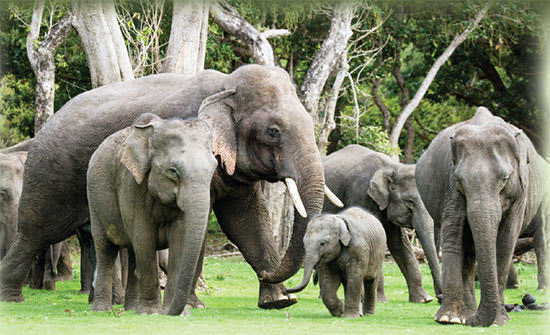
Source:Daily Island
As at May 5, 2021, many as 118 wild elephants had died this year, thus far; that is almost a death a day. The majority of these deaths were at the hands of humans. Of course, these are only those deaths that are recorded. Many elephants, when mortally wounded, will drag themselves away to die in the depths of the jungle, and are thereby unaccounted for. Most of these are males, and a substantial number of them are mature, breeding bulls.
Many instruments of destruction are used in perpetuating this slaughter, and apart from firearms, the most popular ways of killing are electrocution, when a line from the Main Grid is illegally attached to a wire fence, or by blowing out their jaws and mouth parts after they consume food items in which are secreted explosives called hakka patas; a unique way of killing that ensures the victim endures a lingering, agonizing death, from starvation, loss of blood or septicemia. In 2021, however, electrocution seems to be the preferred way of killing.
The Killing Fields
In 2011, the DWC conducted a survey of wild elephants in Sri Lanka. They concluded that there were approximately 6, 000. Since then, the rate of attrition has been such that between 2010 and 2020 over 2, 800 elephants have officially fallen victim to Human – Elephant Conflict (HEC). The actual figure may be much higher. That is almost 50% of the number counted, in 2011, have perished since. Of course, new births would have replenished some of this number but a female elephant has a pregnancy of 22 months duration and, in the natural course of things, will not come into estrus again until her calf is around 2 – 3 years old and largely weaned. Therefore, some studies have shown that there is a gap of six or seven years before a female elephant in the wild can calve.
There is also a high mortality rate among calves, especially in recent times when their ancient elephant ranges have been encroached on, and there is a reduction in food available for them. With insufficient fodder, females produce less and less milk, and the younger calves, for whom this is essential nourishment, die of malnutrition and starvation. If a living example of this is required, observation of the elephants at the Yala National Park, and perusal of the research conducted on them by the Centre for Conservation and Research (CCR), will provide the heartrending evidence of this; babies with just skin draped over protruding bones, barely clinging to life. Data shows that 54% of baby elephants below the age of two years are dying in Yala. This is because an electric fence was erected between the National Park and the adjacent Forest Department lands, a traditional dry season range of these elephant herds. Why? By political directive!
Genetic assassination
On the day Revatha, the iconic tusker of Kala Wewa whose picture adorned many a social media page proudly portraying the natural wonders of Sri Lanka, was electrocuted, four other male elephants suffered the same fate. In commenting on their killings, Dr. Chandana Jayasinghe, a Veterinarian of the Department of Wildlife Conservation (DWC) who conducted the post mortem on Revatha commented, “All of them are fully grown males that would be carrying strong genes…” ().
Female elephants will mate with the biggest and fittest of the mature males. These bulls compete with each other from an early age, mostly in play fighting, and establish a hierarchy of breeding eligibility. This ensures that survival is to the fittest, and the next generation carry the strongest of genes; the basis for the evolution of species. It also results in less aggression between them, as they have already worked out their hierarchy of dominance. If the biggest and the strongest are removed from a population, then the weaker get to pass on their genes and extinction will prove the inevitable end result. That removal is now taking place, and no one is doing much to stop it.
These big bull elephants also perform another valuable function. They calm the others, the younger ones, whose flow of testosterone is inhibited as they know they cannot challenge the larger ones. In contrast, it has been found that when mature bulls are taken out of a population, the aggression levels in the remaining younger males increases rapidly. This leads to frustration which is taken out not just on each other, but on other species as well, including humans. In Sri Lanka, this will inevitably lead to even greater human – elephant conflict.
Is Sri Lanka culling its wild elephants?
It is reported that under the pretext of freeing new lands for poor farmers, that the real beneficiaries of the forest lands being cleared may be private enterprises; those who have political backing. Having populations of wild elephants inhabiting the area poses a developmental problem to these so-called entrepreneurs, even though the wild elephants may earn the country far more direct and sustainable revenue and potential income for the local communities, than the projects for which these areas have been stolen.
With one of the lowest rates of productivity in the region, farmers who are unable to gain much profit from the lands they already have, will now be burdened with even larger areas of poor productivity, thereby trapped in perpetual poverty, and be faced with having to sell their recently gifted properties to a commercial buyer. First, they should be taught how to make their existing farmlands more productive without cutting forests, for that will only result in a reduced rainfall and cause even less to grow.
In the meantime, elephants and humans are dying from HEC; yes, 44 humans have died so far this year too, and many more of both species will die if nothing is done to stop the killing. Revatha’s killer was found and bailed and will probably go free with a minimal penalty, despite killing a national asset, endangering the lives of other humans who may have inadvertently touched this ‘live’ wire, and having broken the Law by tapping the Nation’s main electricity supply.
Turning up the power
It is rumoured that some in power have advised those in conflict areas to ‘turn up the power’ to deter elephant encroachment on to their lands. Whether true or not, the power certainly has been turned up, and Sri Lanka is heading for another record year of elephant deaths.
The tragedy is that true power can really be turned up to reduce the deaths of humans and elephants by using the experience of decades of science and research, along with a determination to preserve the natural heritage of this country for the future. There is a National Policy for the Management of the Wild Elephant in Sri Lanka, as passed by Cabinet. There is an Action Plan, based on the National Policy presented to H. E. the President by a Presidential Committee appointed specifically for this task. The implementation of both will not only result in a reduction in the killing, but a move from conflict to co-existence, where both humans and elephants, and the country, can prosper. This, however, will take leadership and hard work, by those who believe that there is a tomorrow, and that all should not be squandered by the end of today.
Rohan Wijesinha, Member of the Wildlife and Nature Protection
Society subcommittee on Human Elephant coexistence