Looking back: “Hansa Vilak”-By Uditha Devapriya
Source:Island
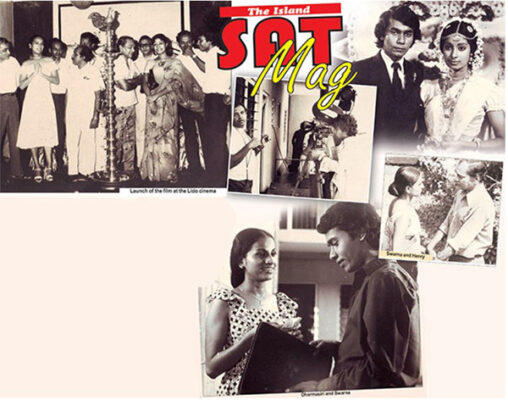
After more than 40 years, Dharmasiri Bandaranayake’s Hansa Vilak reopened in theatres last Wednesday. Has it really been that long? My father was studying for his A Levels when it first came out; he remembers seeing it at the Lido theatre, in Borella. Hansa Vilak is one of possibly four or five films that can be described as epochal, or near-epochal, in the context of the Sinhala cinema. That it effected a transformation in the industry may be an exaggeration, though one believed by those who have seen it and liked it. But that it had an impact on my father’s generation is not.
This is not the first time a restored version of Bandaranayake’s work is being shown to local audiences. It was screened at a festival dedicated to Swarna Mallawarachchi in 2017, and again that year at another festival dedicated to Premasiri Khemadasa. Not entirely coincidental, to have been shown at these events: if it isn’t remembered for anything else, Hansa Vilak will be remembered for Mallawarachchi’s acting and Khemadasa’s music. The associations the film had with the latter particularly have, for all intents and purposes, survived the memory of the film itself: even those who have not seen it will remember the music. In that sense Hansa Vilak has enjoyed or suffered (depending on how you see it) the fate of other classics, most prominently Golu Hadawatha and Hanthane Kathawa (both of which happened to be scored by Khemadasa). But that is not, nor should it be, all there is to these works; it certainly shouldn’t be all there is to Bandaranayake’s work.
To the unwary critic and viewer, Hansa Vilak appears almost strewn with symbolic references. At times, these references take on a theatrical character, as witness the scene, which we never return to thereafter, of Douglas and his daughter carrying a coffin (presumably bearing his wife Miranda’s body) to some undisclosed spot in an undisclosed estate. Yet the impact of these sequences is immediate, if not really self-explanatory: they do not stand out from the story but become very much a part of it, particularly so because they are not, as would be the case with a typical avant-garde picture, a representation of the director’s own fantasies, but rather a projection of the protagonist’s wild, irrational delirium. Is that really Douglas carrying the coffin of the woman who left him for another man, or is the latter dreaming it up?
More problematic than these episodes, however, is the issue of who gets the blame and who does not for what takes place in the film. In the absence of “good” or “bad” characters, the narrative can only be judged in terms of shades of grey. The fate that ultimately befalls the protagonist thus seems, by the direction of his moral compass, almost cruel: he must not only kill the woman he loved, he must also face the shame and ignominy of a twice separated man, first from his lawful wife and then from this other woman who threatens to leave him for her husband. From the conflict the man has to resolve between familial obligation and personal happiness, he can only escape by sacrificing both: by leaving his wife, and by waiting helplessly as the other woman, for whom he gave up his wife, hints that she will abandon him.
This is obviously not the kind of conflict we get to see in the popular cinema, where good triumphs over bad and love triumphs over hate. What is even more interesting about Hansa Vilak is that while refusing to cave into those simplistic binaries, it also refuses to resolve the impasse the protagonist, Nissanka, begins to face when he finds his feelings for Samanthi reawakened by his brother-in-law’s intervention and his feelings for Miranda fading away by her return to her ex-husband. Bandaranayake shows us this two-pronged conflict – between the moral quandary the protagonist faces and the lack of any resolution for that quandary – by means of a division, which he blurs as the story progresses, between external reality and subjective perceptions. I believe any discussion of how the director maintains this dichotomy throughout the story must begin with by contrasting it with two other films that played on the trope of personal feeling versus social reality.
Lester James Peries’s Golu Hadawatha and Vasantha Obeyesekere’s Palagetiyo are, in terms of the discussion, not inapt reference points. Hansa Vilak differs from and also bears a likeness to both works. Like Golu Hadawatha, the love story at the heart of Hansa Vilak does not suffer from convulsions of class. Nissanka is no different in his economic position to Miranda; both are members of an urban lower middle-class, just as much as Sugath and Damayanthi from Peries’s film are members of a rural petty bourgeoisie.
Yet the clash between emotion and social fetters, which in Golu Hadawatha erupts because of the burdens of tradition (Damayanthi must marry her cousin in deference to her mother’s wishes), is in Bandaranayake’s film much more pronounced, for the simple reason that it is not as restricted to personal quirks as the doomed love affair between Damayanthi and Sugath is.
In that sense Bandaranayake’s film shares as much with Golu Hadawatha as it does with Palagetiyo. The idealistic overtones of the love affair between rich girl and poor boy in the latter film are upturned, as events confirm, by the unbearable heaviness of class realities: the rich girl finds it as hard to fit into the world of her poor lover as the poor lover finds it hard to make his way into the world of her rich father. Here the role played by social constraints is more pronounced than it is in Golu Hadawatha, while the ending, a semi-fantasy sequence in which the poor boy tells us that the two of them spent every cent they had on a trip to some mountain spot, refuses to give us the sort of resolution that Sugath had the benefit of in Peries’s film.
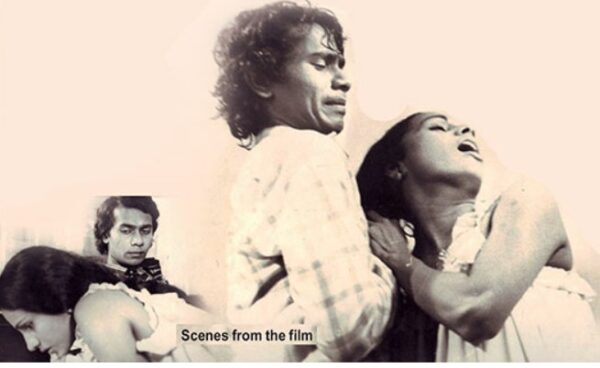
I’d like to take the ending in Palagetiyo as a point of departure for my discussion of Golu Hadawatha. While in Peries’s film Sugath’s fantasies about Damayanthi are at first crushed, and then resolved, by encounters with the object of his affections, in Obeyesekere’s film the two lovers can rid themselves of social-class constraints only by pretending those constraints do not exist. Notice the difference: in the one, the rift between fantasy and reality is resolved by a return to the latter, while in the other, it is resolved by a retreat to the former. To me this points at the specific contexts from which each story unfolds: the one within a particular social class, the other within a conflict between two classes. To put that in perspective, while Peries’s film tries to avoid the relevance of class conflict in personal relations, the latter, more so than any other Sinhala film I have seen until now, highlights its relevance.
Hansa Vilak differs from both Golu Hadawatha and Palagetiyo in how it depicts the conflict between personal feeling and social constraint. As far as Nissanka, Miranda, Douglas, and Samanthi are concerned, class does not really enter that conflict (except perhaps in how these four characters define themselves against other groups). What distaste Samanthi’s family (especially the brother) has for Miranda is rooted, I think, in a difference in cultural conditioning between the two families: Samanthi’s brother hints at the infidelity of women like Miranda, and in the absence of a class rift per se between the two families I am forced to conclude that he is talking about her cultural upbringing, something Miranda herself brings up when she talks of redemption and sin (in the Catholic sense) when responding to Nissanka’s harangues.
Bandaranayake does his best to balance the relevance of social reality with the world of personal feeling when depicting the deterioration of relations between Nissanka and Miranda, and to his credit, the effect the fallout between these two lovers on the audience is almost Bergmanesque; Henry Jayasena, who played Miranda’s husband, confirmed as much for Bandaranayake himself when he told the latter, after shooting had wrapped up, that the film’s style reminded him of the Swedish director.
However, to be fair by Bandaranayake, the lofty goals he set for Hansa Vilak, which attempted to relate the quandary of the protagonist – personal feeling versus familial obligation – to the two spheres within which the film operates – inner consciousness versus social reality – tends to keel, founder, and capsize as the story reaches its end. It is what it is, and it should be discussed as the kind of failing one must expect from an auteur who chose to burden himself with the dual roles of director and actor, and that in a first-time effort which ended up winning every award, and even became (as he remembered for me in an interview) a minor hit at the box-office.
Part of the film’s failing should be attributed to an almost theatrical sentimentality that pervades certain sequences, noticeably in the first quarter when Miranda and Nissanka face the wrath of Douglas and Samanthi at the court. Yet by themselves, the theatricality of these sequences is not enough to explain that failing.
Kamalika Pieris was correct, in my opinion, when she observed that the film gathered momentum “without sufficient explanation.” To be sure, one should not demand an A-Z explanation of events in a work of art. But I’m sure Pieris was not making such a demand in the first place; to her, there seemed to be a contradiction between the immense weight and profundity of the narrative and the efforts made by the director to explain why it was weighty and profound. As with even some of Bergman’s work, this had the effect of depriving the story of a crucial naturalism of style.
There was also the question of how Bandaranayake employed the techniques of film to explicate the themes of this plot. To what extent was he being “profoundly new and original” (Regi Siriwardena) and to what extent was he being “confusing” (Pieris) and “lazy impressionistic” (H. A. Seneviratne)? It is not up to me or any critic to offer an answer to this; that must come from the conclusions the audience reaches on its own. However, a few concluding remarks on that count are called for.
It is unfair by Bandaranayake, given that this was, after all, his debut, to require of it the standard one could expect from a more technically polished later work like Bhava Duka. Yet it would also be unfair to ignore that there is a point, especially in the last third of the story, where the crisscrossing between fantasy and reality becomes a cat’s cradle of tangled wires (borrowing a phrase from Dayan Jayatilleka). To pinpoint just when and where the one becomes the other would, however, be futile; one simply has to sit through the film to register it, particularly in the last half-hour.
Even more unfair would be to ignore the great achievement that is there for all to see in Bandaranayake’s film. To critique or point out the subtle nuances of Hansa Vilak is not to deny its standing as a courageous, daring objet d’art. More so then than now, adultery was considered taboo material, even for a popular medium like film. Duhulu Malak was, as far as I can make it out, the only other film to talk about the theme, yet as anyone who has watched it will testify, it eventually resolves the rift between the imperatives of personal feeling and the strictures of suburban middle-class marriage life in favour of the former. No such resolution exists in Bandaranayake’s film; that is what makes it so unique, so much a landmark, and so much a classic.