




NOEL NEWS

Image Source:Kaizenner
“The real measure of your wealth
is how much you’d be worth
if you lost all your money.”
ANON
Welcome to our April Newsletter
We are now nine months into the 2025/26 financial year, and the mood is vastly different from July last year. My good friend, economist Dr Don Stammer, often spoke about “factor X” — something absolutely unpredicted that had huge effects on the world. Two classic examples are the Global Financial Crisis in 2008 and COVID. I think it’s odds on this year’s Factor X will be the current war in Iran.
A close friend of mine, who has spent years advising large corporations, told me this week that what is happening now will change the world forever. He said it will no longer be “just in time” but “just in case,” pointing to a huge increase in capital expenditure right around the world. I spent Easter at Sunshine Beach near Noosa in Queensland and was amazed by the number of “for sale” signs on properties, and that many apartment signs had changed from the traditional “no vacancy” to “vacancy.” When I queried this with a local real estate agent, she said many buyers are reluctant to sign purchase contracts because there is so much uncertainty in the world, while many sellers are keen to get their property sold before potential capital gains tax changes in the May budget.

Of course, the headlines are now talking about a possible recession. Economists and policymakers are obsessed with recessions, but as an investor I am primarily interested in financial markets, not recessions per se. The problem is that recessions are backward-looking, but financial markets are forward-looking. By the time a recession hits, financial markets have already rebounded into the next cycle.
It is a frustrating time because, as I write, there are still no clear exit routes. All we can do is take things day by day and hang in there. One thing is certain: inflation is rising, and families are already struggling with higher prices. With fuel and food costs up, the latest increase in home interest rates will only add to the pressure.

PODCAST
Making Money
Made Simple
with Noel Whittaker
Renowned broadcaster John Deeks and I discuss all the big topics covered in this newsletter in detail each month.
Interest Rates
And this begs the question: what will the Reserve Bank do about interest rates at its next board meeting? I was astounded when they increased rates last month, and was shocked to find that Westpac are predicting four more interest rate rises this year. Frankly it defies logic. Monetary policy is meant to be straightforward: when the economy overheats, you slow it with higher rates; when it weakens, you ease off. Sadly, in today’s economy, it’s not that simple.

Image by pana design on Vecteezy
The Reserve Bank got it wrong – I fervently hope that Westpac has got it wrong. Today’s inflation is not being driven by households going on a spending spree; it is being fuelled by surging construction costs and a spike in oil prices caused by the conflict in Iran — forces well beyond the control of ordinary Australians. The Reserve Bank is using the only lever it has, but it is hitting the wrong target.
Yes, inflation was already running hot before the conflict began, and a rate rise was always likely. But common sense suggests the better course would have been to pause for a month and see how events unfolded. If they had done that, they would have found that an energy crisis hits the economy much harder than six rate hikes.
Higher interest rates will not bring down global oil prices or ease construction costs, but they will hit households hard. We are now facing a serious energy shock, and families already stretched by rising fuel and grocery bills are being squeezed again — the last thing they need is an increase in their loan repayments.
Of course, this has triggered a flood of headlines about how much more borrowers will have to pay – and many of them were wrong. The maths is simple: a quarter per cent rise in interest rates adds about $5 a week for every $100,000 of debt. So if you have an $800,000 loan, each 0.25 per cent increase costs roughly $40 a week.
Fixing your interest rate
This raises the obvious question: is it time to fix your interest rate? Historically, fixing has rarely paid off, and in this case the horse may already have bolted, because banks have lifted their fixed rates ahead of these moves.
A typical variable rate for owner-occupiers is around 5.84% to 6.4%, depending on the lender and how sharp a deal you have negotiated. Strong borrowers may be a little below this range, while others may be slightly above it. Five-year fixed rates are generally in a similar range, often around 6.0% to 6.49%, and in many cases sit slightly higher than variable rates.
The key point is that fixed rates are no longer the bargain they once were. Banks are pricing in the expectation that rates may stay high for the long term, so locking in for five years usually means paying a premium for certainty rather than securing a lower rate. In simple terms, fixing today is less about saving money and more about buying peace of mind if rates rise further. The trade-off is loss of flexibility: fixed loans may carry significant break costs if you need to exit early. There can also be a rate lock fee before you even get the loan. This is a fee to guarantee the rate at settlement. Some banks will charge a set fee, while others will charge a percentage based on the loan amount. For example, a $500 fee or 0.15 per cent of the loan amount, which on a loan of $700,000 equates to a fee of $1050.

Image by Kampus on Freepik
Some banks say the rate lock starts when you apply; others only lock it in once you have unconditional approval, which can take weeks – especially if you are self-employed and your accountant has to get involved. By then, the banks may already have moved their four- and five-year fixed rates higher.
Also before fixing you must understand break costs: the price you pay to exit a fixed loan early. This is where many borrowers come unstuck. It’s a minefield, and good advice matters. A competent mortgage broker who understands the system can be worth their weight in gold.
Fixing can provide certainty and peace of mind, but it is not for everyone. A variable rate offers flexibility and the chance to benefit if rates fall, particularly if you plan to pay down debt quickly. The key is to think about your future: your income, your job security, and whether your circumstances might change. If you can’t see clearly five years ahead – and few of us can – a shorter fixed term may be a wiser course. Some borrowers also hedge their bets with a cocktail loan: fixing part of the loan and keeping the rest variable, giving them both certainty and flexibility.
Remember, in the end the best strategy is not about picking the perfect rate – it’s about putting yourself in a position where you can sleep at night, whatever happens next.
Markets
|
The share market is bouncing all over the place, with big rises some days and big falls the next. I know that many of you are considering getting out due to the uncertainty and then coming back in when you believe the market has turned. This is not a practical option, and I now quote Keith Fitzgerald, who has studied markets in America for over 40 years: |

“I think we’re getting close to the bottom.
So many incredible companies have been beaten up, beaten down and simply crushed that I believe there is generational wealth sitting there in the corner, waiting for you to walk over and pick it up. Don’t just take my word for it, though.
Here’s what history says:
- Selloffs are normal, not rare. Since 1980, the S&P 500 has experienced an average intra-year decline of about 14%, yet it still finished the year positive in 35 of 46 years, or 76% of the time.
- Corrections are usually shorter than people think. Looking at post-war history, market corrections have averaged a 13.5% decline, lasted about 4.3 months peak to trough, and taken roughly 3.1 months to recover from the trough back to prior levels.
- The biggest up days often happen when fear is highest. Roughly 76% of the market’s best days occurred either during a bear market or in the first two months of a new bull market.
- Extreme pessimism has historically been followed by strong forward returns. J.P. Morgan’s data shows that after sentiment troughs, the S&P 500’s average subsequent 12-month return was 24.1%, compared to just 3.9% after sentiment peaks.
And just in case you’re still not feeling it, or your nerves aren’t ready to go back into hiding, here are two additional points to consider.
Imagine you had invested $1,000 in the S&P 500 twenty years ago and missed just 50 of the best days over that entire period—a mere 0.4%. You and your portfolio would have missed 92% of the gains that would otherwise be in your pocket. My point is the one that most people simply can’t grasp, no matter how hard they try, because they are so scared.”
And that, in a nutshell, is why trying to time the market is so dangerous.

Image Source:Metro
Negative gearing changes
At last week’s Press Club address, Prime Minister Albanese mentioned the Government was considering changes to negative gearing. One can only speculate about what they might be, but nobody seems to have pointed out that when Paul Keating changed negative gearing in 1985, he did not abolish it. His proposal was that any losses be quarantined and offset against future profits from that property. That is very different from “abolishing” negative gearing.
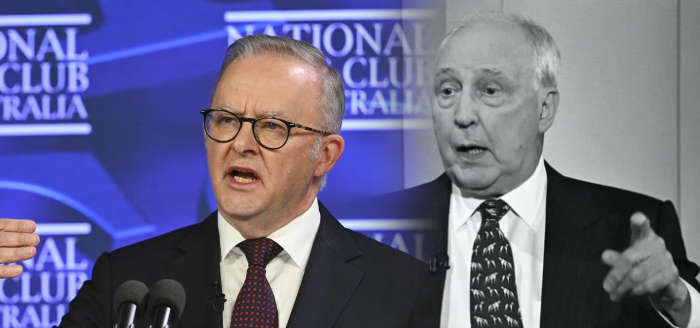
It is also not the big tax saver people think it is. The majority of those who use negative gearing are in the 30% tax bracket. That means for every $100 they claim as an expense, they still pay $70, while the government effectively contributes $30. I do not see that as a tax rort or an incentive to buy property purely for the alleged tax breaks. The key to success in residential real estate has always been to find an undervalued property and add value. Any tax benefits are simply the cream on the cake.
Deeming changes
Deeming is back in the news with a further increase to the deeming rates from 20 March, in parallel with the automatic indexation of the pension. Deeming is a major issue for retirees – it doesn’t just affect income-tested pensioners, it also determines eligibility for the Commonwealth Seniors Health Card and plays a major role in calculating aged care fees.
Deeming began in 1990 to discourage pensioners from using low-interest accounts to dodge the income test. It was later extended to most financial investments, though never property. In theory, rates track the cash rate, but over the years they dropped below it. The government is now playing catch-up by increasing the deeming rates at the same time as pensioners receive their automatic increase due to inflation.

Image Source:Domclick
From 20 March the lower deeming rate lifts to 1.25% and the upper from 2.25% to 3.25%. For singles, the lower rate applies to the first $64,200 of financial assets, with the higher rate on the balance. For couples, it applies to the first $106,200 combined, with the higher rate on the remainder.
At the same time, singles gain an extra $22 a fortnight, bringing the full fortnightly pension to $1,200.90, or $31,223 a year. Couples gain $33.40 combined, lifting their full combined pension to $47,070 a year. As assets increase and deemed income increases accordingly, the pension will reduce at the rate of 50 cents for each additional dollar deemed to be earned.
It’s a brutal reduction rate, and as ever, it hits the poorest pensioners hardest. Here’s how.
Harry is single, with $300,000 in financial investments and $20,000 in household contents. Before the changes, he was getting a fortnightly pension of $1,153.70. From 20 March, due to the increase in deeming rates, his deemed income will jump from $6,966 to $8,466 a year, reducing his fortnightly pension to $1147.09. The increase in deeming rates more than cancels out the pension rise – he is now $6.61 a fortnight worse off. It’s a different outcome for the Bradys, who have total assets of $960,000, of which $900,000 is their superannuation. They get the full pension increase and are $33.40 a fortnight better off.
I’m often asked if the pension you draw from your superannuation fund is assessed as income for the income test. It is not. Your superannuation is given a deemed income for the income test, and the account value of your superannuation fund is the amount assessed under the assets test. And remember, if your superannuation fund drops in value at any time, you are at liberty to advise Centrelink immediately.
To see how the changes affect your own personal situation just go to my website, www.noelwhittaker.com.au, to download the new pension charts and play with the age pension calculator and the deeming calculator, all of which have been updated with the new numbers.
Aged Care Guru, Rachel Lane, says it’s a mistake to assume changes to deeming rates only affect the Age Pension. In reality, deeming also applies across the aged care system — whether you’re receiving care at home through the Support at Home program or living in residential aged care.

The shift in aged care means testing last November has also changed who feels the impact. Under the old rules, it was largely self-funded retirees who were hit hardest. For example, someone with around $3 million in assets would quickly reach maximum home care fees, while in residential care, a retiree with about $1.4 million in investments and a $500,000 refundable accommodation deposit would hit the annual cap.
Today, the pressure is moving down the wealth spectrum. The biggest impact is now likely to fall on part pensioners — the classic “sensible savers” who have built modest wealth through super and investments. Once assets move beyond roughly $215,000, many are pushed into part pension territory, where the system becomes far less forgiving.
For this group, higher deeming rates deliver a double blow: a reduction in pension entitlements and an increase in aged care fees. For those who are tipped into part pension status as a result, it can come as a nasty surprise.
A small rise in deeming rates may sound minor, but for older Australians in care it can mean thousands more in fees.
The Age Pension calculator and the Deeming calculator have been updated on my website. We also have a new CSHC (Commonwealth Seniors Health Card) calculator. The CSHC is highly prized by self-funded retirees because there is no assets test. The only requirement is an income test, which incorporates the deemed value of superannuation assets in pension mode.
From the mail box
“Just wanted to say a big thank you from my wife and me. We have both read your books Making Money Made Simple and Retirement Made Simple. They were very easy to read, and we both gained a great deal from them, both in terms of personal development and knowledge.

As an avid health enthusiast, I was amazed and pleasantly surprised to read your thoughts on the microbiome in your retirement book. I learnt a few things from that section as well.
Keep up the great work you are doing.”
Take charge of your retirement

|
||
|
||
|
And finally

Thief steals wheels off police car! Cops work tirelessly to nab suspect.
Have you ever tried eating a clock? It’s really time consuming, especially if you go for seconds.
What’s the difference between a poorly dressed man on a tricycle and a well dressed man on a bicycle? Attire.
I’m reading a book about anti-gravity. It’s impossible to put down!
My friend went bald years ago but still carries around an old comb with him. He just can’t part with it.
Yesterday I saw an ad that said “Radio for sale, $1, volume stuck on full”. I thought, “I can’t turn that down”.
A slice of apple pie in Jamaica is $2.00. It is $2.50 in the Bahamas. These are the pie rates of the Caribbean.
What’s Irish and stays outside all year? Patty O’Furniture.
What do you call a bulletproof Irishman? Rick O’Shea.
A lumberjack went into a magic forest to cut a tree. Upon arrival he started to swing at the tree when it shouted, “Wait! I’m a talking tree!” The lumberjack grinned and said, “And you will dialogue.”

A big thank you to all you good people who read my newsletter.
If you were forwarded this newsletter by a friend and you would like to subscribe, you can do so here:
You can also find the subscription box in the footer of all website pages.
For more Noel News:
Download recent Noel News as a PDF
I hope you have enjoyed the latest edition of Noel News.
Thanks for all your kind comments. Please continue to send feedback through; it’s always appreciated and helps us to improve the newsletter.
And don’t forget you’ll get more regular communications from me if you follow me on X – @NoelWhittaker.
Noel Whittaker