News & Community eLanka

eLanka

Sunday, 26 Apr 2026
  • Home
  • Read History
  • Articles
    • eLanka Journalists
  • Events
  • Useful links
    • Obituaries
    • Seeking to Contact
    • eLanka Newsletters
    • Weekly Events and Advertisements
    • eLanka Testimonials
    • Sri Lanka Newspapers
    • Sri Lanka TV LIVE
    • Sri Lanka Radio
    • eLanka Recepies
  • Gallery
  • Contact
Newsletter
Sri lankan news
  • eLanka Weddings
  • Property
  • eLanka Shop
  • Business Directory
eLankaeLanka
Font ResizerAa
Search
  • Home
  • Read History
  • Articles
    • eLanka Journalists
  • Events
  • Useful links
    • Obituaries
    • Seeking to Contact
    • eLanka Newsletters
    • Weekly Events and Advertisements
    • eLanka Testimonials
    • Sri Lanka Newspapers
    • Sri Lanka TV LIVE
    • Sri Lanka Radio
    • eLanka Recepies
  • Gallery
  • Contact
Follow US
© 2005 – 2026 eLanka Pty Ltd. All Rights Reserved.
Home » Goodnews Stories Srilankan Expats » Articles » Omicron and Immunity
Articles

Omicron and Immunity

eLanka admin
Last updated: January 22, 2022 6:15 pm
By
eLanka admin
ByeLanka admin
Follow:
Share
5 Min Read
SHARE
Views: 12

Omicron and Immunity

The case for updating covid-19 vaccines for the Omicron variant

A new study puts the variant in a group apart from its predecessors

Variants vary, but how much? Since SARS-COV-2 was first sequenced at the beginning of 2020 dozens of versions have been identified. Five have been designated “variants of concern” by the World Health Organisation (WHO). The latest is Omicron, which was given its name in November last year and looks set to become the dominant form of the virus almost everywhere.

One question occupying both scientists and politicians is whether covid vaccines would work even better if they were updated to deal with novel variants. Up to and including Delta, first identified in India, and designated a variant of concern in May 2021, the answer has been “no”. But new research, which has mapped differences between all of the important versions of SARS-COV-2, suggests that, although administering existing vaccines is still useful, Omicron is so different from the others that the answer might now be “yes”.

Researchers in the Netherlands, co-ordinated by Rogier Sanders and Colin Russell of the University of Amsterdam and Dirk Eggink of the Dutch Public Health Institute, acquired blood samples collected from 51 unvaccinated people shortly after they had been infected with various versions of SARS-COV-2. These included the original, ancestral, strain and the Alpha, Beta, Gamma and Delta variants. (Omicron samples were not available.) They then assessed the antibody response (“neutralizing capacity”) of those samples against different antigens—in other words, different versions of the virus, again using the ancestral strain, Alpha, Beta, Gamma and Delta and, this time, Omicron.

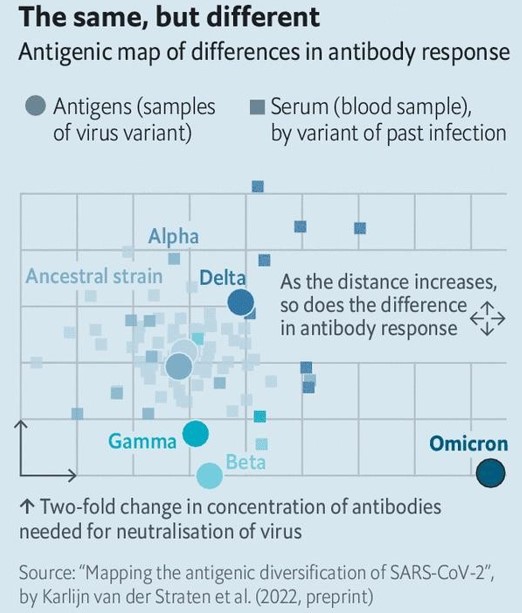
By measuring the neutralizing capacity of the serum of each participant against the various variants and applying what is known as a multidimensional scaling algorithm, Dr Sanders, Dr Russell, Dr Eggink and their colleagues were able to position both the viruses and the serum samples on an “antigenic map” (see chart on page 2). This is used to study how mutations make viruses more or less different from the ancestral strain, in a process called antigenic drift. In such maps, one unit of distance is equivalent to a two-fold change in neutralization titre (a measure of the concentration of antibodies in the blood needed to neutralize a virus). Samples plotted closer together are more similar. Going by a measure conventionally used to group influenza viruses—a distance of three or fewer antigenic units—the researchers found that Omicron would count as the first of a new group of SARS-COV-2. Whereas all widely circulating variants before it, being less than three units apart from each other, cluster as a single group, Omicron is more than five units away from all others.
Omicron and Immunity

A paper describing this research was uploaded to medRxiv, a research portal, on January 3rd, but has not yet been peer-reviewed. The authors also caution that their methods vary slightly from those conventionally used to map influenza. Nevertheless they conclude that “the change in neutralization between Omicron and other variants of SARS-COV-2, including the ancestral strain, is striking”. (A separate investigation, published on the same day in Cell, reaches a similar conclusion.) Dr Russell cautions that the study’s findings should not be interpreted to mean that existing vaccinations, designed for the ancestral strain, are ineffective. “Omicron’s substantial reduction in cross-reactivity with previous variants doesn’t mean that there is no reactivity. This is probably why boosting with current vaccines provides some protection,” he says.

As more people catch Omicron or are vaccinated, so more of the population will have some protection than in the past. Other studies have also shown that the response of another part of the immune system, its t-cells, seems less affected by Omicron’s mutations. That is probably one reason why Omicron rarely causes severe disease and death in those who have acquired immunity through infection or vaccination. The other is that Omicron itself seems to be inherently less lethal. But, just as twice a year the WHO organizes expert reviews of influenza viruses and issues recommendations on how to tweak vaccine compositions, Dr Russell proposes something similar for covid vaccines. For maximum efficacy, he suggests, vaccines should be updated as soon as possible.


TAGGED:Dr RussellDr SandersOmicron and ImmunityWorld Health Organisation
Share This Article
Facebook Whatsapp Whatsapp LinkedIn Email Copy Link Print
Previous Article African elephants The man who saved African elephants in 1980s-By Tharindu Muthukumarana
Next Article Stanley Jayasinghe Hale and hearty Stanley J 91-By Harischandra Gunaratna
FacebookLike
YoutubeSubscribe
LinkedInFollow
Most Read
10 Pictures With Fascinating Stories Behind Them!

“A PICTURE SPEAKS A 1000 WORDS” – By Des Kelly

Look past your thoughts so you may drink the pure nectar of this moment

A Life Hack for when we’re Burnt Out & Broken Down – By Uma Panch

Narration of the History of our Proud Ancestral (Orang Jawa) Heritage. by Noor R. Rahim

eLanka Weddings

eLanka Marriage Proposals

Noel News

Noel News

Noel News

Noel News- By Noel Whittaker

Appreciation: Eileen Mary Sibelle De Silva

K.K.S. Cement Factory

Dr.Harold Gunatillake’s 90th Birthday party

Sri Lanka's women's cricket squad in Melbourne

Cricket: Sri Lanka’s women’s squad in Melbourne

- Advertisement -
Ad image
Related News
Articles Dr Harold Gunatillake

Enough magnesium in your body is really important and can truly help you prioritise your health. Magnesium plays a vital role in many bodily functions-by Harold Gunatillake

Lions Club Celebrates Avurudu with Music, Games, and Tradition-by Trevine Rodrigo
Articles Trevine Rodrigo

Lions Club Celebrates Avurudu with Music, Games, and Tradition-by Trevine Rodrigo

story of black dog
Articles

The Black Four-Legged Peace Walker: A Silent Guide on Day 4 in Sri Lanka

Ratnapura
Articles

“CITY OF GEMS” RATNAPURA Ratnapura, known as the “City of Gems” in Sri Lanka, derives its name from the Sanskrit words “ratna” (gemstone) and “pura” (town or city). As the hub of Sri Lanka’s gem mining industry. The name is derived from Sanskrit and Pali, languages that heavily influenced the region over 2000 years ago. The city earned this name because it has been the traditional center of Sri Lanka’s gem trade for over 2,000 years. It is the primary source of world-renowned precious stones, including blue sapphires, rubies, and cat’s eyes.Some historical accounts suggest a different origin linked to the Portuguese colonial era. There is a view that the name could be derived from the Portuguese word “Rapadura,” which refers to jaggery. Ratnapura is the heart of Sri Lanka’s gem industry, often called the “gem capital of the world” due to its incredible geological wealth and ancient trading history. The region is famous for producing over 40 of the 85 known gemstone varieties in the world. The most famous is the “Ceylon Sapphire,” prized for its vivid cornflower and royal blue hues. Other varieties include yellow, pink, and the rare orange-pink Padparadscha. Specialty Stones: Includes the rare Alexandrite (which changes color in different light), Cat’s Eye Chrysoberyl, Spinel, Tourmaline, Garnet, and Moonstone. The sapphire in Princess Diana’s Iconic engagement ring is a Ceylon sapphire from the Ratnapura area. Many world-renowned gems were unearthed in the Ratnapura district. One of the largest faceted blue sapphires ever found in Ratnapura, Blue Giant of the Orient is over 465 carats. The city features remains of a Portuguese-Dutch Fort, which now houses the National Gem and Jewellery Authority. Ratnapura is the starting point for the “classic” hard route (Gilimale route) to the sacred Sripada. Ratnapura district is home to a significant number of spectacular waterfalls, often described as having the highest concentration of waterfalls in Sri Lanka. – By Francis Paul Welangoda

Kirindi Ella Falls
Articles

Kirindi Ella Falls: Sri Lanka’s Majestic Multi-Tiered Wonder in Ratnapura – By Francis Paul Welangoda

  • Quick Links:
  • Articles
  • DESMOND KELLY
  • Dr Harold Gunatillake
  • English Videos
  • Sri Lanka
  • Sinhala Videos
  • eLanka Newsletters
  • Obituaries
  • Sunil Thenabadu
  • Dr. Harold Gunatillake
  • Tamil Videos
  • Sinhala Movies
  • Trevine Rodrigo
  • Photos
  • eLanka Newsletter

eLanka

Your Trusted Source for News & Community Stories: Stay connected with reliable updates, inspiring features, and breaking news. From politics and technology to culture, lifestyle, and events, eLanka brings you stories that matter — keeping you informed, engaged, and connected 24/7.
Kerrie road, Oatlands , NSW 2117 , Australia.
Email : info@eLanka.com.au / rasangivjes@gmail.com.
WhatsApp : +61402905275 / +94775882546
  • About eLanka
  • Terms & Conditions

Disclaimer:
eLanka is committed to sharing positive and community-focused stories. We do not publish or endorse political, religious, or ethnic viewpoints. The content published on eLanka, including articles and newsletters, reflects the opinions and views of the respective authors and not those of eLanka. eLanka accepts no responsibility or liability for the accuracy, completeness, or consequences of any content provided by contributors.

(c) 2005 – 2025 eLanka Pty Ltd. All Rights Reserved.