On the topic-A Home, At Long Last — India’s Gift to the Forgotten Backbone of Ceylon Tea: A Century of Labour, a Century Without a Home-by Harold Gunatillake

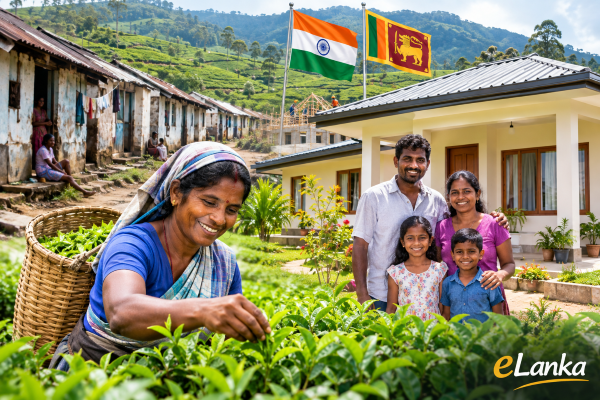
India has committed more than $350 million to build 60,000 dwellings in Sri Lanka, its largest development grant initiative in any nation. The flagship Indian Housing Project (IHP) has progressed through various phases to replace colonial-era “line rooms” with contemporary, autonomous residences for Sri Lanka’s tea plantation workers and upland communities.
Dear Readers,
Dilrook, in one of the forums, commented regarding the article I recently authored about “Tea pluckers’ homes and the donation of houses from India to be constructed for these unfortunate workers living in line houses, which are termed as such, under extremely subhuman conditions.
He comments: Such a meritorious act and a good vote-winner. But the economics around this tells a different story – SL will be bankrupt again, mark my word!
Giving them houses is economically wasteful and has no economic return – they don’t pay income taxes, and tea exports don’t increase as a result. Besides, the largest tea buyers today are in economic disaster. So it is just waste from a purely economic point of view.
Australia is 16 times richer and has a severe housing crisis, but the Australian government does not waste taxpayer funds to build free houses for migrants, etc. That is why Australia is a developed nation and a place people worldwide would love to come to. SL, on the other hand, is always poor and bankrupt. Given the opportunity, Lankans would even leave it for Bangladesh.
As the local saying goes, the kind-hearted woman is always pregnant.
My reply:
Thank you for sharing your insights. I appreciate your concern for Sri Lanka’s economic future; however, I must respectfully clarify a few crucial points that your comment may have overlooked.
1. Housing for Estate Workers Is Not “Waste” — It Is Long-Overdue Justice
The housing program funded by India is not a mere giveaway, but a response to a longstanding humanitarian deficiency that has persisted for over 150 years. Estate workers lived in line rooms built during the colonial era, which were cramped, unhygienic, and inadequate for maintaining human dignity.
Providing proper housing:
- improves health outcomes
- reduces absenteeism
- stabilises families
- increases productivity
- strengthens long-term labour retention
These represent economic returns, even if they do not manifest on a balance sheet immediately.
2. Estate workers do contribute to the economy.
It is incorrect to say they “don’t pay taxes” or “don’t contribute economically.”
- They pay indirect taxes on every item they purchase — VAT, excise, levies.
- Their labour sustains one of Sri Lanka’s most iconic export
- Tea remains a major foreign exchange earner, even during global downturns.
If a country refuses to invest in the wellbeing of the very people who keep its export sector alive, that is not economic prudence — it is economic short-sightedness.
3. Comparing Sri Lanka to Australia Is Misleading
Australia’s housing crisis is driven by urban demand, high land prices, and migration pressures.
Estate housing in Sri Lanka is a rural, labour-welfare issue. The contexts are not comparable.
Furthermore, Sri Lankan taxpayers are not responsible for financing the houses constructed for estate families. Instead, India funds them through grants under a longstanding bilateral development partnership.
Calling it “waste” ignores the fact that Sri Lanka is not footing the bill.
4. “Sri Lanka Will Be Bankrupt Again” — A Misreading of Current Trends
Sri Lanka’s economic recovery is slow but real:
- Tourism numbers are rising even in off-season
- Remittances have reached record
- Foreign reserves are
- Inflation has
- Investor confidence is gradually
A nation does not undergo reconstruction instantaneously; however, it certainly does not succumb solely because its most impoverished citizens are provided with humane living conditions.
5. The Dignity of a Nation Is Measured by How It Treats Its Most Vulnerable
A developed nation is not defined by GDP alone. It is defined by:
- how it treats its workers
- how it uplifts marginalised communities
- how it corrects historical injustices
- how it balances growth with compassion
If Sri Lanka chooses to ensure that estate families finally live in decent homes, that is not a sign of weakness. It is a sign of maturity.
6. “Kind-hearted woman is always pregnant” — A Misapplied Saying
Kindness is not a liability. Compassion is not a burden. A nation that refuses to uplift its poorest will never rise.
Sri Lanka’s future will be shaped not by cynicism, but by balanced development, stable governance, and humane policies that fortify both the economy and society.
In conclusion, the housing program is neither wasteful nor economically detrimental, nor does it serve as a basis for predicting national bankruptcy. It represents a long-overdue affirmation of dignity for a community that has historically served the nation across generations.
Warm regards,
Dr Harold Gunatillake OAM
At eLanka, we respect the rights of creators. If we have used an image you own and you’d like it removed, please email us at info@elanka.com.au and we’ll handle it promptly.
Thanks.
eLanka team
eLanka Disclaimer
Content published on eLanka may be created by the eLanka team, submitted by contributors or third parties, reproduced or adapted from other sources with appropriate source acknowledgement, or provided as promotional/advertising material by our clients. While eLanka takes reasonable care in preparing and publishing content, we do not warrant its completeness or accuracy. Views expressed are those of the respective authors or contributors and do not necessarily represent the views of eLanka. Third-party contributors, content providers and advertisers are responsible for the accuracy of material they supply and for ensuring they hold the necessary rights and permissions for its publication. Advertising and promotional content should not be regarded as an endorsement by eLanka of any product, service or claim.