



President Opens Sri Lanka’s First Grid-Scale Battery Storage Systems in Anuradhapura and Galle
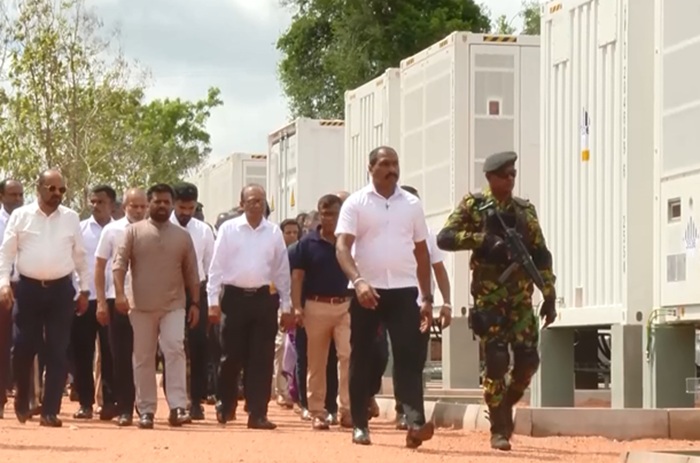
image source : www.newswire.lk
Sri Lanka has taken a significant step towards a more flexible renewable-energy system with the connection of its first grid-scale Battery Energy Storage System in Anuradhapura, while an earlier 10 MW/40 MWh installation at Bataduwa, near the Galle grid substation, has also entered service, demonstrating that commercial-scale electricity storage can be connected and operated within the country’s national power network.
The Anuradhapura facility, which has a power capacity of 10 megawatts and storage capacity of 40 megawatt-hours, was connected to the national grid on 18 September 2026 and formally opened under the patronage of President Anura Kumara Dissanayake. The President unveiled a commemorative plaque and inspected the facility, while Minister of Ports, Civil Aviation and Energy Anura Karunathilaka also participated in the occasion.
Implemented with the contribution of Storex (Pvt) Ltd, the Anuradhapura system has been designed to absorb surplus electricity, particularly solar power generated during daylight hours, and release it when demand rises, including during the evening period when solar generation has declined. The project represents the country’s entry into the grid-scale battery storage era and provides an important foundation for the wider modernisation of Sri Lanka’s electricity infrastructure.
The significance of the development is strengthened by the earlier commissioning of the 10 MW/40 MWh battery system at Bataduwa near Galle. That installation, described as Sri Lanka’s first commercial-scale Battery Energy Storage System, has been connected to the national grid and is capable of supplying its rated output for approximately four hours.

Why electricity storage matters
Renewable electricity has always been accompanied by an inconvenient practical problem: the sun does not necessarily shine when Sri Lanka most needs electricity, while the wind does not adjust its behaviour to match the evening demand peak.
Solar facilities can produce substantial quantities of electricity during the middle of the day, when household demand may not yet be at its highest. Later, as people return home, lights and air-conditioners are switched on and commercial activity continues, demand rises just as solar generation begins to disappear.
Traditionally, the electricity system has had to compensate for that decline by relying on another source capable of producing electricity on demand. Depending on water availability and the condition of the generating fleet, that replacement has involved hydroelectricity, coal or considerably more expensive oil-fired generation.
A battery changes the equation by moving electricity through time. Surplus renewable power can be stored when generation exceeds immediate demand, and that stored electricity can then be discharged when demand increases. Instead of treating excess solar energy as a limitation, the power system can retain a portion of it and use it when it has greater value.
This ability is particularly important for Sri Lanka, where the national electricity system is expected to absorb increasing quantities of solar and wind generation. Batteries can respond rapidly, smooth fluctuations, assist with frequency and voltage control, and provide additional flexibility when generation and demand change quickly.
The beginning of a national storage network
The Anuradhapura and Galle installations are not intended to remain isolated projects. The original procurement plan called for 160 MW and 640 MWh of standalone battery storage divided among 16 grid substations across the country.
Individual 10 MW/40 MWh projects were planned for:
- Kilinochchi
- Vavuniya
- Polonnaruwa
- Valachchenai
- Ampara
- Vavunathivu
- Monaragala
- Mahiyanganaya
- Chunnakam
- Beliatta
- Galle
- Matara
- Hambantota
- Old Anuradhapura
- Maho
- Panadura
Within that broader programme, the systems at Galle and Anuradhapura represent the first operational pieces of a much larger national storage network. The Anuradhapura installation has also been described as the first of 13 systems planned under the Storex national project, with a combined capacity of 130 MW and 520 MWh, with the remaining facilities expected to be completed and connected over the following two to three months.
The overlapping project streams reflect a common national objective: to create a distributed network of batteries positioned at strategic grid locations, where stored electricity can support local supply, strengthen system stability and make renewable generation easier to integrate.
The programme is structured on a Build, Own and Operate basis. Under this model, private developers are responsible for financing, constructing, operating and maintaining the battery facilities over a 15-year operating period. Such an arrangement can reduce the need for the Government to purchase and manage every installation directly, although the resulting tariffs and long-term value provided to electricity consumers will remain important considerations.
The National System Operator is also pursuing another 250 MW/1,000 MWh of standalone storage, together with 150 MW/600 MWh of storage integrated with existing ground-mounted solar plants. If these plans progress, Sri Lanka could move from having virtually no commercial grid battery storage to possessing hundreds of megawatts of flexible energy capacity within a relatively short period.

Supporting the 2030 renewable-energy target
Sri Lanka has set a target of obtaining 70 per cent of its electricity generation from renewable sources by 2030. Achieving that objective will require more than the construction of additional solar panels and wind turbines; it will require a power system capable of managing the variable nature of those energy sources.
Solar and wind generation can fluctuate according to daylight, cloud cover and wind conditions, while electricity demand changes according to household routines, industrial activity and commercial operations. Storage provides one of the missing links between renewable generation and reliable supply.
A battery does not generate electricity by itself, but it can improve the usefulness of electricity that has already been generated. Solar power produced at midday may have limited immediate value if the grid is already receiving more energy than consumers require. Once stored and released during the evening peak, the same electricity can help reduce the need for expensive thermal generation.
The economic implications are also considerable. Sri Lanka imports fuel for electricity generation, placing pressure on foreign exchange and exposing consumers to international price movements. Every unit of renewable electricity that can be stored and delivered when required may reduce dependence on imported fossil fuels, provided that the storage cost remains competitive and the facilities are operated efficiently.
The development may also become increasingly relevant as rooftop solar expands among households, businesses and institutions. A future electricity network is likely to include large solar and wind farms, smaller private generators, distributed batteries and sophisticated control systems, rather than depending solely on a limited number of large power stations.
Safety and technical standards
The expansion of battery storage must be accompanied by rigorous safety practices. Large lithium-based installations require carefully designed fire protection, thermal management, continuous monitoring, electrical isolation systems and emergency-response procedures.
These safeguards are particularly important because battery facilities contain substantial amounts of stored energy in compact spaces. Appropriate design, commissioning, inspection and maintenance are therefore essential, while emergency services and local authorities must have access to clear operating information and response plans.
Sri Lanka’s regulators and standards authorities have been working on safety and technical standards for such installations as the technology begins to develop nationally. Consistent standards will be instrumental in ensuring that future projects are not only delivered quickly, but also operated responsibly throughout their service lives.
A new stage in Sri Lanka’s energy development
The opening of the Anuradhapura facility and the commissioning of the Galle system represent more than the installation of two large batteries. They demonstrate that grid-scale electricity storage can be incorporated into Sri Lanka’s national network and operated as part of a modern renewable-energy strategy.
The next stage will involve ensuring that the wider programme proceeds on schedule, that the arrangements provide value for electricity consumers and that storage genuinely assists the replacement of expensive fossil-fuel generation. Transparent procurement, dependable technical performance and strong safety oversight will be essential as the national network grows.
Nevertheless, the direction is clear. Sri Lanka is no longer considering battery storage only as a future possibility; the technology has now reached the national grid.
The sun may still go down at six, but Sri Lanka’s solar electricity no longer necessarily has to go down with it.
Source: https://www.newswire.lk/2026/09/18/anuradhapura-battery-storage-system-connected-to-national-grid/
This article was written based on the sources https://www.newswire.lk/2026/09/18/anuradhapura-battery-storage-system-connected-to-national-grid/, https://thepeninsulaqatar.com/article/19/09/2026/sri-lanka-to-integrate-first-10-mw-battery-storage-facility-into-national-grid and https://www.independent.lk/sri-lanka-has-just-built-a-giant-battery-it-could-change-how-we-make-electricity/, kindly email us at info@eLanka.com.au if any information needs to be corrected.
At eLanka, we respect the rights of creators. If we have used an image you own and you’d like it removed, please email us at info@elanka.com.au and we’ll handle it promptly.