


Restraining impact of school closure on education-BY HEMANTHA KULATUNGA
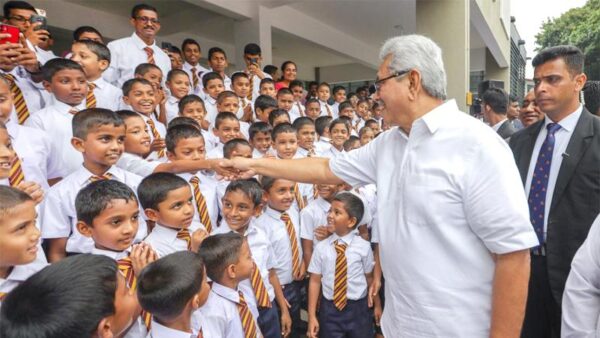
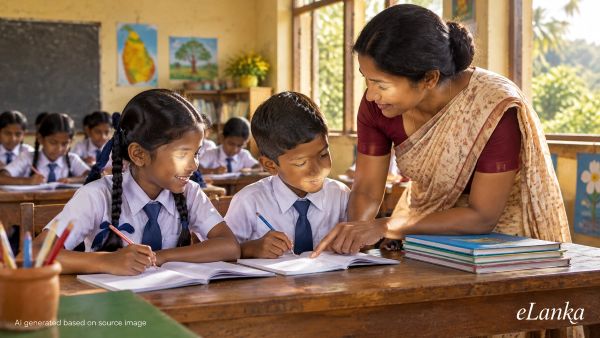
President Gotabaya Rajapaksa greets a student during the Gama Samaga Pilisandara program.
Source:Sundayobserver
The global Covid-19 pandemic has led to the closure of educational institutions throughout the world, including in Sri Lanka, affecting almost 100% of students. Even though throughout modern history, armed conflicts, displacements, and natural disasters have disrupted the education of millions of children and youth globally, Covid-19 has taken this crisis to an unprecedented level. The deadly virus has affected almost every country in the world. This time, as per research, education has been hit particularly hard with the closure of schools in 186 countries depriving formal education of a staggering 1.53 billion students. The impact on education is said to be as high as 87.6% of the world total.
Education secondary to saving life
Usually, the critical needs in a crisis such as health, food, water, and sanitisation are being responded instantly as the highest priority. However, the education needs are given somewhat lesser consideration at least at the initial stage of the crisis. This phenomenon is justifiable because the existence of human beings is the foremost priority for a country. However, loss of education, even temporarily, can be equally detrimental to any country and must be addressed with complete eagerness.
Sri Lanka, with a literacy rate of 91.7% is considered the best in South East Asia and also placed at a very high level among all the other countries. Although there are weaknesses in the education system that needs to be upgraded and modernised, the country’s literacy rate is high for the reason of the existing education system. The country has 10,237 Government schools with a total student base of slightly over 4 million students as per the figures of the Ministry of Education.
All schools in Sri Lanka were closed in March 2020 with the emergence of the Covid-19 pandemic in Sri Lanka. Since then, schools of certain Provinces except the Western Province were partially opened from time to time since December 2020. Even those schools that were opened for students had to function with strict health guidelines, taking in limited numbers of students at any given day. Therefore, all schools functioned with alternative days for students.
New Year Covid wave
After an absence of over one year, the Ministry of Education took a bold decision to open all schools in the country on April 19. Unfortunately, just as the academic activities were set to begin, the country once again started to witness another wave with spiking caseload, perhaps more dangerous and damaging than previous occasions. The Ministry has revoked the decision and currently analysing the situation closely with the health authorities.
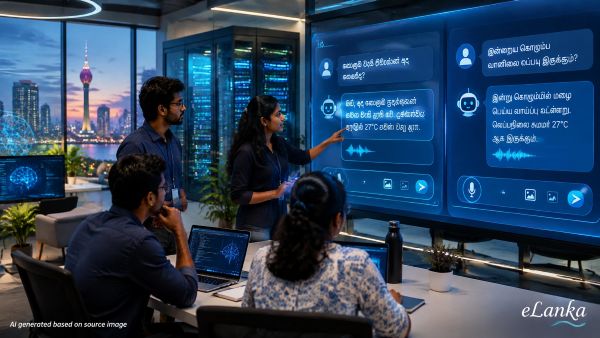
As continuous uncertainty looms over the educational activities, the authorities are trying hard to bridge the learning gaps as well as preventing the loss of time. The Government so far has adopted an effort to a mixture of television programs and online education during the past year although the success or failure is not yet clear. In fact, they have allocated one channel exclusively and several others on a temporary basis.
In the current context, even before the emergence of the third wave, children experienced constrained access to socialisation. This can be critical to their psychological well-being and also to personal development. School closures are preventing their interactions with peers and also limit them from their access to learning. This may lead to confusion and frustration, particularly with adolescents.
Not so perfect online education
In a recent study, UNESCO has identified online education as ‘imperfect substitutes’ for classroom learning. This is primarily because of the limitations on teacher-student interaction.
Also, the limitations in internet access in the rural areas are another factor that hampers online education in Sri Lanka. The total internet penetration in Sri Lanka is just over 34% although the access in remote areas is vastly inadequate, depriving students in those remote areas of online education.
Of the 10,235 schools over 9,000 are Provincial schools that account for 3.2 million students.
The vast majority of Provincial students belong to rural schools that most often do not have internet or other necessary technological assets at their respective schools or homes to attend online education.
Therefore, online education should only be a temporary measure as it can create discrimination between the urban and rural student population.
Digital learning is unfamiliar territory for the majority of Sri Lanka students as yet. Even those who are currently using online education are not completely convinced that digital platforms are the best solution for their continuous education. Although a certain segment of urban society has transitioned to online delivery of classes to avoid the disruption, digital learning still remains uncharted territory for the majority of Sri Lankan students.
Under the directions of President Gotabaya Rajapaksa who believes in the modernisation of education, the Government is extending the highest priority to countrywide internet penetration aiming at online education mixed with classroom attendance, even after the complete annihilation of Covid-19. However, the further utilisation of digital resources in mainstream education is currently being explored.
Also, even if internet access becomes available, the dissemination of education through online classes requires access to computers for the students. Given the socio-economic situation in Sri Lanka, this can be unachievable to students of low-income families in rural areas. If not managed properly, this disparity can create social and academic stress in students.
To ensure the disruption as little as possible, continuing education through alternative learning pathways must be a top priority of the authorities, particularly with the surfacing of the third wave. The seemingly more intense third wave may continue for an indefinite period according to experts.
Therefore, although online classes or television programs are not the ideal processes, as temporary measures any innovative method must be used to cover the prevailing time lapse.
Being at home
One does not have to go through complex theories to understand the psychological impact created in students due to long-term closures of schools, universities, and other various educational institutions. This is a topic that has so far second fiddle. By staying too long at home generates stress even for a grown-up. According to various studies, a vast majority of students indicated a high level of stress and anxiety during the long shut down of schools.
The tension projected by the interruption to a certain pattern of life has produced psychological stress in the vast majority of the student population in the country.
Main among the personal psychological issues were difficulty in concentration, fear of their own health and that of family, concerns about academic performance, adjusting to the unknown territory of online learning, and so forth. Research has revealed that many of them have reported disruption to sleep patterns, fear of social isolation, and tension from parents led to depressive thoughts.
The pandemic has grown from a mere public health crisis to an overstretched humanitarian catastrophe. The danger is that the virus creates unpredictable continuous new waves around the world. The most dangerous behaviour of the virus is that it emerges without warning when people presume that they are safe. The education sector is one of the most affected areas in Sri Lanka due to the pandemic.
The Government is doing its utmost to manage the system with limited resources, particularly restricted financial resources. However, with the seemingly creditable commitment of the educational authorities with the unparalleled Presidential interest in the subject, the citizenry can see a light at the end of the tunnel concerning school education in Sri Lanka.
A powered-up public school network in every community is what President Rajapaksa pledged and indeed is possible if all stakeholders can collectively work together to harness the opportunities presented by this crisis.
The President has an ambitious vision on education that can become a reality. Articulating such a vision is an absolute necessity to guide the country to prosperity.