Mustafa Kassim, Founder and CEO of Roar Global. (Image: Ada Derana Biz)
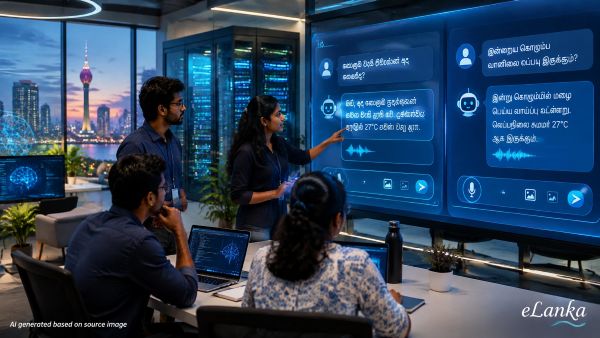
Sri Lankan developers, startups and businesses have been given access to a new national technology platform intended to simplify the adoption of advanced artificial intelligence, following the introduction of Roar AI, described by Roar Global as Sri Lanka’s first AI gateway.
Announced on 8 September 2026, Roar AI brings together more than 200 frontier and open-source artificial intelligence models through a single platform, providing local builders with access to technologies from Anthropic, Gemini, Perplexity, Llama, DeepSeek and Kimi, among others.
The initiative is significant because artificial intelligence development has traditionally required businesses to navigate a fragmented international ecosystem of providers, application programming interfaces, hosting platforms, payment systems and data-management arrangements. By placing these functions within a more integrated infrastructure layer, Roar AI seeks to make experimentation, application development and commercial deployment more accessible to Sri Lankan organisations.
A single gateway to a broad AI ecosystem
Artificial intelligence models differ considerably in their strengths, costs and technical requirements. Some are suited to reasoning and research, while others are designed for coding, document processing, language generation, image creation or high-volume business automation.
For a small development team, selecting and connecting these models can be a complex undertaking. Separate accounts may be required, international payment mechanisms can create administrative obstacles, and applications often need to be redesigned when a business moves from one model provider to another.
Roar AI is intended to address these challenges by giving users a single connection through which they can access more than 200 leading models. This structure allows developers to compare and select different models while reducing the need to rebuild their applications whenever the underlying AI service changes.
The platform is also positioned as more than a model directory or conversational assistant. Roar AI is being introduced as an infrastructure layer through which businesses can build, operate and manage AI-powered products.

Beyond a chatbot: infrastructure for applications
Roar AI is not being presented as another chatbot for general conversation. Instead, the platform is intended to support the infrastructure surrounding AI applications, including hosting, databases, transactional email and automated backups.
This distinction is important for developers and businesses moving from experimentation to deployment. A demonstration created with an AI model may be useful as a prototype, but a commercially viable application requires dependable hosting, structured data storage, user communication, security controls and a reliable backup system.
Roar AI brings these functions into a connected environment, enabling local applications to be hosted within the platform while providing access to integrated databases and supporting services. Applications can therefore be developed with a clearer pathway from initial concept to operational product.
The platform also includes usage controls, budgets and guardrails, which are intended to help organisations manage how artificial intelligence is used across their applications. Such controls can assist businesses in monitoring expenditure, limiting unnecessary usage and establishing boundaries around automated processes.
Billing in Sri Lankan rupees represents another practical feature. International software and cloud services are frequently priced in foreign currencies, creating uncertainty for organisations that must forecast expenditure in local terms. Local-currency billing may make budgeting more straightforward, particularly for smaller businesses and early-stage companies.
Reducing barriers for Sri Lankan businesses
Roar Global Founder and CEO Mustafa Kassim said the new platform was intended to make access to advanced artificial intelligence less dependent on a company’s location or its ability to navigate international infrastructure.
“AI adoption should not be limited by where a business is based or by how easily it can access global infrastructure…”
The comment reflects a wider challenge facing technology companies in emerging markets. Access to powerful models may be technically available, but practical barriers involving payments, hosting, compliance, data governance and operational support can prevent smaller organisations from using those tools effectively.
For Sri Lankan businesses, a locally oriented platform could provide a more accessible starting point. A software company developing a customer-service application, for example, may be able to test several language models through one interface, compare their performance and manage costs without establishing separate international arrangements for every provider.
A financial-services company, educational organisation or professional firm may also benefit from clearer control over application hosting, databases and backups, particularly where data governance and business continuity are important considerations.

Building products in Sri Lanka for the world
Roar Global has framed the launch as part of a broader effort to strengthen Sri Lanka’s position in the international technology economy, rather than limiting the country’s role to that of a consumer of overseas products.
“We don’t want Sri Lanka to simply be a market that consumes AI products built elsewhere,” Mr Kassim said. “We want Sri Lankan developers and businesses to have the infrastructure to build those products here and take them to the world.”
That ambition places emphasis on product creation, export potential and local technical capability. Sri Lanka has a substantial pool of software professionals, entrepreneurs and technology graduates, although many smaller teams continue to face difficulties when attempting to develop and scale globally competitive products.
Accessible infrastructure can be instrumental in closing that gap. Developers can concentrate more closely on solving customer problems and refining product quality when the underlying technology stack is easier to access, manage and price.
The wider opportunity extends beyond established technology companies. Traditional businesses may use the platform to automate internal processes, improve customer communication, analyse documents or create specialised digital services. Startups may be able to test ideas more quickly, while educational institutions and independent developers could use the gateway to build practical experience with a range of leading models.
Roar Global’s wider evolution
Roar AI forms part of Roar Global’s evolution from a digital media and marketing company into a broader venture-building group. The company has increasingly focused on artificial intelligence, technology products and the development of business-oriented digital solutions.
According to the information supplied for the launch, Roar Global has processed 10 billion AI tokens, a measure that indicates the scale of language-model activity handled across its technology operations. Tokens are units of text processed by AI systems, and the figure provides an indication of the company’s accumulated experience with model-based applications and infrastructure.
That experience is relevant because the effective use of artificial intelligence involves more than simply connecting to a model. Businesses must determine which models are appropriate, understand the relationship between performance and cost, establish security and governance procedures, and monitor how applications behave in real-world situations.

Early access for selected users
Roar AI is currently being introduced to selected early adopters. Developers, startups and businesses interested in exploring the platform can apply through the early-access page at roar-ai.com/early-access.
The early-access phase will allow Roar Global to gather feedback from users working across different industries and technical environments. Such feedback is likely to be important as the service develops its model catalogue, hosting functions, billing systems and governance controls.
The introduction of Roar AI nevertheless represents a notable step in Sri Lanka’s technology landscape. Its value will ultimately be measured not only by the number of models available, but by whether local businesses can use the infrastructure to create dependable products, improve productivity and reach customers beyond the country.
If the platform succeeds in reducing the practical friction surrounding AI development, Sri Lankan builders may be better positioned to participate in a rapidly expanding global industry. The central promise is therefore not merely access to artificial intelligence, but the ability to turn that access into locally developed applications with international potential.
eLanka continues to share positive stories about Sri Lankan innovation, enterprise and achievement worldwide. Readers can explore community news, business updates and professional stories through the eLanka website.
(adsbygoogle = window.adsbygoogle || []).push({});
Source: https://bizenglish.adaderana.lk/roar-global-introduces-sri-lankas-first-ai-gateway/
This article was written based on the source https://bizenglish.adaderana.lk/roar-global-introduces-sri-lankas-first-ai-gateway/, kindly email us at info@eLanka.com.au if any information needs to be corrected.
At eLanka, we respect the rights of creators. If we have used an image you own and you’d like it removed, please email us at info@elanka.com.au and we’ll handle it promptly.