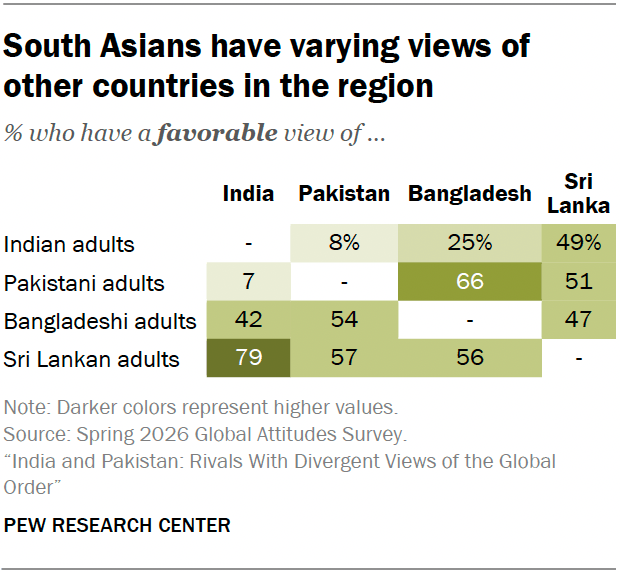
Pew Research Center data on how South Asians view other countries in the region. (Source: Pew Research Center)
A new study by the Pew Research Center has identified Sri Lanka as the only one of four South Asian countries surveyed to receive more favourable than unfavourable ratings in each of the other three countries included in the research, providing an encouraging indication of the island nation’s regional standing and the continuing strength of its people-to-people connections.
The report, published on 13 August 2026, examined public attitudes in Bangladesh, India, Pakistan and Sri Lanka, asking adults how they viewed other countries in the region. Its central finding was carefully defined: Sri Lanka was the only country among those asked about that achieved a more positive than negative balance of opinion in Bangladesh, India and Pakistan.
This does not mean that every respondent held a favourable view, nor that all public opinion across the region was uniform. Rather, the research showed that around half of adults in each of the three neighbouring countries viewed Sri Lanka positively, while a third or fewer expressed a negative view, placing Sri Lanka in a distinctive position within the regional comparison.

A carefully measured view of regional opinion
Pew Research Center surveyed 3,566 people in India, 1,039 people in Pakistan, 1,044 people in Bangladesh and 2,513 people in Sri Lanka. Interviews were conducted between 8 February and 7 May 2026, with the surveys designed to reflect the views of the adult population in each country.
The research measured public attitudes and perceptions; it did not assess government policy, diplomatic relations or formal agreements between countries. This distinction is important because public opinion is shaped by a broad range of experiences, including family connections, education, travel, cultural familiarity, business, sport, entertainment and personal relationships.
Within that framework, Sri Lanka’s position is particularly notable. The country was viewed favourably by 47% of adults in Bangladesh, 49% in India and 51% in Pakistan, while the corresponding negative ratings were lower in each case. The results therefore show a consistent regional pattern, although they should be understood as a snapshot of public sentiment rather than a permanent judgement.
What the figures show
The Pew findings provide a useful comparative picture of how the four countries regard one another.
| Country being viewed | Positive views among surveyed neighbouring publics |
| India | 79% of Sri Lankans, 42% of Bangladeshis and 7% of Pakistanis viewed India favourably. |
| Bangladesh | 66% of Pakistanis and 56% of Sri Lankans viewed Bangladesh favourably, compared with 25% of Indians. |
| Pakistan | 57% of Sri Lankans and 54% of Bangladeshis viewed Pakistan favourably, compared with 8% of Indians. |
| Sri Lanka | Around half of adults in Bangladesh, India and Pakistan viewed Sri Lanka positively, while a third or fewer viewed it negatively. |
The figures indicate that views of India varied most widely across the region, with Sri Lankans expressing a particularly favourable opinion, while the results for Bangladesh and Pakistan were more mixed depending on the country in which respondents were interviewed.
Sri Lanka, by contrast, recorded a positive balance of opinion in all three neighbouring publics surveyed. That consistency is the principal reason the country stands apart in the study, rather than any single exceptionally high rating in one location.
Sri Lanka’s favourable image has strengthened in India
The report also identified a positive movement in perceptions of Sri Lanka among Indian adults. Favourable views rose by six percentage points since 2024, while the share expressing a negative view remained unchanged.
The wider trend data also showed that Sri Lankans’ favourable views of several regional neighbours increased during the same period. Favourable views of India among Sri Lankans rose by 14 percentage points, while favourable views of Bangladesh increased by nine points. Positive views of Pakistan among Sri Lankans rose from 44% in 2024 to 57% in 2026.
These changes illustrate that public perceptions can develop over time as regional familiarity, social contact and shared experiences evolve. They also reinforce the value of examining public opinion through reliable, methodologically transparent research rather than relying on isolated impressions or unverified claims.
A positive image built through people-to-people connections
Sri Lanka’s regional reputation is likely to be understood through many overlapping experiences rather than one single cause. The country’s cultural heritage, religious traditions, historic cities, distinctive cuisine, music, dance and literary contributions have long provided points of connection for neighbouring communities.
Tourism has also introduced millions of visitors to Sri Lanka’s beaches, hill country, wildlife reserves, ancient cities and welcoming local communities. The island’s compact geography allows visitors to experience a remarkable range of landscapes and cultural sites, from the historical significance of Anuradhapura and Kandy to the coastal character of Galle and the biodiversity of its national parks.
Education and professional relationships have further strengthened regional familiarity. Students, academics, medical professionals, entrepreneurs and skilled workers have contributed to relationships that extend beyond official institutions, while sporting and artistic links have created additional opportunities for people to meet, collaborate and build mutual respect.
The contribution of Sri Lankans living overseas is equally significant. Across Australia, the United Kingdom, the United States, Canada, New Zealand and other countries, Sri Lankan expatriates continue to share the country’s traditions, cuisine, music, religious observances and community values. Through schools, temples, churches, mosques, cultural associations, sporting clubs, social organisations and charitable initiatives, these communities provide a living connection between Sri Lanka and the wider world.
In Australia, platforms such as eLanka’s community news and business directory, together with its coverage of Sri Lankan cultural events, help share the achievements, activities and contributions of Sri Lankan communities with a broad international audience. Articles on Sri Lankan heritage and history and the work of Sri Lankan musicians and artists also demonstrate how cultural identity can remain active, accessible and relevant across generations.
An encouraging result and a shared responsibility
The Pew Research Center findings offer a positive moment for Sri Lankans at home and abroad, because they show that Sri Lanka is regarded favourably by substantial proportions of the public in all three neighbouring countries surveyed.
Such a reputation is valuable, but it should not be treated as automatic or unchanging. Public attitudes are complex, and they can shift as social, economic, cultural and regional circumstances develop. The most constructive response is therefore to protect and strengthen this positive image through respectful relationships, cultural exchange, responsible tourism, educational cooperation, sporting friendships and continued engagement between ordinary people.
Sri Lanka’s standing in the survey reflects an opportunity as well as an achievement. By continuing to present its heritage with authenticity, welcoming visitors with warmth, encouraging constructive regional connections and supporting the positive work of Sri Lankans worldwide, the country’s people can help ensure that its favourable reputation remains grounded in meaningful human contact.
The study’s findings provide an encouraging reminder that Sri Lanka’s influence is not limited to geography or formal institutions. It is also expressed through the everyday relationships, shared traditions and generous human connections that continue to link Sri Lanka with its neighbours and with the global Sri Lankan community.
This article was written based on the source https://www.pewresearch.org/global/2026/08/13/how-do-south-asians-view-other-countries-in-the-region/, kindly email us at info@eLanka.com.au if any information needs to be corrected.
(adsbygoogle = window.adsbygoogle || []).push({});
At eLanka, we respect the rights of creators. If we have used an image you own and you’d like it removed, please email us at info@elanka.com.au and we’ll handle it promptly.