Sri Lanka’s First Grid-Scale Battery Goes Live in Galle, a Leap for Renewable Energy

Sri Lanka’s first commercial-scale Battery Energy Storage System has been connected to the national grid at Bataduwa near Galle. Image credit: Ceylon Independent.
Sri Lanka has reached an important milestone in its transition towards a more flexible and renewable electricity system, with the country’s first commercial-scale Battery Energy Storage System (BESS) beginning operations on the national grid on 10 September 2026.
The facility, installed at Bataduwa near the Galle grid substation, has a capacity of 10 megawatts (MW) and 40 megawatt-hours (MWh), enabling it to deliver its rated 10 MW output for approximately four hours. In practical terms, the system can store surplus electricity generated during periods of strong solar or wind production and release that energy back to the grid when demand increases.

The Galle facility represents a significant step towards integrating more renewable electricity into Sri Lanka’s national grid. AI-generated based on source image.
Why battery storage matters
Renewable electricity has long presented a scheduling challenge for power-system planners, because the availability of sunlight and wind does not always coincide with the hours when electricity demand is highest.
Solar generation, for example, can reach substantial levels during the middle of the day, when household demand may not yet have reached its evening peak. As the sun sets, however, electricity consumption generally rises as households return home, lighting is switched on and appliances, cooling systems and other equipment are used.
Without storage, the electricity system must compensate for the rapid decline in solar generation by relying on another source that can respond when required, including hydropower, coal-fired generation or more expensive oil-based power. A grid-scale battery alters that equation by allowing surplus renewable electricity to be retained rather than curtailed or used immediately.
The stored electricity can then be discharged during the evening or at other periods when the national system requires additional supply. Batteries can also respond rapidly to changes in demand, while supporting frequency and voltage management across the grid.
The Galle BESS therefore represents more than a large rechargeable battery. It is an important piece of infrastructure for a power system expected to accommodate increasing volumes of variable renewable generation.
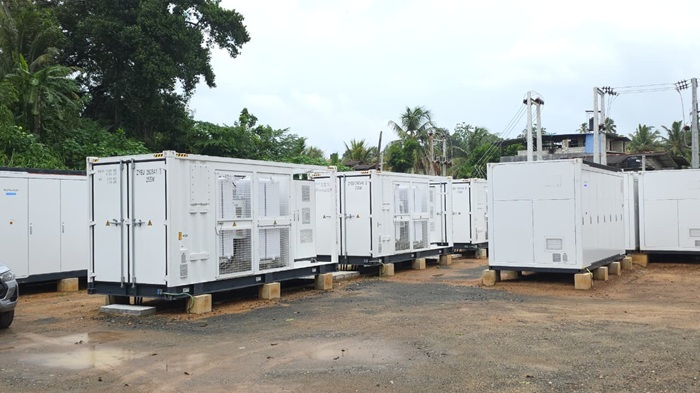
The Bataduwa installation was officially connected to the national grid on 10 September 2026. Image credit: Newswire.
The first of 16 planned facilities
The Galle project is the first of 16 BESS units tendered in 2025 by the newly established National System Operator, or NSO Pvt Ltd. The state-owned company was formed following the restructuring of the Ceylon Electricity Board and is responsible for managing the national power system and overseeing electricity purchases.
The original procurement called for 160 MW and 640 MWh of standalone battery storage, distributed among 16 grid substations around the country. Each project was planned with an individual capacity of 10 MW and 40 MWh.
The planned locations are:
- Kilinochchi
- Vavuniya
- Polonnaruwa
- Valachchenai
- Ampara
- Vavunathivu
- Monaragala
- Mahiyanganaya
- Chunnakam
- Beliatta
- Galle
- Matara
- Hambantota
- Old Anuradhapura
- Maho
- Panadura
The geographical distribution of these units is significant, as a network of batteries positioned at different substations could provide more effective support than a single large installation concentrated in one location. Such a structure may help the national system manage local fluctuations, reduce pressure on transmission infrastructure and improve the use of renewable electricity in several regions.
The Galle BESS has been implemented by Galilee BESS Limited, a subsidiary of WKV Hydro Technics, which is fully owned by Singapore-based Khen Energy Ltd.
The wider programme is structured on a Build, Own and Operate basis. Under this arrangement, private developers are responsible for financing, constructing, operating and maintaining the battery facilities over a 15-year operating period, while the national electricity system purchases the storage service.
Ambitions are already expanding
Sri Lanka’s plans for energy storage have developed beyond the original 16-unit programme. The National System Operator is now pursuing an additional 250 MW and 1,000 MWh of standalone battery storage, while proposals have also been invited for 150 MW and 600 MWh of battery systems integrated with existing ground-mounted solar plants.
This expansion reflects the changing economics and requirements of the electricity sector. The Public Utilities Commission approved bringing forward battery storage that had originally been envisaged for later years, after renewable generation began increasing more rapidly than anticipated and battery prices declined.
Cabinet subsequently approved accelerated procurement, while the Government has stated that the country’s increasing night-time peak demand is appearing approximately two years earlier than projected in the Long-Term Generation Expansion Plan.
These developments indicate that storage is no longer being considered merely as a distant technical option. It is increasingly being treated as an instrumental part of the country’s immediate energy planning.

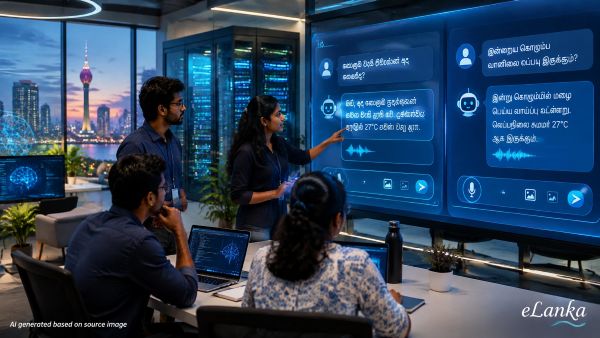
Battery storage can help connect daytime renewable generation with evening electricity demand. AI-generated based on source image.
Supporting the 2030 renewable-energy target
Sri Lanka has set a target of obtaining 70 per cent of its electricity generation from renewable sources by 2030. Achieving that objective will require more than the construction of additional solar farms, wind installations and rooftop solar systems.
The national grid must also become capable of accepting, balancing and distributing electricity whose supply can vary according to weather and time of day. Storage is one of the missing pieces in that transition.
The relevance of BESS technology extends beyond major power stations. Hundreds of thousands of rooftop solar installations are appearing across Sri Lanka, allowing households and businesses to become electricity producers as well as consumers. As more distributed generation is connected to the grid, the importance of managing when electricity is produced, stored and consumed will increase.
A more modern electricity system could therefore involve large solar and wind projects, household generation, commercial batteries and advanced grid-management systems operating together. The National System Operator will have an increasingly important role in coordinating these different sources while maintaining a reliable supply for homes, businesses and essential services.
Safety and technical standards
The expansion of large lithium-based battery installations must be accompanied by rigorous safety procedures. Such facilities require effective fire protection, thermal management, continuous monitoring and clearly defined emergency-response arrangements.
Sri Lanka’s regulators and standards authorities have been working on safety and technical standards for BESS installations as the technology begins to enter the national electricity sector. These standards will be essential as additional facilities are constructed, particularly in relation to site design, equipment certification, emergency access, fire separation and operational monitoring.
Strong standards will help ensure that the development of renewable infrastructure is matched by an equally serious commitment to public safety, technical reliability and environmental responsibility.
A significant beginning for Sri Lanka
The Bataduwa facility is modest when compared with the total requirements of a national electricity system, yet its significance extends well beyond its 10 MW rating. Sri Lanka has demonstrated that commercial grid-scale electricity storage can be connected and operated within the country’s power network.
The next stage will involve ensuring that the remaining projects are delivered efficiently, that procurement provides value for electricity consumers and that the batteries are used to reduce reliance on expensive fossil-fuel generation while improving system stability.
For Sri Lanka’s global community, the project offers an encouraging example of local engineering, international investment and public-sector planning converging around a practical national objective. Renewable energy is no longer being discussed only as an environmental aspiration; it is becoming part of a more sophisticated electricity system in which generation, storage and demand can be managed together.
The sun may still go down at six, but Sri Lanka’s solar electricity no longer necessarily has to go down with it.
Source: https://www.independent.lk/sri-lanka-has-just-built-a-giant-battery-it-could-change-how-we-make-electricity/ , This article was written based on the source https://www.independent.lk/sri-lanka-has-just-built-a-giant-battery-it-could-change-how-we-make-electricity/, kindly email us at info@eLanka.com.au if any information needs to be corrected.
Source: https://www.newswire.lk/2026/09/15/sri-lankas-first-commercial%E2%80%91level-battery-energy-storage-system-joins-national-grid-in-galle/ , This article was written based on the source https://www.newswire.lk/2026/09/15/sri-lankas-first-commercial%E2%80%91level-battery-energy-storage-system-joins-national-grid-in-galle/, kindly email us at info@eLanka.com.au if any information needs to be corrected.
(adsbygoogle = window.adsbygoogle || []).push({});
At eLanka, we respect the rights of creators. If we have used an image you own and you’d like it removed, please email us at info@elanka.com.au and we’ll handle it promptly.