Sri Lankan-Born Scientist Lahiru Jayakody Leads Research Turning Waste Plastic into Protein-Rich µBites Cookies
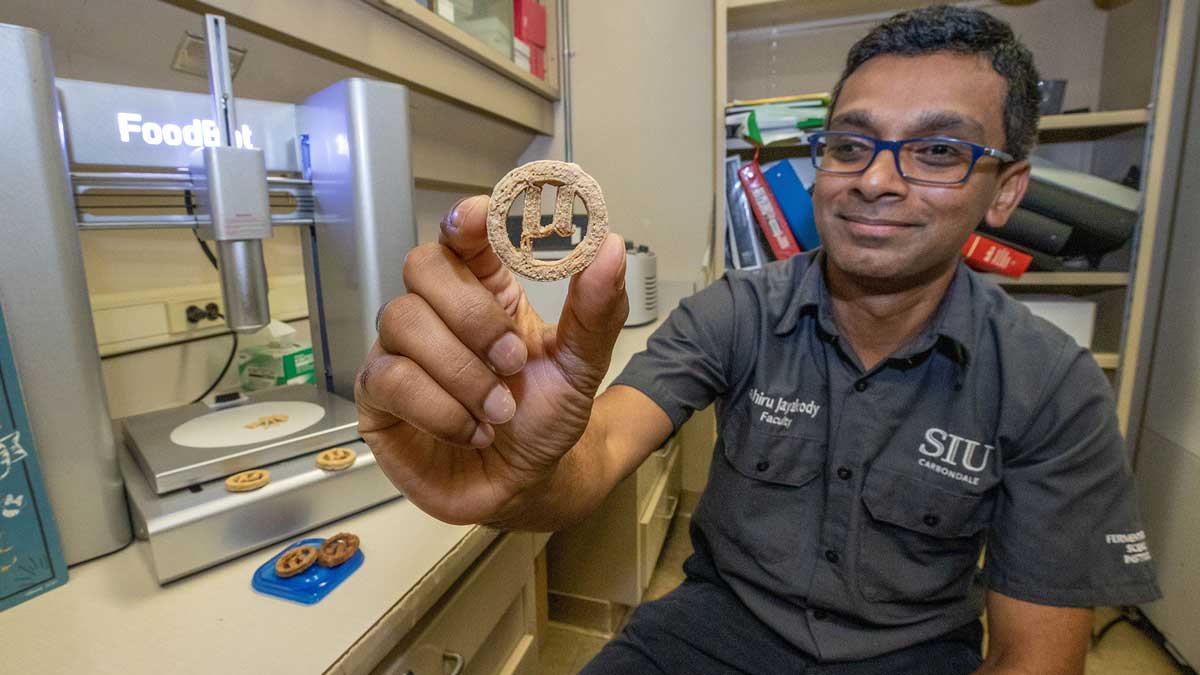
Lahiru Jayakody holds a 3D-printed µBites cookie made from proteins derived from processed biomass and plastic. Photograph: SIU Carbondale. Featured image.
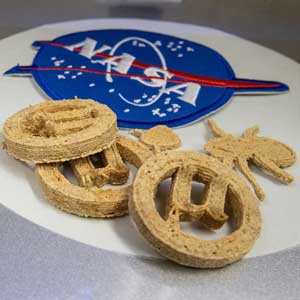
The 3D-printed cookie prototypes developed through the µBites research project. Photograph: SIU Carbondale.
A Sri Lankan-born scientist at Southern Illinois University Carbondale is helping lead an ambitious research project that seeks to address two of the world’s most persistent challenges, plastic pollution and food insecurity, by converting discarded materials into protein-based food ingredients.
Lahiru Jayakody, a microbiologist and associate professor at Southern Illinois University Carbondale, is part of the research team developing µBites, pronounced “microbites”, a cookie-like food prototype produced from ingredients derived from waste plastic and biomass. Although the concept may initially appear unconventional, the underlying process is not intended to place plastic directly into the human food chain. Instead, the plastic is chemically broken down into component materials, which are then converted by specialised microbes into food ingredients.
The research represents a notable example of Sri Lankan scientific expertise being applied to a global problem, while also demonstrating how biotechnology, food science and advanced manufacturing may be combined to develop more resilient food systems.
From discarded plastic to food ingredients
The µBites process centres on polyethylene terephthalate, commonly known as PET, a material widely used in plastic bottles and other consumer packaging. Rather than leaving the plastic intact, the research team uses a sequence of chemical and biological processes to break it down and make its carbon components available to microorganisms.
The plastic and biomass are first ground into a uniform slurry. The material is then processed through a method known as oxidative hydrothermal dissolution, or OHD, which was invented by Ken Anderson, director of Southern Illinois University Carbondale’s Advanced Energy Research Center.
OHD uses water, heat, pressure and oxygen to break biomass and plastic into water-soluble carbon molecules. In this form, the material becomes more accessible to microorganisms, including specially selected or genetically engineered microbes, which can metabolise the carbon and convert it into proteins and fats.
The resulting ingredients are combined with starch, fibre and sweetener before the mixture is shaped into cookie forms using a 3D printer and baked. The process can also be adapted to produce different consistencies, ranging from semi-solid foods to liquid nutritional products, while spices, supplements and other ingredients may be added to vary the final composition.
Jayakody has clarified that the researchers are not attempting to make people eat plastic. The plastic is broken down into its component materials and converted into food ingredients; it does not remain as plastic or microplastics in the finished product.

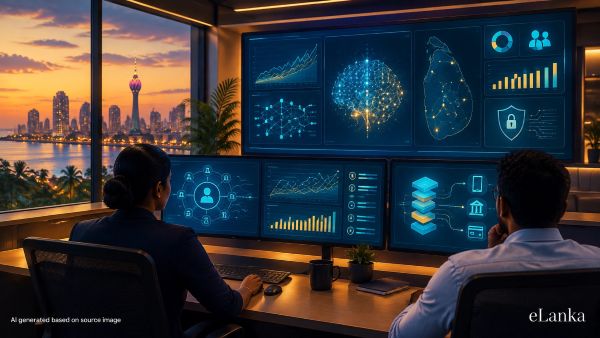
AI-generated illustration based on the µBites research described by Southern Illinois University Carbondale. The image is provided for visual context and does not depict the actual research laboratory or product.
A project inspired by space exploration
The project began in 2021, when researchers initially explored ways to transform discarded plastic into materials such as nylon for textiles. Its direction was subsequently strengthened through a US$25,000 grant from NASA’s Deep Space Food Challenge, which invited research teams to develop innovative technologies capable of feeding astronauts during long-duration missions.
The requirements of space travel created an unusual but valuable framework for addressing challenges on Earth. Food systems designed for long voyages must use limited water, occupy minimal space, require relatively little human intervention and operate reliably in environments where regular resupply is difficult.
Jayakody has explained that food insecurity is a global and severe problem affecting millions of people, and that the challenge is expected to intensify as climate change becomes more severe. In regions where farmland is limited, soils are contaminated or food deliveries are disrupted by distance, conflict or extreme conditions, compact food-production systems could offer an additional source of nutrition.
The µBites system is designed to use water efficiently and operate in a relatively small area. Its modular structure could allow nutrient composition to be adjusted for different populations, dietary requirements and culinary preferences. Jayakody has indicated that such a system could potentially be installed on naval ships and submarines, or in remote environments such as the Arctic and Antarctic, where resupply by aircraft or boat can be difficult.
“µBites is a transformative technology for treating world hunger and plastic pollution, creating a sustainable world for future generations.”
Testing the cookie prototype
To demonstrate that the approach could produce a palatable food product, the SIU researchers created cookies using the converted ingredients and a 3D printer. Once the product had undergone safety and nutritional testing, a sensory analysis was conducted at the university’s Fermentation Science Institute.
The taste test was designed and conducted by Marta Albiol Tapia, assistant professor of practice at the Fermentation Science Institute and a specialist in consumer analysis. The prototype achieved an overall acceptability score of 6.5 out of 9 on the Hedonic scale, a widely used measure of consumer acceptance for food and beverages.
Aroma achieved the highest result, with a mean score of 7.33, while the cookie’s colour, shape and texture each recorded scores above 5. The research team stated that, to its knowledge, the result represented the first demonstrably safe-to-eat cookie made from repurposed waste biomass and plastic to achieve a Hedonic score above 6.5.
The result does not mean that µBites is ready for immediate commercial sale, nor does it remove the need for further safety, nutritional, regulatory and consumer research. It does, however, provide an important proof of concept: waste-derived carbon can be processed into microbial biomass and formulated into a food prototype that participants found broadly acceptable.
A wider research collaboration
Jayakody is leading the project alongside Ken Anderson, with contributions from several Southern Illinois University Carbondale researchers. The team includes Matt McCarroll, director of the Fermentation Science Institute; Scott D. Hamilton-Brehm, associate professor of microbiology; Poopalasingam Sivakumar, associate professor of physics; and Gayan L. Aruma Baduge, associate professor in the School of Electrical, Computer and Biomedical Engineering.
Researchers from other institutions are also contributing to the project, including Kaustav Majumder of the University of Nebraska-Lincoln, Iwona M. Jasiuk of the University of Illinois Urbana-Champaign and Rina R. Tannenbaum of Stony Brook University.
The team’s research was reported in the Cell Press journal Trends in Biotechnology, highlighting the interdisciplinary nature of the work, which brings together microbiology, fermentation science, physics, engineering, food analysis and environmental technology.

AI-generated illustration based on the reported plastic-to-protein research. It is a conceptual representation and does not show the actual SIU Carbondale equipment or process.
Consumer acceptance remains a central challenge
Despite the encouraging test results, significant challenges remain. Jayakody has identified consumer acceptance of food derived from waste materials as one of the most important barriers, alongside the policy changes that may be required to support a transition towards novel and sustainable diets.
The team hopes to expand the nutritional profile of µBites by incorporating essential vitamins, as well as improving flavour and aroma compounds. Additional development funding from government agencies and industrial partners is also being sought to construct a fully integrated and automated system.
The environmental implications are equally significant. According to the SIU coverage, the approach is intended to depolymerise plastic without creating toxic chemicals or carbon streams, while biological processing could result in very low or zero greenhouse gas emissions, depending on the complete system design and energy sources used.
Such claims will require continued independent verification as the technology advances, particularly at larger scales. Industrial processing, energy demand, regulatory approval, contamination control and long-term nutritional safety will all need to be assessed before the method can move beyond research laboratories.
Nevertheless, the project offers an instrumental example of how scientific innovation can connect environmental responsibility with food-system resilience. For Sri Lankan communities worldwide, the leadership of Lahiru Jayakody provides an encouraging reminder that Sri Lankan-born researchers are contributing to some of the most complex technological and humanitarian questions of the modern era.
The µBites project remains a developing research initiative rather than a finished commercial product. Its significance lies in the possibility that plastic waste, agricultural biomass and microbial biotechnology could eventually be brought together in carefully controlled systems to produce useful nutritional ingredients, particularly in locations where conventional food production and supply chains are constrained.
For further positive stories about Sri Lankan achievement, innovation and community contribution, eLanka readers can explore the eLanka Articles section.
This article was written based on the source https://news.siu.edu/2024/05/051524-siu-researchers-mitigate-two-problems-by-transforming-waste-plastic-into-food.php, kindly email us at info@eLanka.com.au if any information needs to be corrected.
This article was written based on the source https://www.linkedin.com/posts/oureconomics-share-7508872469139873792-wrS8/?utm_source=share&utm_medium=member_desktop&rcm=ACoAAA6d9hIBkIh9030rWZ4SPN7oycafGFwTvj8, kindly email us at info@eLanka.com.au if any information needs to be corrected.
At eLanka, we respect the rights of creators. If we have used an image you own and you’d like it removed, please email us at info@elanka.com.au and we’ll handle it promptly.